Baggage
How to pack fragile items for air travel
By the TSA Wait Times team · Updated · Published June 2026
Airlines are not legally required to handle bags marked “Fragile”any differently — your only real protection is how you pack. For truly irreplaceable items, the only guaranteed safe route is the carry-on bin above your seat. Here is what the law actually says, how to pack everything from wine bottles to camera lenses, and what to do if something breaks.
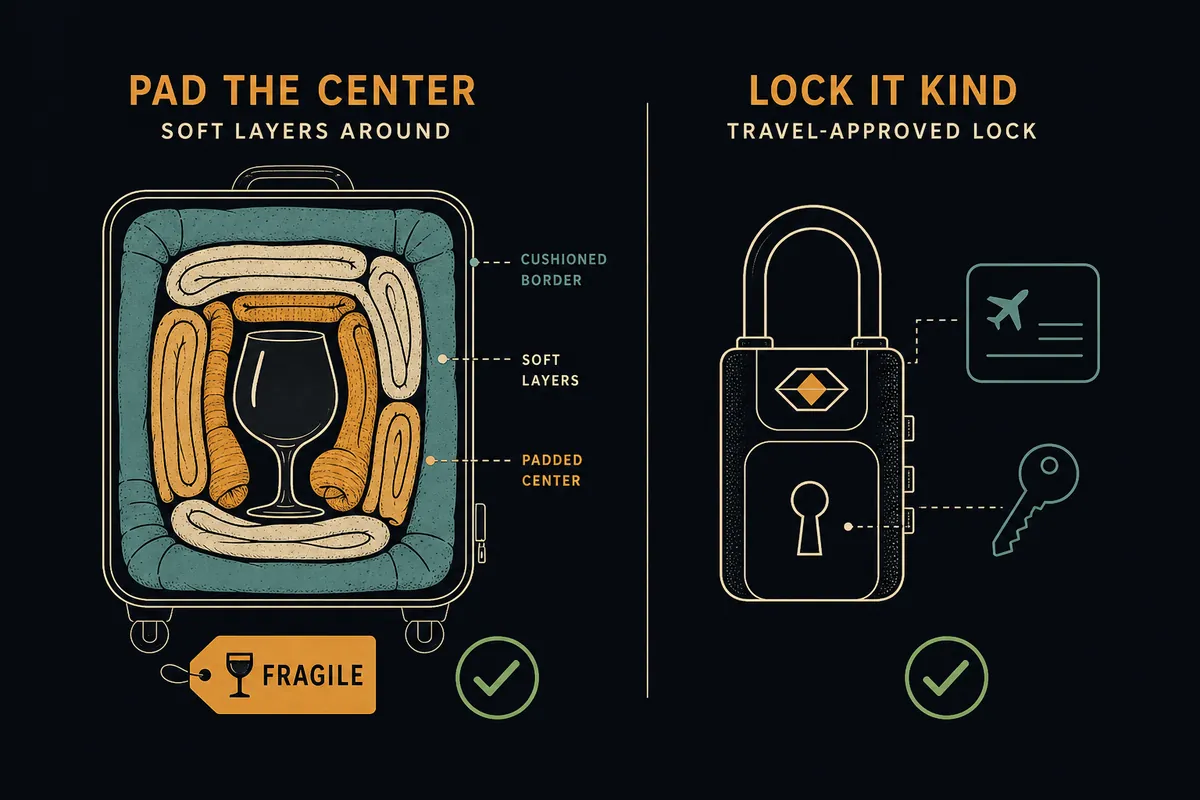
Does putting a ‘Fragile’ sticker on your bag actually help?
No airline in the US is legally obligated to give fragile-stickered bags special handling, and most major carriers explicitly disclaim liability for breakage of inherently fragile itemsin checked luggage regardless of labeling. The sticker is symbolic at best and may occasionally prompt a ramp agent to load your bag last, but it offers no contractual protection. Every major US carrier's conditions of carriage — including Delta, United, American, and Southwest — include an “inherently fragile” exclusion for items like glass, ceramics, and electronics. Your packing method, not a sticker, is your only reliable safeguard.
- No US airline is legally required to give fragile-labeled bags different treatment.
- Delta, United, American, and Southwest all exclude “inherently fragile” items from damage liability.
- A sticker is still worth adding — it costs nothing and may occasionally influence handling.
- Never rely on a sticker as a substitute for proper internal cushioning.
Should you carry fragile items on the plane or check them?
For anything truly irreplaceable — an heirloom, a high-end camera body, a bottle of wine gifted abroad — the only safe answer is a carry-on. Checked bags are handled by conveyor belts, tossed into cargo holds, and stacked under other luggage; even perfect packing reduces risk, it does not eliminate it. Most full-size carry-on bags (22×14×9 inches) have enough volume for a padded electronics case or a pair of wrapped wine bottles alongside your clothes. If an item cannot fit in the cabin and cannot be replaced, weigh the cost of shipping it insured versus the risk of checking it.
- Carry-on is the only option that keeps an item in your direct sight the entire flight.
- Standard carry-on dimensions (22×14×9 in) fit most padded camera cases and a couple of wrapped bottles.
- For oversized fragile items, insured ground shipping (UPS/FedEx declared value) is often safer than checking.
- Gate-check risk:if overhead bins fill up, agents may force-check your carry-on at the jetway — plan for this on small regional jets.
For a full rundown of what fits in the cabin, see carry-on size limits by airline.
How do you pack fragile items in a checked bag?
The goal is to ensure every fragile object is isolated from the walls of the bag and from every other object inside it. Start by wrapping each item individually in at least two full inches of bubble wrap secured with packing tape, then nest it inside a layer of soft clothing. Place all fragile items in the center of the bag, away from the edges and corners where the most impact occurs during loading and conveyor transport. A rigid-sided hardshell suitcase provides meaningfully better protection than a soft-sided bag because it does not deform or compress under pressure from other luggage.
- Wrap each item individually — never let two fragile pieces touch each other.
- Two inches of bubble wrap is the minimum; three is better for anything glass.
- Use rolled sweaters, fleece, or thick socks as secondary cushioning layers around the bubble wrap.
- Pack fragile items in the center of the suitcase, not near zippers, corners, or wheels.
- Choose a rigid-hardshell suitcase over soft-sided luggage for any trip with breakables.
- Shake the packed bag gently — if you hear or feel movement, add more cushioning.
How do you pack wine and glass bottles for a flight?
Each bottle must be wrapped individually and completely sealed — airlines will not accept responsibility for leakage that damages other passengers' property, and you may be liable for it. The most reliable single-item solution is an inflatable wine skin (brands like Jet Bag or Wine Skin): slide the bottle in, inflate the plastic sleeve, and it cushions and seals in one step. For multiple bottles, purpose-built padded wine carriers (GoVino, Lazenne Wine Check) hold up to 12 bottles and are designed to check as luggage. If you are bringing back an especially valuable or hard-to-replace bottle, consider shipping it home through a licensed wine shipper instead.
- Wrap each bottle completely in bubble wrap before placing it in any sleeve or carrier.
- Inflatable wine skins (Jet Bag, Wine Skin) cushion and seal in a single step — best for 1–2 bottles.
- Purpose-built padded wine carriers hold up to 12 bottles and check as standard luggage.
- Place bottles upright or on their side in the center of the bag, never near corners.
- Consider insured wine shipping (Total Wine, many wineries) for bottles over $50 in value.
- Seal the bottle opening with plastic wrap + a rubber band before any other wrapping, in case the cork shifts.
How do you pack camera equipment and electronics for a flight?
Camera bodies, lenses, and laptops are the items most commonly damaged in checked luggage, and airlines universally exclude electronics from checked-baggage liability. If you must check camera gear, use a hard-sided case (Pelican, Nanuk, or similar) with custom-cut foam inserts that hold each piece immobile — the foam should grip the item, not just surround it loosely. For electronics without a hard case, wrap in three or more layers of bubble wrap, place in the center of the suitcase, and surround entirely with soft clothing. A carry-on camera bag is the strongly preferred option; TSA allows camera equipment through security and it can be reviewed in the x-ray bin.
- Airlines exclude electronics from checked-baggage damage liability — carry them on whenever possible.
- Hard-sided cases (Pelican 1510, Nanuk 935) with custom foam inserts are the gold standard for checked camera gear.
- Each lens and body should have its own foam cutout — items must not shift when the case is shaken.
- For laptops in checked bags: wrap in 3+ layers of bubble wrap, place in bag center, surround with clothing.
- Remove batteriesfrom cameras before checking — airlines and TSA have rules on lithium batteries in checked bags.
- Label the inside lid of any hard case with your name, phone number, and email in case of separation.
For TSA's rules on batteries and electronics, see TSA rules for electronics and lithium battery rules on planes.
What should you do if something breaks in your checked luggage?
Document everything before you touch or move anything: open the bag at the baggage carousel and photograph the damage in place, showing the broken item surrounded by your packing materials. This photo evidence is critical — airlines routinely deny claims if damage is reported after you have left the airport and they cannot verify the bag was actually the source. File a Property Irregularity Report (PIR) at the airline's baggage desk before you leave the terminal; US DOT rules require airlines to acknowledge and respond to written claims. Keep the damaged item, all packing materials, and the original receipt if you have it.
- Photograph the damage inside the bag before removing or rearranging anything.
- File a Property Irregularity Report (PIR) at the airline baggage desk before leaving the airport.
- US DOT rules require airlines to respond in writing to baggage damage claims within 30 days.
- Keep the damaged item — airlines may request it for inspection before processing a claim.
- US carriers must pay up to $4,700 (domestic) and approximately $1,780 (international, Montreal Convention) for checked baggage loss or damage.
- If the airline denies a claim citing “inherently fragile,” escalate to your travel insurance provider.
For the full step-by-step claims process, see how to file a damaged baggage claim. If the airline misplaces the bag entirely, see how to avoid lost luggage.
Does travel insurance cover broken items in checked bags?
Most comprehensive travel insurance policies include checked-baggage damage coverage, typically ranging from $500 to $2,500 per traveler depending on the plan tier. The key requirement is documentation: you must have receipts (or purchase records) for the damaged items and a written denial or partial payment from the airline before most insurers will process a secondary claim. High-value fragile items like jewelry, art, and professional camera equipment often have per-item sub-limits of $250–$500 unless you purchase a specific rider. For any item worth over $200, photograph it before your trip and keep the receipt in cloud storage so you have immediate access when filing.
| Coverage type | Typical limit | Key requirement |
|---|---|---|
| Standard baggage damage (travel insurance) | $500–$2,500 per traveler | Airline denial letter + receipts |
| Electronics/camera sub-limit | $250–$500 per item (base plans) | Original purchase receipt |
| Airline domestic liability (US DOT) | Up to $4,700 | PIR filed before leaving airport |
| Airline international liability (Montreal Convention) | ~$1,780 (1,288 SDR) | Written claim within 7 days of receipt |
| Credit card purchase protection | Varies ($500–$10,000) | Item purchased on that card |
For a deeper dive into bag costs, how to avoid checked bag fees and oversize and overweight baggage fees are worth a read before you pack anything large or fragile.
Information verified . Sources: US DOT baggage liability rules (domestic $4,700 limit, current); Montreal Convention Article 22 (~1,288 SDR / ~$1,780); Delta, United, American, and Southwest conditions of carriage (inherently fragile exclusion clause).
Know your Leave-By Time before you head to the airport
Calculate today's live security wait at your airport, then work backward from your flight to the exact minute to walk out the door.
Calculate your Leave-By Time →Keep planning
Baggage
Airline baggage fees, compared
What every major airline charges for carry-on and checked bags in 2026 — including Southwest, which dropped free bags.
BaggageHow to avoid checked bag fees
Credit card waivers, airline status perks, and packing tricks that keep bag fees off your bill.
BaggageOversize and overweight baggage fees by airline (2026)
Bags over 50 lbs or 62 linear inches cost $100–$200 extra — here is what each major US airline charges.
BaggageCarry-on size limits by airline (2026)
Maximum carry-on and personal item dimensions for every major US airline — and which base fares include a carry-on.