Baggage
How to avoid lost luggage: tags, trackers, and tips
By the TSA Wait Times team · Updated · Published June 2026
Roughly 6.3 in every 1,000 checked bags are mishandled globally — and 41% of those cases happen during connecting-flight transfers. Bluetooth trackers like the Apple AirTag, now shareable directly with airline baggage recovery systems, plus distinctive labeling and smart routing choices are the most effective defenses in 2026. Here is what the data shows and exactly what to do.
Bags are delayed, not permanently lost: the mishandling numbers you should know
According to SITA's Baggage IT Insights 2025 (published June 2025, reflecting full 2024 data), airlines globally mishandled 6.3 bags per 1,000 passengers last year — down from 6.9 in 2023 and 67% lower than in 2007. The good news: 74% of mishandled bags are simply delayed, not gone forever, and over 61% are reunited with their owners within 48 hours. Truly lost or stolen bags account for only 8% of all mishandling cases. The biggest single cause of mishandling is the transfer step between connecting flights, which drove 41% of all incidents in 2024, down from 46% the year before.
- 6.3 bags mishandled per 1,000 passengers globally in 2024 (SITA, verified June 2025)
- 74% of mishandled bags are delayed — not destroyed or stolen
- Only 8% of mishandled bags are truly lost or stolen
- 41% of all mishandling happens during connecting-flight transfers
- Baggage mishandling still costs airlines an estimated $5 billion per year
AirTag vs. Tile: which Bluetooth tracker is best for checked luggage in 2026?
Both Apple AirTag and Tile are accepted inside checked bags by all major US airlines, and both are placed insidethe bag rather than attached externally where they can snag on conveyor equipment. AirTag is the stronger performer for iPhone users: it taps Apple's Find My network of over one billion devices, giving it far more location resolution in busy airports than Tile's millions-strong network. A standout 2024–2025 development verified by SITA: airlines including British Airways, Lufthansa, Qantas, Cathay Pacific, and Virgin Atlantic now accept direct AirTag location shares via Apple's Share Item Location feature inside the SITA WorldTracer baggage recovery platform — meaning your bag's coordinates can flow straight to the airline's baggage desk with no manual steps. Tile Mate is the clear pick for Android users and offers up to three years of battery life compared to AirTag's one year.
| Feature | Apple AirTag (2nd gen) | Tile Mate (2025) |
|---|---|---|
| Compatible phones | iPhone / iOS only | iOS and Android |
| Tracking network | 1 billion+ Apple devices (Find My) | Millions of Tile / Life360 devices |
| Battery life | ~1 year (CR2032, user-replaceable) | Up to 3 years |
| Airline system integration | Direct Share Item Location to WorldTracer at BA, Lufthansa, Qantas, Cathay, Virgin Atlantic | Manual share via Tile app — no airline system link |
| Price (2026) | $24 single / ~$60 four-pack | ~$19–$25 |
| Attachment | Requires separate holder or case | Built-in keyhole; attaches directly to zipper or tag |
| Precision mode | Ultra-wideband (UWB) directional finding when close | Bluetooth only; no UWB |
Label your bag inside and out: the tagging rules that prevent permanent loss
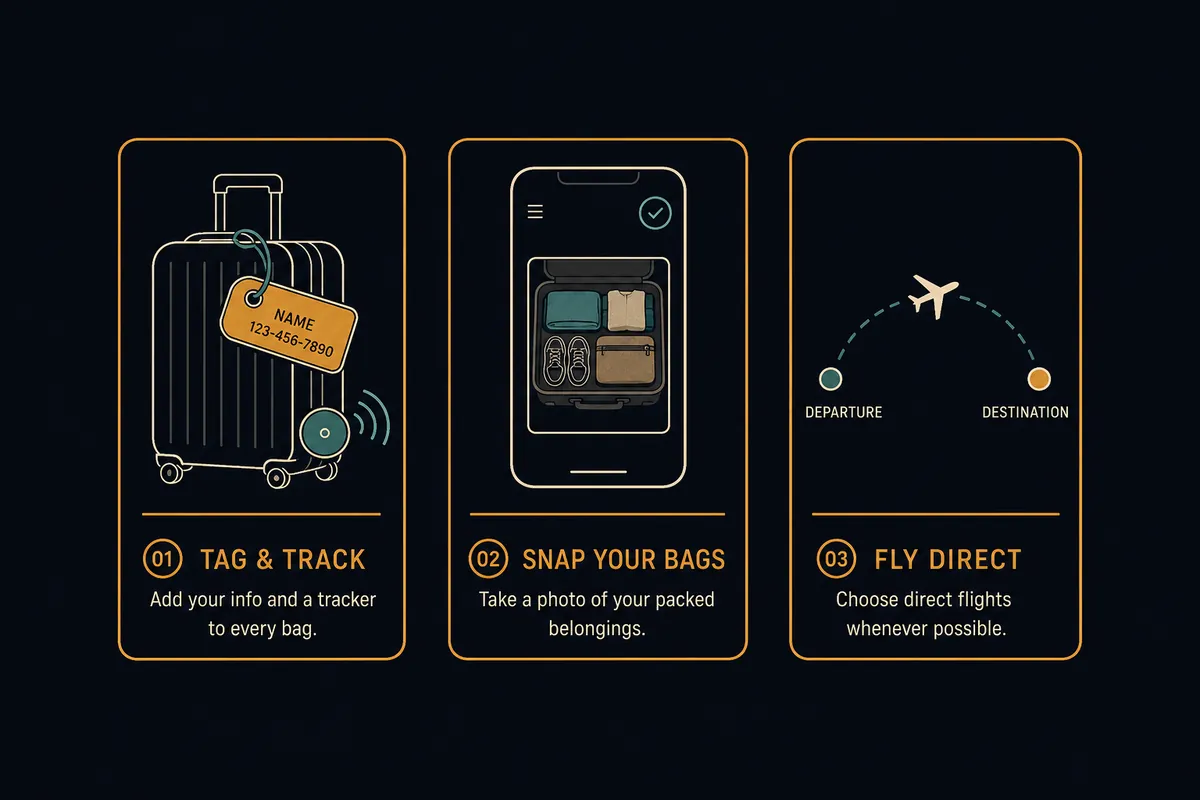
A bright, distinctive external luggage tag with your name, cell phone number, and email address is your first line of defense — skip the home address for privacy. Back it up with a paper tag sealed inside the bag, because external tags are torn off in automated sorting more often than travelers expect. Before every trip, peel off every old airline barcode sticker from previous flights: airport scanners can misread old tags and route your bag to the wrong carousel or a different city. A TSA-approved lock on checked zippers reduces tampering without triggering security removal, but note that TSA agents can and do open locked bags when required.
- Use a bright or uniquely patterned tag that stands out on the carousel
- Include: full name, cell number, and email — skip home address
- Seal a second written contact slip inside the bag as a backup
- Remove ALL old airline barcode stickers before each new trip
- Use a TSA-approved combination lock to reduce pilfering risk
- Take a photo of your bag and its contents before closing — essential for claims
For a full breakdown of what airlines cover and what fees to expect, see airline baggage fees compared.
Book nonstop and check in early: routing habits that protect your bag
Every connection adds a transfer point, and transfer mishandling is responsible for 41% of all baggage problems globally — making this the highest-leverage single decision a traveler can make. Flying nonstop eliminates that risk entirely. When a connection is unavoidable, choose itineraries with at least 90 minutes of layover so ground crews have a realistic window to move bags between aircraft. Arriving at the airport early matters too: airlines typically require bags to be checked at least 45–60 minutes before departure, and tight check-in windows increase the chance your bag misses the load.
- Nonstop flights eliminate the #1 cause of mishandling (transfer gaps)
- Allow 90+ minutes on connections — tight layovers are the leading delay trigger
- Check in at least 60 minutes before departure
- Verify the destination tag printed at check-in shows your final city code, not a hub city
- Watch the agent attach your baggage claim sticker and confirm the routing on the receipt
File your claim at the baggage desk before you leave the airport
Do not leave the terminal without filing a Property Irregularity Report (PIR)at the airline's baggage service counter — filing later dramatically reduces your odds of timely compensation. Ask for the PIR case number and request status update frequency. US Department of Transportation rules require airlines to deliver delayed bags to your accommodation at no extra cost, and airlines must reimburse reasonable emergency purchases such as clothing and toiletries while your bag is missing — keep every receipt. Bags not recovered within 5–7 days are typically reclassified as “lost” and trigger the full compensation process.
- File a Property Irregularity Report (PIR) before leaving the baggage claim area
- Get a case/reference number and written confirmation
- Keep receipts for emergency essentials — airlines must cover reasonable costs
- Most airlines offer a portal or hotline for 24/7 bag status updates
- Flag high-value contents at filing to support a larger claim if the bag is declared lost
US airlines owe up to $3,800 for lost domestic bags — know your rights before you fly
Under US Department of Transportation regulations, airlines are liable for up to $3,800 per passenger for lost, damaged, or delayed checked bags on domestic flights. International flights covered by the Montreal Convention cap liability at 1,288 Special Drawing Rights — approximately $1,700 USD. Both limits are ceilings, not guaranteed payouts; airlines typically negotiate based on documented value. You can raise your protection before check-in by purchasing excess valuation (typically $1 per $100 of declared value above the standard limit). Electronics, jewelry, cash, and fragile items are routinely excluded from standard airline liability, making travel insurance worth considering for bags with high-value contents.
- Domestic US: airlines owe up to $3,800 per passenger for lost or damaged bags
- International Montreal Convention: liability capped at ~$1,700 USD (1,288 SDR)
- Purchase excess valuation at check-in for bags worth more than $3,800
- Electronics, jewelry, and fragile items are routinely excluded from airline liability
- Travel insurance can bridge the gap airlines won't cover
Common questions
Bags are delayed, not permanently lost: the mishandling numbers you should know
Globally, 6.3 in every 1,000 checked bags were mishandled in 2024, but 74% are simply delayed rather than truly lost. Over 61% are returned to passengers within 48 hours, according to SITA's June 2025 industry report based on data from 280 airlines.
AirTag vs. Tile: which Bluetooth tracker is best for checked luggage in 2026?
Apple AirTag is the top pick for iPhone users — it uses a 1 billion-device Find My network and can now share your bag's location directly with participating airlines' WorldTracer baggage recovery systems. Tile Mate is the better choice for Android users and offers up to three years of battery life versus AirTag's one year.
Label your bag inside and out: the tagging rules that prevent permanent loss
Use a distinctive external tag with your name, phone number, and email, and place a second paper tag inside the bag. Remove all old airline barcode stickers before each trip — scanners can misread them and misroute your bag to the wrong destination.
Book nonstop and check in early: routing habits that protect your bag
Booking a nonstop flight removes the transfer step that causes 41% of all baggage mishandling globally. When a connection is unavoidable, allow at least 90 minutes of layover time and check your bag at least 60 minutes before departure.
US airlines owe up to $3,800 for lost domestic bags — know your rights before you fly
US DOT rules require airlines to pay up to $3,800 for lost or damaged checked bags on domestic flights. File a Property Irregularity Report at the airport's baggage desk before leaving, purchase excess valuation at check-in for high-value bags, and keep receipts for all emergency purchases made while your bag is delayed.
Know exactly when to leave for your flight
The Leave-By Time calculator folds in today's live TSA wait, your drive, bag drop cutoff, and gate close time — so you have one number to walk out the door.
Calculate your Leave-By Time →Data verified . Sources: SITA Baggage IT Insights 2025; US DOT baggage rights; Montreal Convention compensation guide.
Keep planning
Baggage
Airline baggage fees, compared
What every major airline charges for carry-on and checked bags in 2026 — including Southwest, which dropped free bags.
BaggageHow to avoid checked bag fees
Credit card waivers, airline status perks, and packing tricks that keep bag fees off your bill.
BaggageOversize and overweight baggage fees by airline (2026)
Bags over 50 lbs or 62 linear inches cost $100–$200 extra — here is what each major US airline charges.
BaggageCarry-on size limits by airline (2026)
Maximum carry-on and personal item dimensions for every major US airline — and which base fares include a carry-on.