Guide · Baggage
Carry-on size limits by airline (2026)
By the TSA Wait Times team · Updated · Published June 2026
The standard carry-on is 22 × 14 × 9 inches at most major US airlines — but Southwest and Frontier allow a larger 24 × 16 × 10 inches. What varies more than dimensions is whether your base fare includes a carry-on at all. Frontier, Allegiant, and United Basic Economy charge separately for overhead bin access. Below are the verified 2026 dimensions and fee rules for every major US airline.
Which airlines include a carry-on in their base fare?
Most legacy and mid-size carriers include a carry-on bag on all fare classes in 2026, but ultra-low-cost carriers treat overhead bin access as a paid add-on. Delta, American, Southwest, JetBlue, Alaska, and Hawaiian all include a carry-on at no extra charge on their cheapest fares. United is the notable exception among the Big Four: Basic Economy passengers on domestic routes are limited to a personal item only, and must pay $45 prepaid (or $70 total at the gate) to bring a full-size bag. A practical caveat for Delta and American Basic Economy travelers — carry-on access is technically free, but both airlines board Basic Economy passengers last, so overhead bins are frequently full by the time they board.
- Delta Basic Economy: carry-on FREE (boards last — bin space not guaranteed)
- American Basic Economy: carry-on FREE (boards last — bin space not guaranteed)
- United Basic Economy (domestic): carry-on NOT included — $45 prepaid, $70 at gate
- JetBlue Blue Basic: carry-on FREE
- Alaska Saver: carry-on FREE
- Southwest (all fares): carry-on FREE
- Hawaiian (all fares): carry-on FREE
- Frontier (all base fares): carry-on NOT included — dynamic fee $29–$99+
- Allegiant (all base fares): carry-on NOT included — $10–$75 per segment
- Breeze No Flex / Nice: carry-on NOT included; Nicer / Nicest: carry-on FREE
- WestJet UltraBasic (domestic): carry-on NOT included — personal item only
For a full side-by-side of checked-bag fees across these same airlines, see airline baggage fees compared.
Carry-on size limits by airline: the complete 2026 dimension chart
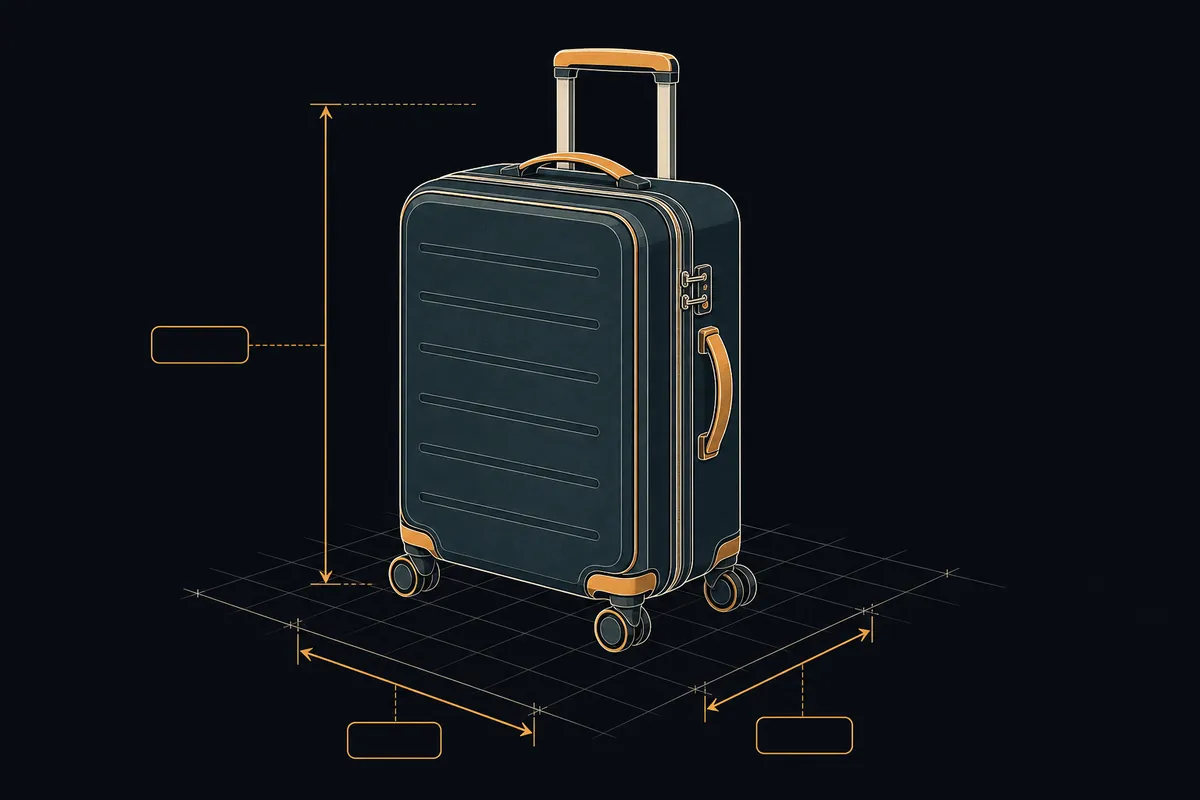
The industry de facto standard is 22 × 14 × 9 inches (56 × 35 × 23 cm) including wheels and handles, and it applies to Delta, United, American, JetBlue, Alaska, Hawaiian, Breeze, and WestJet. Southwest and Frontier allow a larger 24 × 16 × 10 inches. All measurements include wheels and handles extended — measure your bag this way before heading to the airport.
| Airline | Max Carry-On (L × W × H) | Weight Limit |
|---|---|---|
| Delta | 22 × 14 × 9 in (56 × 35 × 23 cm) | None |
| United | 22 × 14 × 9 in (56 × 35 × 23 cm) | None |
| American | 22 × 14 × 9 in (56 × 35 × 23 cm) | None |
| Southwest | 24 × 16 × 10 in (61 × 41 × 25 cm) | None |
| JetBlue | 22 × 14 × 9 in (56 × 35 × 23 cm) | None |
| Alaska | 22 × 14 × 9 in / 45 linear in | None |
| Frontier | 24 × 16 × 10 in (61 × 41 × 25 cm) | 35 lbs (16 kg) |
| Allegiant | 22 × 16 × 10 in (55 × 40 × 25 cm) | None published |
| Hawaiian | 22 × 14 × 9 in (56 × 35 × 23 cm) | None |
| Breeze | 22 × 14 × 9 in (56 × 36 × 23 cm) | 35 lbs (16 kg) |
| WestJet | 22 × 9 × 14 in (56 × 23 × 36 cm) | None published |
| Aeromexico | 21.6 × 15.7 × 9.8 in (55 × 40 × 25 cm) | 22–33 lbs (10–15 kg) by fare |
| Copa Airlines | 22 × 14 × 10 in (56 × 36 × 26 cm) | 22 lbs (10 kg) |
Personal item size limits by airline: what fits under the seat?
Every airline allows one free personal item — purse, laptop bag, small backpack, or tote — regardless of fare class or whether a carry-on fee applies. Published dimensions range from roughly 17–18 × 13–14 × 8 inches. Airlines without published dimensions (Delta, Southwest, Alaska, Hawaiian) simply require the item fit entirely under the seat in front of you without going into the aisle.
| Airline | Max Personal Item (L × W × H) | Notes |
|---|---|---|
| Delta | No published dimensions | Must fit completely under seat |
| United | 9 × 10 × 17 in (22 × 25 × 43 cm) | |
| American | 18 × 14 × 8 in (45 × 35 × 20 cm) | |
| Southwest | No published dimensions | Must fit completely under seat |
| JetBlue | 17 × 13 × 8 in (43 × 33 × 20 cm) | |
| Alaska | No published dimensions | Purse, briefcase, or laptop bag |
| Frontier | 18 × 14 × 8 in (45 × 35 × 20 cm) | Max 35 lbs; free on all fares |
| Allegiant | 8 × 14 × 18 in (20 × 35 × 45 cm) | Free for all passengers |
| Hawaiian | No published dimensions | Must fit completely under seat |
| Breeze | 17 × 13 × 8 in (43 × 33 × 20 cm) | Free on all fares |
| WestJet | 16 × 6 × 13 in (41 × 15 × 33 cm) | Only allowance on UltraBasic domestic |
| Aeromexico | 17.7 × 13.8 × 7.9 in (45 × 35 × 20 cm) | |
| Copa Airlines | 17 × 10 × 9 in (43 × 25 × 23 cm) |
How much do airlines charge for carry-on bags in 2026?
Ultra-low-cost carriers (ULCCs) use dynamic pricing for carry-on fees, meaning costs rise sharply the closer you get to departure. Frontier charges $29–$69 at booking and $99–$115 at the gate. Allegiant charges $10–$75 per segment depending on route and purchase timing, with a flat $75 at the airport. Breeze charges $40 at booking on its No Flex and Nice fares, escalating to $75 at the airport. United's Basic Economy carry-on costs $45 prepaid; trying to board with an unpaid carry-on results in a $70 gate fee ($45 bag fee plus $25 gate handling charge). The single biggest savings rule: always add the bag at checkout, never at the gate.
- Frontier: $29–$69 at booking; $99–$115 at gate
- Allegiant: $10–$75 per segment (varies by route); flat $75 at airport
- Breeze (No Flex / Nice fare): $40 at booking; $45 online pre-check-in; $50 after check-in opens; $75 at airport
- United Basic Economy (domestic): $45 prepaid; $70 total at gate ($45 bag + $25 gate handling)
- WestJet UltraBasic (domestic): carry-on not permitted in overhead bin; gate agents will require check-in plus a service fee
Which airlines enforce carry-on weight limits?
The majority of US carriers enforce size only and publish no weight limit for carry-ons. The exceptions are airlines with international operations or ULCC models with tighter baggage controls. Frontier and Breeze both cap carry-ons at 35 lbs (16 kg). Copa Airlines limits carry-ons to 22 lbs (10 kg). Aeromexico applies 22 lbs (10 kg) on economy fares and up to 33 lbs (15 kg) on select international or flexible fares. If you carry a camera kit, hiking gear, or a dense laptop bag, weigh it before flying these carriers.
- Frontier: 35 lbs (16 kg) — enforced
- Breeze: 35 lbs (16 kg) — enforced
- Copa Airlines: 22 lbs / 10 kg — enforced
- Aeromexico: 22–33 lbs (10–15 kg) depending on fare class
- Delta, United, American, Southwest, JetBlue, Alaska, Allegiant, Hawaiian, WestJet: no published weight limit
Pro tips to avoid carry-on fees and gate surprises in 2026
A few simple strategies eliminate most carry-on fee surprises. Always add the bag during initial booking. Before you fly, review airline check-in policies and bag drop cutoff times so your bag makes the flight.
- Book carry-on at checkout, not at the airport — saves $30–$75+ per segment on Frontier and Allegiant
- Measure your bag with wheels down and handle fully extended — many 22-inch rollaboards measure 23–24 inches with the handle up
- Southwest's larger 24 × 16 × 10 in limit accommodates most soft-sided spinner bags without issues
- United Basic Economy carry-on restriction is waived on international routes and for MileagePlus elite members and qualifying co-brand cardholders
- WestJet UltraBasic overhead bin restriction is domestic-only — Europe and Asia routes include a carry-on
- Delta and American Basic Economy technically include a free carry-on, but late boarding group means bins are often full — pack a personal-item-sized bag if you want certainty
- Spirit Airlines is defunct as of May 2026 — remove from any fee comparison tools or itinerary planning
What is the standard carry-on size for most US airlines?
The most common maximum carry-on size is 22 × 14 × 9 inches (56 × 35 × 23 cm) including wheels and handles. This applies to Delta, United, American, JetBlue, Alaska, and Hawaiian. Southwest and Frontier allow a larger 24 × 16 × 10 inches. Always measure with the handle fully extended and wheels down.
How much does Frontier Airlines charge for a carry-on bag in 2026?
Frontier uses dynamic pricing, so fees vary by route and purchase timing. Carry-on fees typically run $29–$69 when added at booking and can reach $99–$115 if you wait until the gate. Adding the bag at initial checkout is always the cheapest option.
Can I bring a carry-on on WestJet UltraBasic?
On domestic WestJet routes, UltraBasic fare passengers are limited to one personal item (16 × 6 × 13 in / 41 × 15 × 33 cm) stored under the seat — no overhead bin access. The restriction is waived on WestJet flights to Europe and Asia, where UltraBasic passengers may bring both a carry-on and a personal item.
Dimensions and fee rules verified . Sources: Delta carry-on baggage, United carry-on bags, United Basic Economy, Frontier bag fees, Allegiant baggage, WestJet carry-on, American Airlines 2026 bag policy update.
Know exactly when to leave for the airport
Once you know what you're carrying, the Leave-By Timecalculator counts backward from your flight using today's live security wait, your drive time, and the walk to your gate — so you head out with room to breathe.
Get your Leave-By TimeKeep planning
Baggage
Airline baggage fees, compared
What every major airline charges for carry-on and checked bags in 2026 — including Southwest, which dropped free bags.
BaggageHow to avoid checked bag fees
Credit card waivers, airline status perks, and packing tricks that keep bag fees off your bill.
BaggageOversize and overweight baggage fees by airline (2026)
Bags over 50 lbs or 62 linear inches cost $100–$200 extra — here is what each major US airline charges.
BaggageHow to pack a carry-on bag: tips to fit more and move faster
The right folding method, the right bag, and the right order can fit a week of clothes into one carry-on and save you $45–$100 in bag fees.