Flight-day guide
Minimum connection time: the shortest layover a hub will book
By the TSA Wait Times team · Updated · Published June 2026
Minimum connection time — MCT — is the shortest layover an airline will sell you at a given airport, often as little as 35 minutesfor a domestic-to-domestic connection. It's set by the airline, not the government, and the booking system simply won't let you go tighter. The catch: it's a floor under perfect conditions, not a safe buffer. Here's the minimum by hub, why international connections need so much more, and how to know if your layover is really enough.
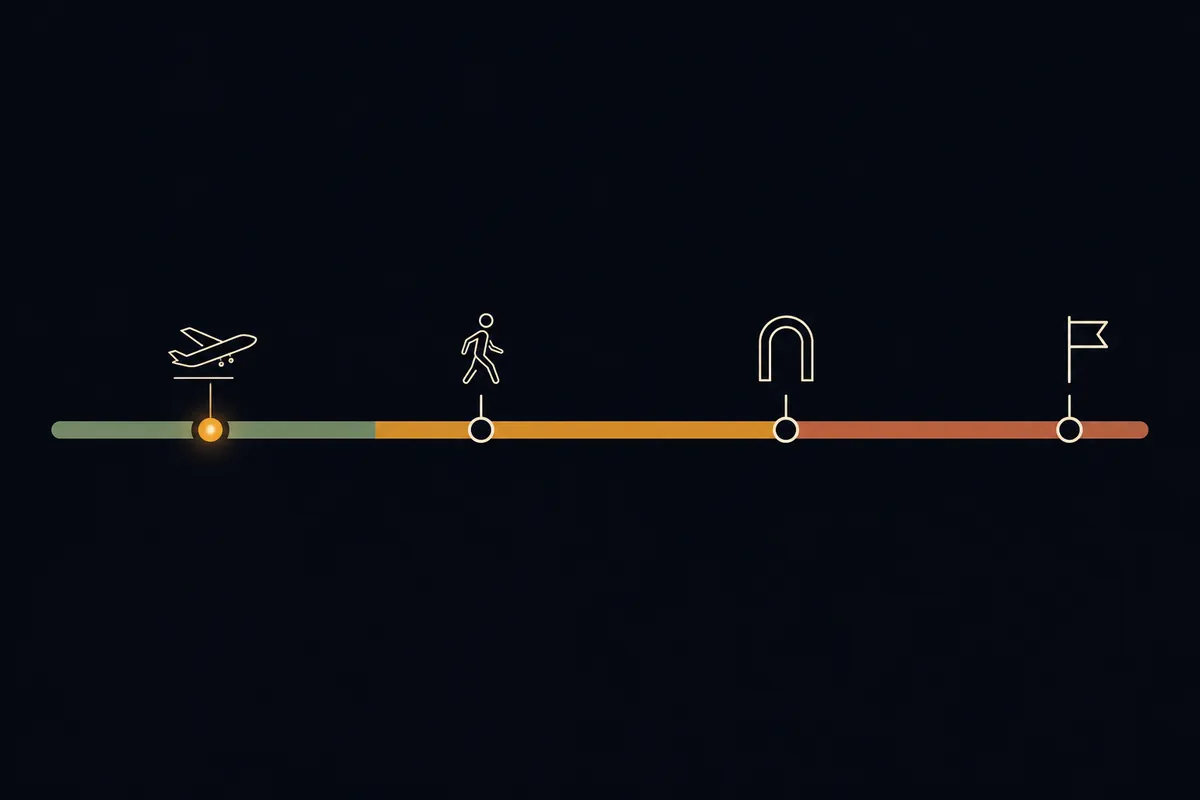
Minimum connection times at major U.S. hubs
These are typical published floors — the shortest the airline will book. They assume an on-time arrival and a quick walk; treat them as the minimum, not the time you should actually leave yourself:
| Hub | Domestic → Domestic | Domestic → Intl | Intl → Domestic |
|---|---|---|---|
| Atlanta (ATL) | 35 min | 45 min | 90 min |
| Charlotte (CLT) | 35 min | 45 min | 60 min |
| Denver (DEN) | 35 min | 90 min | 120 min |
| Dallas/Fort Worth (DFW) | 40 min | 40 min | 120 min |
| Detroit (DTW) | 40 min | 45 min | 120 min |
| Houston (IAH) | 45 min | 55 min | 120 min |
| Minneapolis (MSP) | 45 min | 60 min | 120 min |
| Chicago O'Hare (ORD) | 60 min | 120 min | 150 min |
Airlines file exact MCTs that vary by terminal and partner, so your itinerary may show a slightly different number. Terminal-change hubs like Los Angeles, San Francisco, and Newark run higher still — plan on 90+ minutes domestic and 2.5 to 3 hours when an international leg is involved.
Why international connections need 2 hours or more
A short domestic connection is just a walk to another gate. An international arrival into the U.S. is a whole process, because there's no sterile transit — every connecting passenger has to:
| Your connection | Customs | Re-check bag | Re-clear security |
|---|---|---|---|
| Domestic → Domestic | No | No | No |
| Domestic → Intl | No | No | Usually no |
| Intl → Domestic | Yes | Yes | Yes |
That's three extra lines stacked on top of the walk to your gate — and any one of them can run long. It's why an international-to-domestic connection floor is 90 minutes or more even at the fastest hubs.
How much buffer to actually book
Don't book the floor. A comfortable buffer looks more like this:
- Domestic to domestic — about 60 minutes at most hubs, 75+ if you change terminals.
- Domestic to international — 90 to 120 minutes, since boarding starts earlier and you may switch to an international concourse.
- International to domestic — 2 to 3 hours to absorb customs, bag recheck, and security.
- First or last flight of the day — pad it. A missed early connection can cost you the whole day.
Knowing your terminals helps you judge the walk. If you're connecting at Atlanta, see getting between terminals at ATL for the Plane Train and walk times.
A tight connection is a Leave-By Time problem in reverse
Booking a connection is the same backward math you do before you leave home, just inside the airport: count the steps between your two gates — walk or train, maybe customs and a bag recheck — and make sure they fit the layover. If they don't, the connection is too tight no matter what the booking site allowed.
And when a flight runs late, the fix is the same one you'd use at home: recompute. Your Leave-By Time tells you when to head to the airport for your first flight, and checking the live security wait at a hub like Chicago O'Hare (ORD) tells you whether a tight connection there is realistic today. For the arrival side of a long trip, see how early for an international flight.
A few more questions about connections:
What is minimum connection time?
Minimum connection time, or MCT, is the shortest layover an airline will let you book at a given airport. It's set by the airline, not a government rule, and booking systems simply won't sell you a tighter connection. OAG tracks more than 157,000 of these MCTs worldwide.
Is a 1-hour layover enough?
For a domestic-to-domestic connection at a single-security hub like Atlanta or Denver, an hour is usually comfortable. For anything international, an hour is tight to impossible — you may need to clear customs, collect and recheck a bag, and pass security again.
How much time do I need to connect from an international flight?
Give yourself at least 2 hours, and 2.5 to 3 at a big hub. Arriving from abroad in the U.S. means clearing customs and immigration, collecting your checked bag, rechecking it, and re-clearing security before your next flight — there is no sterile transit.
What happens if I miss my connection?
If both flights are on one ticket and the airline's delay caused it, the carrier rebooks you on the next available flight and handles your checked bag. On separate tickets, the miss is on you — which is the real risk of booking below the minimum connection time.
Do I have to re-clear security on a layover?
Not for a domestic-to-domestic connection — you stay airside and just walk or take the train to your next gate. Arriving internationally into the U.S., you always re-clear security after customs, which is why those connections need far more time.
Get your Leave-By Time for the first flight
Your connection is set when you book — but the day still starts at home. Enter your airport and first flight, and we'll fold in today's live security wait, your drive, and parking to give you the one moment to walk out the door.
Keep planning
Flight day
How early should you get to the airport?
Two hours domestic, three international — then let today's real security wait and your drive set the exact time to leave.
Flight dayHow early for an international flight?
Three hours is the rule of thumb — but the 60-minute check-in cutoff and today's live wait set your real time to leave.
Flight dayCheck-in and bag-drop cutoff times
Most airlines close check-in 45 minutes before a domestic flight, 60 before international. Every cutoff, plus what changed in 2025.
Flight dayWhat to do if your flight is delayed or canceled
What airlines must give you under US law, how to rebook fast, and when you are owed a cash refund.