Baggage
How to file a damaged baggage claim with your airline
By the TSA Wait Times team · Updated · Published June 2026
Airlines are legally required to compensate you up to $4,700 on domestic flights or 1,519 SDR (~$2,175) on international flights for bags damaged during their handling — but only if you act fast. Most carriers require an in-person report at the airport before you leave. Miss that window and your claim disappears. Here is the step-by-step process, every airline's deadline, and what to do if the airline refuses to pay.
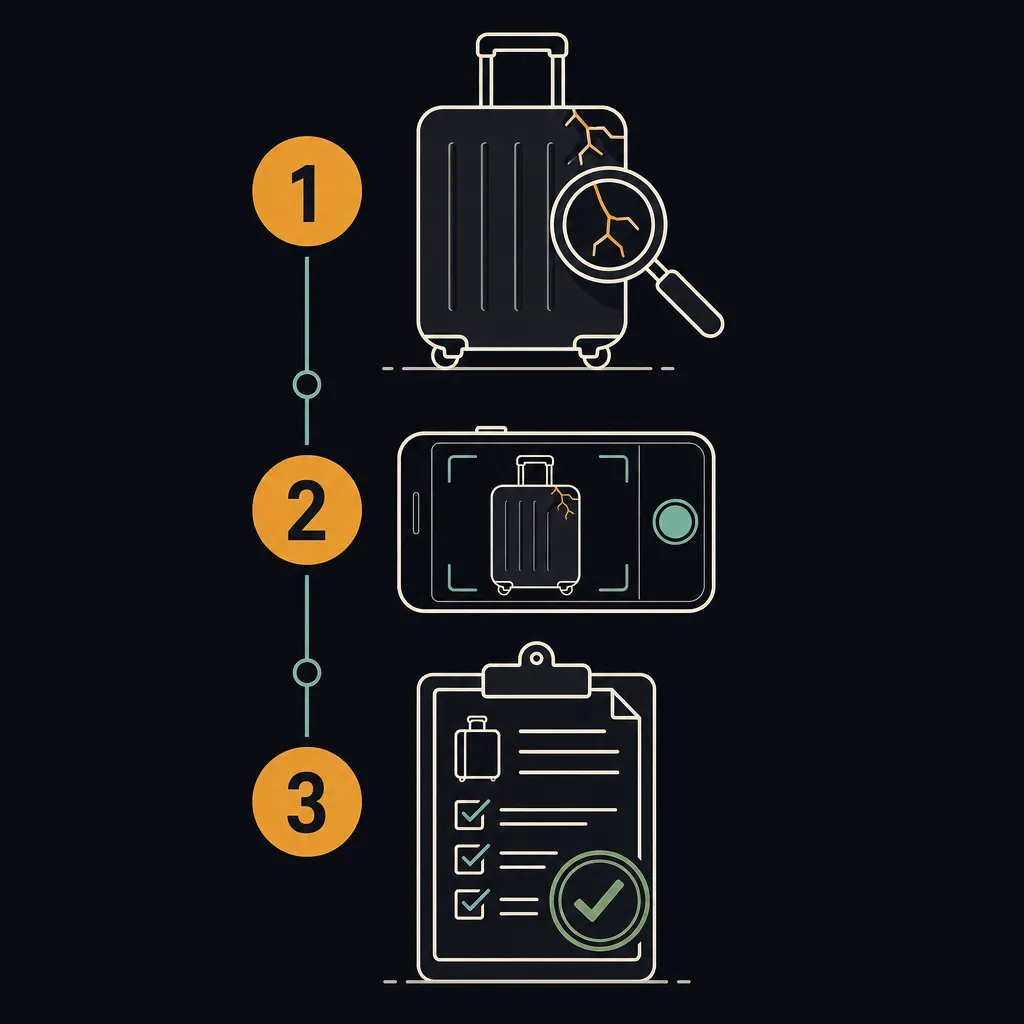
Report damage before you leave the airport — you may have as little as 4 to 6 hours
The single most important step is filing a report in person at the airline's Baggage Service Office (BSO), located in or near baggage claim, before leaving the terminal. Airlines enforce strict time limits that vary by carrier: Delta shortened its domestic damage deadline to just 6 hoursfor tickets issued on or after October 8, 2025. Southwest gives 24 hours for domestic damage reports. For international flights, most airlines follow the Montreal Convention's 7-day reporting window. The safe rule: report before you exit baggage claim and leave with a file reference number — also called a Property Irregularity Report (PIR).
- Find the Baggage Service Office in or near baggage claim before leaving the terminal
- Insist a written report is created and do not leave without a reference number
- If the BSO is unstaffed, call the airline's baggage line before you exit the airport
- International flights covered by the Montreal Convention allow 7 days for damage reports
Airline reporting deadlines for damaged bags compared
Each US airline sets its own reporting window within DOT and treaty limits. Delta made a notable policy change in late 2025, shortening its domestic damage deadline from 24 hours to 6 hours for newer tickets. Always verify your airline's current contract of carriage, as deadlines for damage and delayed or lost bags often differ within the same airline.
| Airline | Domestic — damage deadline | International — damage deadline |
|---|---|---|
| Delta | 6 hours (tickets issued Oct 8, 2025+); 24 hours for earlier tickets | 7 days |
| Southwest | 24 hours | 7 days |
| American Airlines | 24 hours (damage); 4 hours (delayed or lost) | 7 days |
| United Airlines | 24 hours (standard per contract of carriage) | 7 days |
| Alaska Airlines | 24 hours | 7 days |
| DOT guidance (all carriers) | As soon as possible — report at the airport | 7 days (Montreal Convention) |
Spirit Airlines is not listed: it ceased operations in May 2026. For full per-airline fee and policy details, see the airline baggage fees comparison.
What you are owed: DOT liability limits for damaged baggage in 2026
Federal rules set a floor on how much airlines must pay. The DOT raised the domestic liability cap from $3,800 to $4,700 per passenger, effective January 22, 2025 (Federal Register 2024-23588, 89 FR 84815). This is a maximum, not a guaranteed payout — compensation is based on depreciated replacement value, and you must prove the damage. Assistive devices such as wheelchairs have no cap on domestic flights: airlines owe the original purchase price.
| Situation | Maximum liability (2026) | How value is calculated |
|---|---|---|
| Domestic US flights | $4,700 per passenger | Depreciated value of bag and contents |
| International — Montreal Convention | 1,519 SDR (~$2,175 USD) | Depreciated value |
| Domestic assistive devices (wheelchairs, walkers, etc.) | Full original purchase price — no cap | Original cost, not depreciated |
| International assistive devices | Capped at Montreal Convention limit | Depreciated value |
What airlines will and will not cover — including the wheel and handle rule
Airlines are responsible for damage that occurs while your bag is in their control. They are not liable for pre-existing damage, overpacked bags, or minor cosmetic wear such as scuffs and small dents. On domestic flights, airlines can also exclude liability for fragile items, electronics, cash, and jewelry packed in checked bags. However, the DOT explicitly states that airlines cannot exclude liability for damage to wheels, handles, straps, and other structural components of the bag — even if the airline tries to label them as wear and tear. If a wheel was snapped off by mishandling, that is compensable.
- Covered: cracked shells, broken frames, snapped wheels or handles, structural damage
- Not covered: scratches, scuffs, dents from routine handling, pre-existing damage, overpacking
- Not covered on domestic routes: electronics, cash, jewelry, fragile items in checked bags
- Covered on international routes: any item accepted for transport, even if not disclosed at check-in
- Challenge a wheel or handle denial: DOT rules bar airlines from excluding these components
How to document damage and build a strong claim
Documentation is what separates an approved claim from a denied one. Before filing your report at the BSO, spend two minutes photographing the damage. Airlines calculate compensation using depreciated replacement value, so the more evidence you have of the bag's age, brand, and condition, the better positioned you are to negotiate.
- Photograph all exterior damage from multiple angles while the bag tag is still attached
- Photograph any damaged contents and note their approximate purchase price
- Photograph the bag's brand label, model tag, and serial number if visible
- Keep your boarding pass and baggage claim receipt until the claim is fully settled
- Save all receipts for repairs or replacement items — airlines may ask for these later
The claim process after you file a PIR
After you file the Property Irregularity Report, the airline assigns a case number and begins review. For damaged bags, the airline may take the bag to an authorized repair facility, offer you a replacement bag voucher, or propose a cash settlement based on depreciated value. If you escalate to a formal complaint, DOT requires airlines to acknowledge it within 30 days and send you a written response within 60 days. Airlines can offer repair, replacement, or a cash amount — you do not have to accept a voucher if you prefer cash, and you do not have to accept a repair you consider inadequate.
- Keep your file reference number — every follow-up call or email will require it
- Airlines may offer store vouchers rather than cash; ask for cash-equivalent compensation
- If offered a repair, inspect the bag before accepting the outcome
- Follow up in writing to create a paper trail in case you later need to escalate
If the airline denies your claim or offers too little: escalation options
You have several escalation paths if the airline refuses to pay or lowballs you. The most direct is filing a complaint with the DOT through its Aviation Complaint, Enforcement, and Reporting System (ACERS), launched August 2025, at airconsumer.dot.gov. Airlines are required to respond to DOT-forwarded complaints. Credit cards used to purchase the ticket often include trip protection or baggage protection benefits. Travel insurance policies may also cover what the airline will not. As of April 2026, DOT requires airlines to post a one-page passenger rights summary on their websites.
- File a DOT complaint at airconsumer.dot.gov/consumer/s/oacp-form — airlines must respond within 60 days
- Check your credit card guide to benefits: many premium travel cards cover damaged baggage
- Review your travel insurance policy for baggage damage provisions
- Small claims court is available for amounts within your state's limit (typically $5,000–$10,000)
- As of April 2026, DOT requires airlines to post a one-page passenger rights summary on their websites
For full airline-by-airline fee data, see the airline baggage fees comparison. Researching whether PreCheck helps you avoid bag issues at security? See PreCheck vs. CLEAR vs. Global Entry. All airline policies are also summarized on the airlines hub.
Know exactly when to leave for your flight
The Leave-By Time calculator folds in today's live TSA wait at your airport, your drive time, parking, and airline check-in cutoffs — so you get one clear moment to walk out the door.
Get your Leave-By Time →Facts verified . Sources: DOT — Lost, Delayed, or Damaged Baggage; Federal Register 2024-23588 (89 FR 84815); Delta baggage policy; Southwest baggage policy; DOT ACERS complaint portal.
Keep planning
Baggage
Airline baggage fees, compared
What every major airline charges for carry-on and checked bags in 2026 — including Southwest, which dropped free bags.
BaggageHow to avoid checked bag fees
Credit card waivers, airline status perks, and packing tricks that keep bag fees off your bill.
BaggageOversize and overweight baggage fees by airline (2026)
Bags over 50 lbs or 62 linear inches cost $100–$200 extra — here is what each major US airline charges.
BaggageCarry-on size limits by airline (2026)
Maximum carry-on and personal item dimensions for every major US airline — and which base fares include a carry-on.