Flight tips
What to eat before and during a flight to feel your best
By the TSA Wait Times team · Updated · Published June 2026
Gas in your gut expands up to 30% at cruise altitude while cabin humidity drops to 10–20% — drier than most deserts. The foods you eat in the two to three hours before boarding and during the flight are a direct lever on bloat, dehydration, energy, and how sharp you feel when you land.
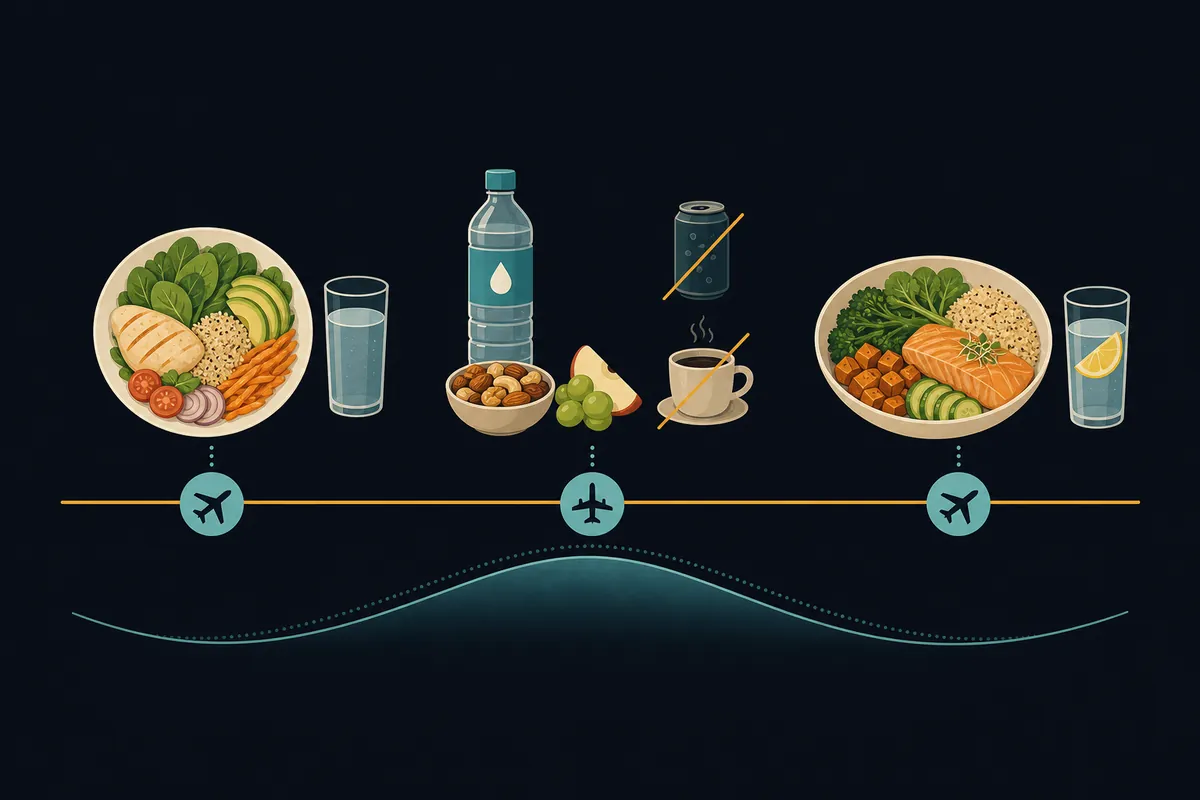
Why does flying change the way your body handles food?
At cruise altitude the cabin is pressurized to the equivalent of roughly 6,000–8,000 feet above sea level, not sea level. That pressure drop causes gas trapped in your digestive tract to expand by up to 30% — you can watch a sealed bag of nuts inflate mid-flight as proof. At the same time cabin humidity falls to 10–20% (drier than the Sahara), accelerating fluid loss through respiration and skin. On top of that, reduced pressure dulls sweet and salty taste receptors by roughly 30%, while the umami receptor is largely unaffected — which is why savory foods hit differently at 35,000 feet.
- Cabin pressure equivalent to 6,000–8,000 ft elevation, not ground level
- Gut gas expands up to 30% — a sealed packet of nuts visibly inflates
- Cabin humidity 10–20% — dehydration begins before your first drink cart
- Sweet and salty taste dulled ~30%; umami (savory/glutamate) largely preserved
What should you avoid eating before your flight?
Skip anything that produces gas on the ground — it will be magnified in the air. High-sodium fast food worsens fluid retention in an already-dehydrating environment. Carbonated drinks add a direct gas load on top of altitude expansion. Alcohol is a diuretic that competes with the hydration your body desperately needs and degrades sleep quality on overnight flights.
| Food or Drink | Why It Causes Problems at Altitude | Better Alternative |
|---|---|---|
| Carbonated drinks (soda, sparkling water) | Adds gas that expands ~30% in pressurized cabin — painful bloat | Still water or herbal tea |
| Cruciferous vegetables (broccoli, cabbage, beans) | Already gas-producing on the ground; amplified at altitude | Cucumber, carrots, or light green salad (no legumes) |
| Alcohol | Diuretic, worsens dehydration, disrupts sleep architecture | Water with electrolytes or diluted fruit juice |
| High-sodium fast food | Causes water retention, puffy feeling, and worsens dehydration | Unsalted nuts or a lean protein with complex carbs |
| Excess coffee (3+ cups) | Diuretic effect accelerates fluid loss; heightens anxiety at altitude | One coffee before boarding, then switch to water |
| Chewing gum (sugar-free) | Artificial sweeteners (sorbitol/xylitol) cause gas; swallowing air adds to bloat | Sip water for ear pressure instead |
What are the best foods to eat before a flight?
Eat something before boarding — flying on an empty stomach is not a strategy. Lower oxygen levels at cabin pressure already slow digestion; add acid reflux from an empty stomach and you have a miserable first hour. A light meal of lean protein, complex carbohydrates, and high-water-content vegetables threads the needle between hunger and heaviness. Aim to finish eating 60–90 minutes before departure so digestion is underway before altitude changes kick in.
- Oatmeal with banana — complex carbs for steady energy, potassium for fluid balance
- Grilled chicken or turkey with rice or whole-grain crackers — lean protein, low gas risk
- Light salad (no beans, no raw cruciferous) with olive oil dressing
- Hummus with carrots or grain crackers — protein and fiber without bloat triggers
- Hydrating fruits: watermelon, cucumber slices, orange wedges — counter cabin dryness pre-emptively
What should you eat and drink during a flight?
Hydration is the single highest-leverage action mid-flight: target 8 oz (roughly 250 ml) of water per hour in the air. Do not wait until you feel thirsty — by the time thirst registers in a low-humidity cabin you are already mildly dehydrated. For food, eat small and light; large meals slow digestion that is already sluggish at altitude. If you are trying to sleep on an overnight flight, avoid sugar and stick to a small protein snack — a blood sugar spike will fragment your sleep cycle.
- 8 oz water per hour in the air — bring a reusable bottle to refill post-security
- Avoid alcohol entirely on overnight flights; it suppresses REM sleep
- Light snacks only: handful of almonds, a banana, or a protein bar
- Skip sugar if you want to sleep — blood sugar spikes shorten sleep cycles
- Magnesium-rich snacks (almonds, dark chocolate) may ease in-flight water retention bloating
- Ask for herbal tea (peppermint or ginger) instead of coffee — both soothe digestion and hydrate
Why does tomato juice taste better on a plane?
Tomato juice outsells almost every other beverage on certain European carriers at altitude — and it is not coincidence. When cabin pressure drops, sweet and salty taste receptors are suppressed but the umami (glutamate) receptor is largely unaffected. Tomatoes are one of the richest natural sources of glutamate. The result: tomato juice's savory, complex flavor actually intensifies relative to everything else on the cart. Research by Lufthansa in partnership with the Fraunhofer Institute confirmed this taste-shift effect — it is the same reason airline food tends to be over-seasoned, compensating for dulled sweetness and salt perception.
- Tomato juice is rich in glutamate — the umami compound whose receptor survives altitude intact
- Sweet and salty receptors suppressed ~30%; umami is not — so tomato tastes richer, not flatter
- Airline kitchens salt food heavily for the same reason: compensating for dulled salty perception
- Ordering tomato juice is scientifically defensible — it also contains lycopene and hydrates
Is airline food actually bad for you?
Airline meals are engineered for preservation and palatability at altitude, which means high sodium and low fiber almost by default. A typical economy meal can contain 1,000–1,500 mg of sodium in a single tray — in a dehydrating cabin, that drives additional fluid retention and bloating. Low fiber compounds the digestion slowdown already caused by reduced oxygen and inactivity. The practical fix: eat half portions, skip the bread roll if it has no protein pairing, and treat airline food as a supplement rather than a full nutritional strategy for long flights.
- Economy trays commonly contain 1,000–1,500 mg sodium — near the recommended daily limit in one sitting
- Fiber is low by design — long shelf life and altitude digestion slowdown compound each other
- Eat half portions if already full from a pre-flight meal
- Decline sugary desserts if flying overnight — the energy spike will cost you sleep
- Probiotics (yogurt, a probiotic capsule) before or during the flight can help offset digestive disruption
What are the best snacks to bring from home?
Airport food is optimized for convenience and shelf life, not flight comfort. Bringing your own snacks gives you control over sodium, sugar, and gas-risk content. The ideal carry-on snack is calorie-dense enough to satisfy, low in sodium and fermentable fibers, and packaged to survive a bag without refrigeration. The five-snack shortlist below covers most flight lengths and hunger patterns.
- Unsalted almonds or mixed nuts — healthy fats, magnesium, protein; no gas risk
- Protein bar (low sugar — check labels for sorbitol/sugar alcohols, which cause bloat)
- Whole-grain crackers with individual nut butter packets — complex carbs plus protein
- Dried mango, apricots, or raisins (small portion) — natural sugar, iron, fiber
- Fresh fruit: banana or apple — easy to pack, hydrating, potassium-rich; avoid gas-producing fruits like pears
Packing snacks means passing through security — keep liquids (nut butter, yogurt, hummus) to 3.4 oz or less per container. See the 3-1-1 liquids rule so nothing gets flagged at the checkpoint.
More questions about eating and flying:
Why does flying change the way your body handles food?
Cabin pressure drops to the equivalent of 6,000–8,000 ft at cruise altitude, causing gut gas to expand up to 30% and cabin humidity to fall to 10–20%. This combination slows digestion, accelerates dehydration, and dulls sweet and salty taste by roughly a third.
What should you avoid eating before your flight?
Skip carbonated drinks, cruciferous vegetables (broccoli, cabbage, beans), alcohol, high-sodium fast food, and more than one coffee — all produce or trap gas that expands painfully at altitude, or accelerate the dehydration your body will already be fighting.
Why does tomato juice taste better on a plane?
Tomato juice is high in glutamate, the compound behind umami flavor. At altitude, sweet and salty taste receptors are suppressed by ~30% but the umami receptor is unaffected, so tomato juice's savory depth intensifies relative to everything else — the effect is real and has been scientifically studied.
Is airline food actually bad for you?
Not dangerous, but poorly suited to in-flight physiology — airline meals are high in sodium (often 1,000–1,500 mg per tray) and low in fiber, which worsens dehydration and the digestion slowdown already caused by altitude. Eat smaller portions and supplement with lower-sodium snacks you bring yourself.
What are the best snacks to bring from home?
Unsalted almonds, a low-sugar protein bar, whole-grain crackers with nut butter, a small portion of dried fruit, and fresh fruit like a banana or apple all travel well and cover hydration, protein, and energy needs without the gas risk of airport fast food.
Know when to leave for the airport
Food is one piece of a calm departure. The other is leaving home at the right time. The Leave-By Time calculator folds in your airport's live TSA wait, your drive, and your airline's check-in cutoff to give you one exact moment to walk out the door.
Calculate my Leave-By Time →Data verified . Sources: Condé Nast Traveler, Biospringer / Fraunhofer umami research, Connected Health Pittsburgh, Skyscanner, Pegasus Airlines / gas expansion.
Keep planning
Flight tips
How to sleep on a plane: positions, gear, and seat choices
Window seat, neck pillow, eye mask, and a slight recline get most people 2–3 hours of sleep on a cross-country flight.
Flight tipsAirplane ear pain: why it happens and how to prevent it
Ear pain on descent is caused by blocked Eustachian tubes. Swallowing, yawning, the Valsalva maneuver, and EarPlanes plugs all help.
Flight tipsHow to survive a long-haul flight: tips for flights over 6 hours
Stay hydrated, move every 90 minutes, and manage sleep with melatonin — here is the complete guide to arriving rested after a long international flight.
Flight tipsHow to manage flying anxiety: techniques that work
Flying is statistically one of the safest forms of travel. Here is what actually helps — from breathing techniques to medication options.