Flight tips
How to manage flying anxiety: techniques that work
By the TSA Wait Times team · Updated · Published June 2026
Commercial flying carries roughly a 1-in-11-million chance of a fatal accident per flight. Peer-reviewed research places the worldwide death risk per boarding at 1 in 13.7 million for 2018–2022, improving approximately 50 percent every decade. For the roughly 25 percent of travelers whose nervous systems do not cooperate with that fact, the techniques below address the anxiety response directly — from controlled breathing to medication considerations.
Flying is statistically the safest way to travel — here is the data
The odds of dying on any single commercial flight are approximately 1 in 11 to 14 million. A peer-reviewed study in the Journal of Air Transport Management (2024) calculated worldwide death risk per boarding at 1 in 13.7 million for 2018–2022, and found that safety continues improving at roughly 50 percent per decade. By comparison, the National Safety Council puts your lifetime odds of dying in a car accident at about 1 in 102. Commercial aviation accounts for just 0.01 deaths per 100 million miles traveled versus 0.04 for trains. Knowing this does not always silence anxiety, but it gives the rational mind accurate ground to stand on.
- Aviation safety has improved ~50% per decade for the past half century and continued improving through 2022 (peer-reviewed).
- US commercial carriers had zero fatal passenger accidents from 2013 through 2018 — a six-year streak.
- Modern airliners are designed with redundant systems: dual engines, dual hydraulics, dual flight computers — no single failure point brings down the aircraft.
| Transport mode | Risk metric | Approximate odds |
|---|---|---|
| Commercial flight | Per boarding (death) | ~1 in 11–14 million |
| Car (US) | Lifetime risk | ~1 in 102 |
| Motorcycle (US) | Lifetime risk | ~1 in 800 |
| Walking (US) | Lifetime risk | ~1 in 625 |
| Train (US) | Deaths per 100M miles | 0.04 vs air's 0.01 |
Sources: Journal of Air Transport Management (2024), National Safety Council.
What turbulence actually is (and why it cannot bring down a modern plane)
Turbulence is nothing more than irregular air movement — the aerial equivalent of a boat passing over choppy water. Modern commercial aircraft are certified to withstand forces many multiples greater than any turbulence ever recorded. No modern jet airliner has ever been brought down by turbulence alone. The real turbulence danger is narrow: injury to passengers who are not wearing seatbelts when unexpected bumps occur, which is exactly why the seatbelt sign stays on during cruise at altitude.
- Clear-air turbulence (the most common type) is invisible on radar but pilots receive weather data and route around known areas when possible.
- The physical “drop” sensation during turbulence is typically only a few feet, though it can feel like much more.
- Severe turbulence is rare — the vast majority of in-flight bumps are rated “light” on the aviation scale.
- Keeping your seatbelt fastened while seated eliminates virtually all personal risk from turbulence.
How to prepare before your flight so anxiety is lower at the gate
Anxiety spikes when you feel out of control; preparation restores a sense of control. Arrive early — at least 90 minutes before domestic flights and 3 hours before international departures — because a rushed security experience is one of the most reliable pre-flight anxiety amplifiers. Check the weather at your destination and along your route the day before so forecast turbulence is expected, not a surprise. Look up the aircraft type on your booking confirmation so you know whether you are flying a wide-body or a regional jet.
- Download your entertainment, a meditation app, or a podcast before departure — do not rely on in-flight Wi-Fi.
- Avoid heavy meals, excess caffeine, and alcohol in the hours before boarding; all three worsen anxiety symptoms physiologically.
- Tell a travel companion or flight crew before boarding that you are anxious — saying it aloud reduces the isolation and sets up the support system.
- Check flightaware.com or FlightAware's turbulence layer for a route-specific forecast the morning of your flight.
Use the Leave-By Time calculator to back-calculate exactly when to leave home — removing the clock-watching anxiety that compounds at the airport. Enrolling in TSA PreCheck or CLEAR also cuts through the security line and removes one of the biggest pre-flight stressors.
Breathing and grounding techniques that interrupt anxiety in real time
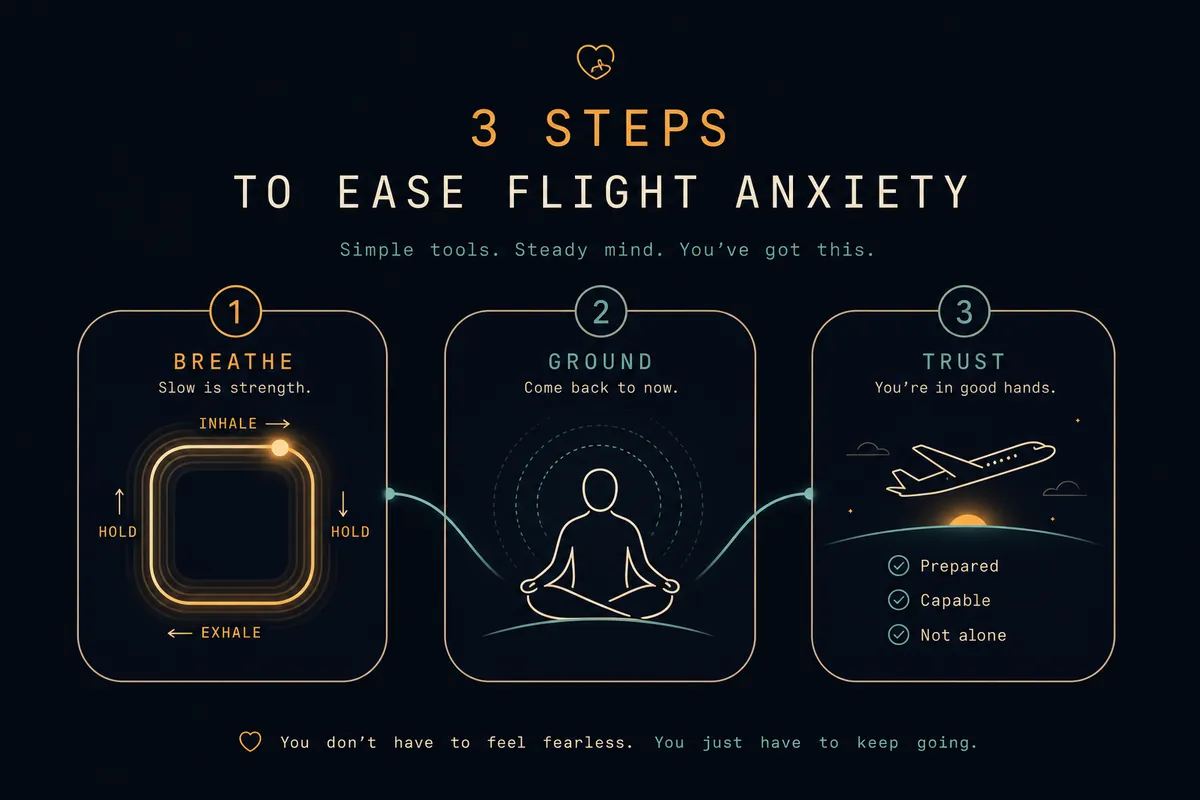
Controlled breathing is one of the only tools that directly down-regulates the nervous system in real time, with no equipment required. The 4-7-8 method works because the extended exhale (8 counts) activates the parasympathetic response and lowers heart rate within seconds. Box breathing (4-4-4-4) is slightly easier to remember during peak-anxiety moments and is the same technique used by US Navy SEALs under stress. The 5-4-3-2-1 grounding technique interrupts catastrophizing thought loops by pulling attention into the present through sensory detail.
- 4-7-8 breathing: inhale through the nose for 4 counts, hold breath for 7, exhale fully through the mouth for 8 — repeat 3 to 4 cycles.
- Box breathing: inhale 4, hold 4, exhale 4, hold 4 — used by military and first responders; easy to remember under stress.
- 5-4-3-2-1 grounding: name 5 things you can see, 4 you can physically feel, 3 you can hear, 2 you can smell, 1 you can taste.
- Progressive muscle relaxation: tense and release each muscle group from feet upward — particularly effective during long taxi delays or climb-out.
Medication options for flight anxiety: what to know before asking your doctor
Over-the-counter diphenhydramine (Benadryl, 25–50 mg) is the most accessible option for mild anxiety combined with a desire to sleep on long flights — it causes drowsiness without requiring a prescription. For more significant anxiety, some US physicians will still prescribe a short-acting benzodiazepine such as lorazepam (Ativan) for a specific flight. However, clinical guidance has shifted significantly: multiple medical bodies now note that benzodiazepines are contraindicated for phobic states per prescribing guidelines, may increase DVT risk on flights longer than 4 hours, and evidence from a Stanford study shows they can worsen long-term anxiety by preventing natural habituation. Never combine any benzodiazepine with alcohol.
- Diphenhydramine (Benadryl):OTC, 25–50 mg, mild sedation — test a dose at home before your flight to confirm your personal response.
- Lorazepam (Ativan) / diazepam: prescription only; reduces acute anxiety but impairs reaction time and deepens sedation-related DVT risk on long flights.
- Beta blockers (propranolol): sometimes prescribed off-label to blunt physical symptoms — racing heart, sweating — without heavy sedation; discuss with your doctor.
- Benzodiazepines are illegal to import into Japan, the UAE, and other countries — verify customs rules before travel.
- CBT (cognitive behavioral therapy) is the only intervention with evidence of long-term improvement in flight anxiety; medication does not treat the underlying phobia.
Which seat should you choose if you have flight anxiety?
Seats directly over the wing experience the least turbulence sensation because they sit closest to the aircraft's center of mass — the fuselage flexes most at the nose and tail during turbulence, while the wing-root region moves least. This is confirmed by multiple pilots and aeronautical engineers: the further from the wing you sit, the more amplified the motion. For the window-versus-aisle question, the right answer depends on what drives your anxiety: if seeing altitude or the horizon makes it worse, choose an aisle; if having a fixed visual reference helps you stay grounded, choose a window.
- Best for minimal turbulence sensation: seats directly over the wing (rows vary by aircraft — check a seatmap like SeatGuru).
- Second best: forward of the wing, toward the front of the cabin.
- Worst: rear seats — motion is amplified furthest from the center of mass.
- Aisle seat advantage: easy to stand, walk, and access the lavatory — movement helps anxious flyers regulate.
- Window seat advantage: fixed visual anchor; you control the window shade.
- Exit row over-wing seats combine both advantages — minimal motion and extra legroom; book early as they fill quickly.
Apps, therapy, and talking to your crew — resources that actually help
The SOAR app (soarflying.com), created by licensed therapist and former pilot Tom Bunn LCSW, is the most purpose-built tool for flight anxiety — it provides turbulence explanations, real-time flight data to contextualize bumps during flight, and audio exercises. ZeroPhobia combines CBT with VR exposure therapy in six app-based modules and does not require a clinic. Telling a flight attendant you are nervous is one of the most underused tools available: crew are trained to reassure passengers, explain unusual sounds, and check on you throughout the flight — it costs nothing and works.
- SOAR app: purpose-built for flight anxiety; real-time turbulence data overlay during flight; iOS and Android; founded by a therapist-pilot.
- Headspace / Calm: both include dedicated flight anxiety and in-flight meditation packs — download content before departure.
- ZeroPhobia: app-based CBT plus VR exposure therapy for aviophobia; six structured modules; no clinic required.
- British Airways Flying with Confidence and easyJet Fearless Flyer: structured courses led by pilots and therapists — one-day and online formats.
- Tell your flight attendant before or during boarding: they can explain noises (gear retraction, flap sounds), alert you before descent, and simply check in.
Frequently asked questions
Flying is statistically the safest way to travel — here is the data
Your odds of dying on any single commercial flight are approximately 1 in 11–14 million, versus a 1-in-102 lifetime risk of dying in a car accident. A peer-reviewed 2024 study found worldwide aviation death risk per boarding has improved roughly 50% every decade and stood at 1 in 13.7 million for 2018–2022.
What turbulence actually is (and why it cannot bring down a modern plane)
Turbulence is irregular air movement — the aircraft equivalent of a boat on choppy water. No modern commercial jetliner has ever been brought down by turbulence; aircraft are certified to withstand forces far beyond anything encountered in service. Injury risk from turbulence is limited almost entirely to unbuckled passengers.
Medication options for flight anxiety: what to know before asking your doctor
OTC diphenhydramine (Benadryl) works for mild anxiety and drowsiness. Prescription benzodiazepines like lorazepam are available from some US physicians but clinical guidance has shifted against prescribing them for phobias — they are contraindicated per prescribing guidelines, increase DVT risk on long flights, and may worsen long-term anxiety. Never combine with alcohol.
Which seat should you choose if you have flight anxiety?
Seats over the wing experience the least turbulence because they sit nearest the aircraft's center of mass; rear seats amplify motion most. Choose an aisle if freedom to move helps you regulate; choose a window if a fixed visual anchor is more calming.
Does arriving early at the airport actually reduce flight anxiety?
Yes — rushing through security is a well-documented anxiety amplifier. Arriving at least 90 minutes before a domestic flight and 3 hours before an international departure removes time pressure and lets your nervous system regulate before you board, rather than boarding already activated.
Data verified . Sources: Journal of Air Transport Management (2024), aviation accident statistics, NHS medication guidance for fear of flying, benzodiazepines and fear of flying (prescribing guidance), Statista US air transportation safety.
Remove the clock-watching from your pre-flight routine
Enter your airport and flight time and we'll calculate exactly when to leave home — folding in today's live security wait, your drive, and your airline's check-in cutoff into one number.
Get your Leave-By Time →Keep planning
Flight tips
How to sleep on a plane: positions, gear, and seat choices
Window seat, neck pillow, eye mask, and a slight recline get most people 2–3 hours of sleep on a cross-country flight.
Flight tipsAirplane ear pain: why it happens and how to prevent it
Ear pain on descent is caused by blocked Eustachian tubes. Swallowing, yawning, the Valsalva maneuver, and EarPlanes plugs all help.
Flight tipsHow to survive a long-haul flight: tips for flights over 6 hours
Stay hydrated, move every 90 minutes, and manage sleep with melatonin — here is the complete guide to arriving rested after a long international flight.
Flight tipsWhich airlines have the most legroom in economy class (2026)
Standard economy seat pitch has shrunk to 28–31 inches on US carriers. JetBlue leads at 32–34 inches. Here is the full comparison.