Flight tips
How to survive a long-haul flight: tips for flights over 6 hours
By the TSA Wait Times team · Updated · Published June 2026
Cabin humidity drops to 10–20% at cruise altitude — drier than desert air — so you lose moisture from your skin and respiratory tract at a much faster rate than you do on the ground. Add six or more hours of sitting still and a disrupted sleep schedule, and a long-haul flight can leave you stiff, dehydrated, and jet-lagged before you even reach your hotel. The fix is systematic: drink 8 oz of water every hour, stand and walk every 90 minutes, and take 1–3 mg of fast-release melatoninat your destination's bedtime. Here is exactly how to do each one.
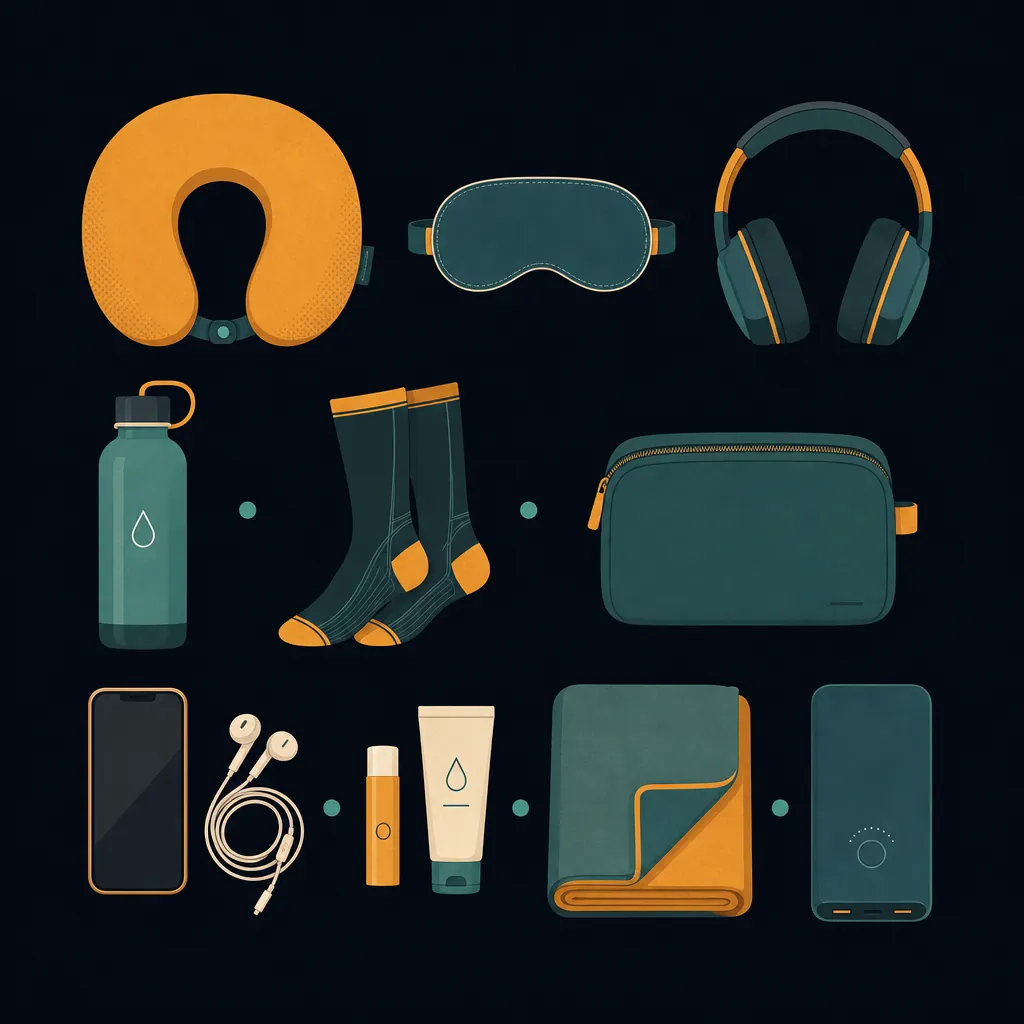
How to stay hydrated on a long-haul flight
Drink 8 oz (240 ml) of water every hour — that is the single most important thing you can do on a long flight. Cabin relative humidity drops from 35–50% at departure to 10–25% during cruise, verified by peer-reviewed aircraft air quality research (ScienceDirect, 2013 study across 14 commercial flights), which is roughly the humidity of a desert and significantly accelerates moisture loss from your skin and respiratory tract. Bring an empty reusable water bottle through security and fill it at the gate; the TSA 3-1-1 rule applies only to containers carried in your bag, not an empty bottle. Limit alcohol and excessive caffeine, both of which act as mild diuretics and compound in-cabin dehydration.
- Target 8 oz of water per hour of flight time
- Cabin humidity at cruise: 10–20% (well-established; confirmed by multiple aircraft air-quality studies)
- Empty water bottle through security, fill post-screening at a fountain or café
- Limit alcohol — even one drink worsens dehydration and fragments sleep
- 1–2 cups of coffee is acceptable; more amplifies fluid loss
How to prevent blood clots (DVT) on long flights
Long-haul flights increase venous thromboembolism (VTE) risk by 1.5–4 times compared to baseline, primarily because prolonged immobility slows blood return from the deep veins of the legs. The most effective prevention is to stand and walk the aisle every 60–90 minutes — calf contractions during walking act as a muscle pump that pushes blood toward the heart. When you cannot stand, do ankle circles in both directions, calf raises with both feet flat, and toe wiggles every 30 minutes. Dehydration thickens blood and is a secondary risk factor, which is why aggressive hydration and DVT prevention are linked strategies.
- Stand and walk every 60–90 minutes; set a phone timer if needed
- In-seat: ankle circles (both directions), calf raises, and toe wiggles — 10 reps each, every 30 min
- Stay hydrated — dehydration raises blood viscosity and DVT risk
- Higher-risk travelers (pregnant, recent surgery, obesity, prior DVT, hormone therapy): consult a doctor before flying
- Absolute risk remains low: ~27 symptomatic cases per million passengers within 14 days of travel (AAFP/Cochrane 2021)
Should you wear compression socks on a long-haul flight?
Compression socks reduce asymptomatic DVT risk on flights longer than four to five hours, based on high-certainty Cochrane systematic review evidence (2021, 2,821 patients across 9 trials). For healthy low-risk travelers the American Society of Hematology does not mandate them but notes they cause no harm; for high-risk travelers (prior DVT, obesity, active malignancy, hormone therapy, pregnancy) ASH explicitly recommends compression socks on flights over four hours. For general flying, 15–20 mmHg moderate compression is the standard recommendation from Mayo Clinic. Put them on before boarding while you are still mobile and keep them on for the full flight.
| Compression Level | mmHg Range | Best For |
|---|---|---|
| Mild / Over-the-counter | 10–15 mmHg | First-time wearers, low-risk travelers on any flight, general comfort |
| Moderate (standard flying rec.) | 15–20 mmHg | Most travelers on flights 4+ hours; standard DVT prevention recommendation |
| Firm / Medical grade | 20–30 mmHg | High-risk travelers (prior DVT, obesity, pregnancy); use under doctor guidance |
| Extra firm / Prescription | 30–40 mmHg | Prescribed medical conditions only — not for general travel use |
- Put on socks before boarding, not in the cramped airplane bathroom
- Knee-high preferred over thigh-high for travel; never roll the cuff down (tourniquet effect)
- Quality brands: Sockwell, Comrad, Sigvaris — size correctly to get the rated mmHg
- Compression socks also reduce leg swelling and fatigue independent of DVT risk
How to sleep better and beat jet lag on a long-haul flight
Begin shifting your sleep schedule toward your destination time zone 1–2 days before departure — this is the single highest-leverage jet lag intervention. Melatonin helps: use 1–3 mg fast-release(not slow-release) taken at your destination's bedtime, a dose range recommended by circadian researchers because higher doses (5–10 mg common in US supplements) stay in the system too long and can shift the clock in the wrong direction. Light is the primary driver of circadian reset — seek morning light at your destination on day one and avoid bright screens in the evening. On the plane, a quality sleep mask and foam earplugs or noise-cancelling headphones are low-cost and highly effective.
- Melatonin: 1–3 mg fast-release only; take at destination bedtime, not your home bedtime
- Slow-release and high-dose (5–10 mg) formulations linger too long and may worsen jet lag
- Set watch to destination time zone the moment you board
- Seek morning sunlight at destination on arrival day — it is the strongest circadian reset signal
- Avoid alcohol before sleeping on the plane — it induces drowsiness but fragments sleep architecture
- Eastward travel (shortening the day) causes worse jet lag than westward for most people
What to eat on a long-haul flight
Eat light on the day of travel and during the flight — heavy, high-fat meals slow digestion and cause sluggishness at altitude. Cabin pressure is maintained at the equivalent of 6,000–8,000 feet, which causes intestinal gas to expand by roughly 25%, making gas-producing foods noticeably more uncomfortable in the air. Airport and airline standard meals are typically high in sodium, causing water retention and bloating that compounds the already-cramped discomfort. On international flights, pre-booking a special meal (vegetarian, Asian, low-sodium, or fruit plate) is free, served ahead of standard service, and is generally fresher.
- Pre-book a special meal at time of booking — it is free on most international carriers
- Special meals (VLML, AVML, LFML, FPML codes) are loaded first and served before the standard cart reaches your row
- Avoid: carbonated drinks, beans, cabbage, broccoli, onions, and excess alcohol pre-flight
- Good in-flight snacks to pack: unsalted nuts, whole-grain crackers, low-sodium jerky, dark chocolate
- Skip the salty airport fast food — it worsens in-flight bloating
Best seat and clothing choices for a long-haul flight
Choose an aisle seat on a long-haul flight — it lets you stand and walk without climbing over neighbors, which is essential for DVT prevention every 90 minutes. Exit rows and bulkhead seats offer substantially more legroom but have trade-offs. For clothing, wear loose, comfortable layers: cabin temperature fluctuates 10–15°F during a long flight. Avoid tight waistbands, which become painful as intestinal gas expands at altitude, and wear slip-on shoes since feet often swell by half a size or more on flights over six hours.
| Seat Type | Best For | Watch Out For |
|---|---|---|
| Aisle seat | DVT prevention, frequent walkers, tall passengers | Aisle cart bumps; may be woken by neighbors exiting |
| Bulkhead (front of cabin section) | Extra legroom, families with infants (bassinet rows on many wide-bodies) | No underseat storage; fixed armrests on some aircraft |
| Exit row | Maximum economy legroom | Cannot recline on some aircraft; must be able-bodied (FAA safety requirement); limited overhead bin directly above |
| Window seat | Wall to lean against for sleep | Must climb over neighbors to walk; worst seat for DVT prevention on long flights |
- Wear loose-fitting pants, leggings, or joggers; avoid skinny jeans and tight waistbands
- Layer up — a lightweight cardigan or packable hoodie handles temperature swings
- Wear or pack compression socks for the journey
- Slip-on shoes or travel slippers — feet swell significantly on long-haul flights
- A wraparound or J-shape neck pillow prevents the painful head-drop when dozing upright
Data verified as of . Sources: AAFP DVT/VTE review 2022; American Heart Association 2024; Mayo Clinic compression guidance; Timeshifter melatonin dosing; ScienceDirect cabin humidity study 2013.
Know when to leave for your flight
Before you pack your compression socks and melatonin, make sure you know exactly when to leave home. Our Leave-By Time calculator folds today's live TSA wait, your drive, and your airline's cutoff into one number.
Calculate your Leave-By Time →Keep planning
Flight tips
How to sleep on a plane: positions, gear, and seat choices
Window seat, neck pillow, eye mask, and a slight recline get most people 2–3 hours of sleep on a cross-country flight.
Flight tipsAirplane ear pain: why it happens and how to prevent it
Ear pain on descent is caused by blocked Eustachian tubes. Swallowing, yawning, the Valsalva maneuver, and EarPlanes plugs all help.
Flight tipsHow to manage flying anxiety: techniques that work
Flying is statistically one of the safest forms of travel. Here is what actually helps — from breathing techniques to medication options.
Flight tipsWhich airlines have the most legroom in economy class (2026)
Standard economy seat pitch has shrunk to 28–31 inches on US carriers. JetBlue leads at 32–34 inches. Here is the full comparison.