Flight tips
How to sleep on a plane: positions, gear, and seat choices
By the TSA Wait Times team · Updated · Published June 2026
The window seat plus a neck pillow, eye mask, and noise-canceling headphones gets most economy passengers 2–3 hours of sleep on a cross-country flight. Most people pick a random seat, bring no gear, and wonder why they land exhausted. This guide covers seat selection, the six essential gear items, melatonin dosing, and the eating and clothing choices that make the biggest difference.
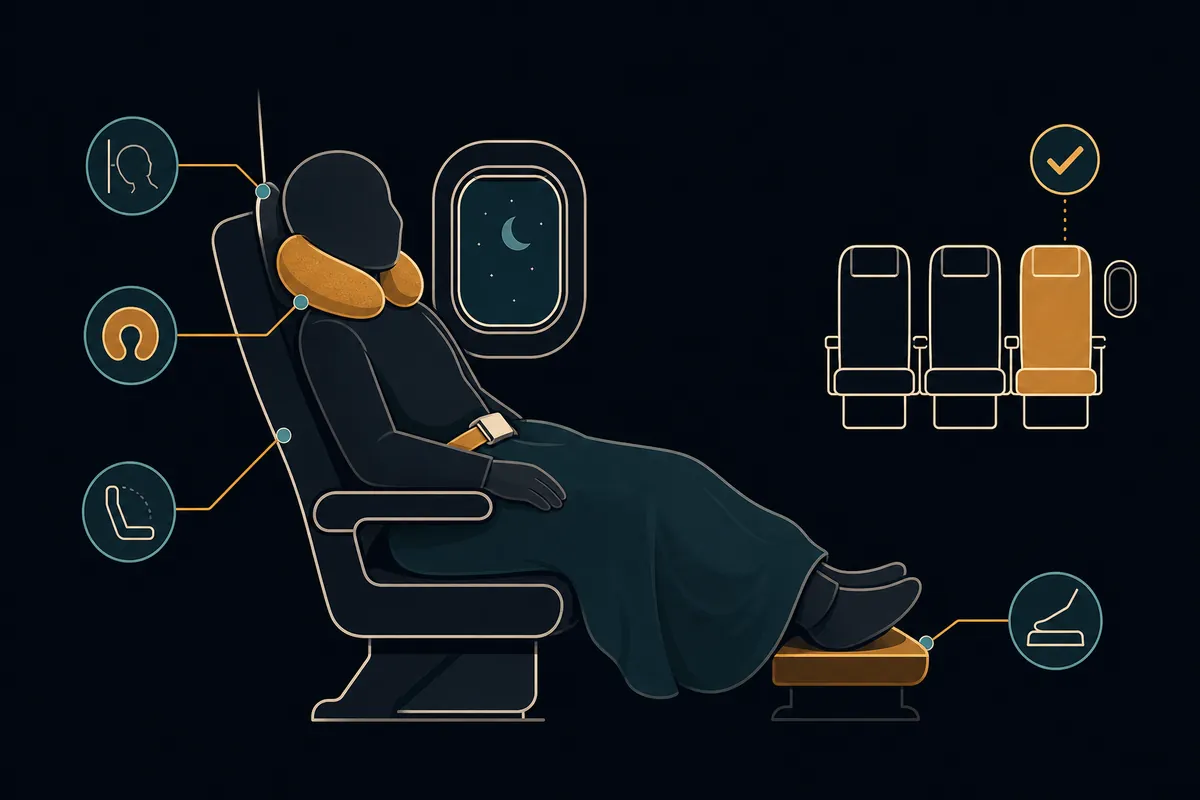
Window seat, aisle, or middle: which seat is best for sleeping on a plane?
The window seat is the clear winner for in-flight sleep. It gives you a wall to lean your head against, eliminates disturbance from seatmates needing to get up, and lets you control the window shade. The middle seat is the worst choice: no wall to lean on and you get bumped from both sides. The aisle seat offers easy bathroom access but costs you head support and exposes you to cart traffic and passing passengers throughout the night.
- Window seat: wall support for head, no forced wake-ups from seatmates, shade control
- Aisle seat: easy exits, but exposed to cart bumps and no head support
- Middle seat: avoid entirely if sleep is a priority
- On overnight / red-eye flights, window plus bulkhead or exit-row extra legroom is ideal
- Book window seats early — they fill first on popular red-eye routes
Essential gear for sleeping on a plane: what actually works (and what to skip)
Six items cover the full range of sleep disruption on a plane: head support, light, noise, temperature, foot comfort, and chemical assistance. A neck pillow and eye mask alone improve economy sleep dramatically. Noise-canceling headphones are the biggest upgrade for long hauls — they reduce the 85+ dB engine hum that prevents deep sleep more than any other single factor.
| Gear | What it solves | Price / 2026 pick |
|---|---|---|
| Neck pillow (memory foam) | Head-drop, neck pain | $40–$65 / Cabeau Evolution S3 or Trtl |
| Contoured eye mask | Cabin lights, seatmate screens | $10–$30 / Manta Sleep Mask |
| Noise-canceling headphones | Engine hum, cabin noise | $179–$449 / Bose QC Ultra Headphones |
| Foam earplugs | Budget noise reduction | $1–$5 / 3M 1100 or Howard Leight MAX |
| Compression socks | Foot and ankle swelling | $15–$40 / any graduated 15–20 mmHg |
| Melatonin (0.5–3 mg) | Circadian misalignment on red-eyes | $5–$15 OTC / generic or Nature Made |
Trtl vs Cabeau Evolution S3: which neck pillow is best for airplane sleep?
Both the Trtl and the Cabeau Evolution S3 are the two most recommended neck pillows in 2026 editor reviews. Wirecutter (2026) gives its top slot to the Trtl for its slim pack size and rigid internal support that holds your head upright without bulk. CNN Underscored (updated March 22, 2026) names the Cabeau Evolution S3 its overall best pick, citing superior memory-foam comfort and packability via its compression pouch. Neither is objectively better — your sleeping style determines which wins.
- Trtl: best if you sleep upright with your head tilted forward or have a shorter neck
- Cabeau Evolution S3: best if you sleep leaning sideways against a window or seat
- Both pack smaller than a traditional horseshoe pillow
- Avoid inflatable pillows: they provide minimal firm support and deflate mid-flight
| Feature | Trtl Pillow | Cabeau Evolution S3 |
|---|---|---|
| Design | Fleece wrap with internal rigid support frame | U-shaped memory foam with raised chin rest |
| Best sleeping position | Upright, head slightly forward | Side lean, window rest |
| Packed size | Very small, clips to bag strap | Compresses into included carry pouch |
| Price (2026) | ~$60 | ~$40–$50 |
| 2026 editors' pick | Wirecutter Top Pick | CNN Underscored #1 Overall |
Should you recline your seat to sleep on a plane?
Yes — recline your seat fully. Even a modest 10–15 degree recline shifts your center of gravity back enough to reduce the effort your neck muscles expend holding your head up, meaningfully improving sleep quality. You have paid for the recline function and it is entirely within your rights to use it. The only exception is meal service: briefly return to upright as a courtesy, then recline again. Do not let social pressure from the passenger behind you override a legitimate comfort feature.
- Recline as soon as the seat-belt sign turns off on long flights
- Return to upright during meal service — a short courtesy window, not a permanent concession
- Exit rows and bulkhead seats often cannot recline; check before booking
- Premium economy reclines 35–40 degrees, significantly better for sleep than standard economy 18 degrees
How much melatonin should I take on a flight?
Take 0.5 mg to 3 mg of melatonin 30–60 minutes before your target sleep time on the plane, not your departure time. A 2026 doctor-reviewed protocol confirms the 0.5–3 mg range and stresses timing to your destination bedtime rather than your home time zone. Start with 0.5 mg if you have never used melatonin — higher doses increase grogginess without proportionally improving sleep onset. Do not take melatonin for the first time on a plane.
- Effective dose: 0.5–3 mg (lower is often sufficient; avoid the common 5–10 mg OTC tabs)
- Timing: 30–60 minutes before you want to fall asleep on the plane, not at takeoff
- Eastbound flights benefit most; westbound travelers may not need it
- Avoid combining with alcohol — the interaction amplifies grogginess
- First-time users: test at home before any travel to check for adverse reactions
What to eat, drink, and wear to sleep better on a plane
The biggest controllable variables outside gear are food, hydration, and clothing. Dress in layers — aircraft cabin temperatures range from 68°F to 77°F and change during the flight; a light hoodie or travel blanket covers the gap. Remove your shoes to reduce foot swelling, and elevate feet slightly on your carry-on bag if the seat in front allows it.
- Stop caffeine 6+ hours before your target in-flight sleep time
- Dress in layers: lightweight joggers or travel pants plus a zip hoodie or wrap
- Remove shoes; compression socks reduce swelling better than bare feet
- Stay hydrated with water — cabin humidity is 10–20%, far drier than most indoor environments
- Eat a light meal before boarding rather than a heavy in-flight meal, which delays sleep
Does alcohol help you sleep on a plane?
No. Alcohol is the single most common sleep mistake on flights. It causes fragmented REM sleep and dehydrates you, leaving you more groggy on arrival than if you had skipped it entirely. The already dry cabin air — humidity sits at 10–20% — makes dehydration worse. Travelers who skip alcohol on red-eyes consistently arrive more rested than those who drink to get drowsy. If you want a drink for other reasons, limit it to one and pair it with at least two glasses of water.
Packing light for the trip? See airline baggage fees compared before you check a bag. And use the Leave-By Time calculator to build a calm morning — arriving at the airport relaxed makes it easier to settle in and sleep once you board.
Sources: CNN Underscored, best travel pillows (March 22, 2026); Wirecutter, best travel pillow (2026); Ubiehealth, melatonin doctor protocol (March 2026); Bose, noise-canceling headphones for travel; Timeshifter, melatonin for jet lag.
Know exactly when to leave for your flight
Good in-flight sleep starts with a calm morning. Enter your airport and flight time and the Leave-By Time calculator folds in live TSA wait times, your drive, and parking — so you arrive relaxed, not rushed.
Calculate my Leave-By Time →