Security
Traveling with a baby through airport security: formula, breast milk, and more
By the TSA Wait Times team · Updated · Published June 2026
Baby formula, breast milk, toddler drinks, and puréed baby food are all exempt from the TSA 3-1-1 liquid rule — you may carry any quantity in your carry-on with no quart-bag required. Declare these items at the checkpoint before screening begins, expect a routine explosives swab, and know the gear rules for strollers and car seats before you reach the lane.
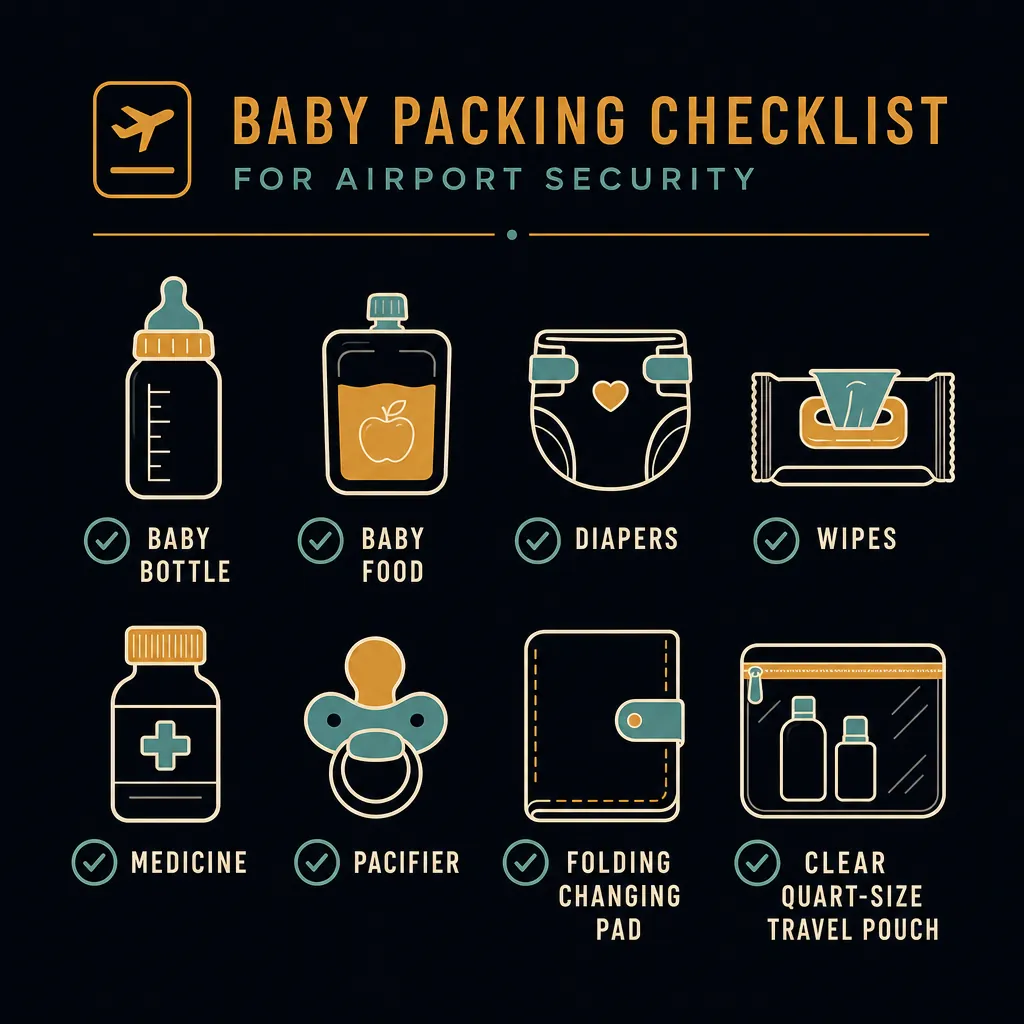
Formula, breast milk, and baby food are fully exempt from the 3-1-1 rule
Formula, breast milk, toddler drinks, and baby/toddler food — including purée pouches — may travel in your carry-on in any quantity and do not need to fit inside a quart-sized bag. TSA classifies these as medically necessary liquids, placing them entirely outside the standard 3.4-ounce-per-container limit that governs everything else in your bag. See the full 3-1-1 carry-on liquids rule if you need a refresher on what that limit covers.
Cooling accessories — ice packs, freezer packs, and gel packs — are also exempt and are allowed even if no breast milk is present in the container. Crucially, your child does not need to be traveling with you for these rules to apply; pumping parents on solo trips have the same protections.
- Any quantity allowed — no volume cap on formula, breast milk, or baby food
- No quart-sized bag required
- Ice packs and gel packs allowed even without breast milk present
- Baby does not need to be on the same flight
How to declare baby items at the security checkpoint — the right order matters
Tell the TSA officer at the very start of the interaction — before placing anything on the belt — that you are carrying formula, breast milk, toddler drinks, or baby food in quantities over 3.4 ounces. TSA guidance is explicit on sequence: announce first, then remove those items from your carry-on so they can be screened separately from the rest of your belongings.
Clear, translucent bottles are recommended over pouches or opaque plastic bags because they work with the Bottle Liquid Scanner; pouches may require additional alternate testing. Announcing proactively and separating the containers yourself is the single biggest factor in minimizing checkpoint delays.
- Announce before placing bags on the belt — not after
- Remove formula and breast milk containers from carry-on for separate screening
- Use clear translucent bottles when possible; pouches may need extra processing
- Diaper bag counts as one bag — most US carriers allow it in addition to a carry-on and personal item
How TSA screens breast milk and formula — and what the swab test means
TSA officers may test breast milk, formula, and puréed food for explosives using Explosive Trace Detection — the officer swabs the outside of the container or your hands and runs it through a detector. This is a routine, non-invasive step and does not contaminate the liquid; TSA policy explicitly states that screening will never involve placing anything inside a medically necessary liquid.
TSA X-ray machines are considered safe for food and medicines, including breast milk, per official TSA guidance. However, if you prefer not to X-ray your breast milk or formula, you have the right to request alternative screening — be aware that opting out shifts additional procedures (Advanced Imaging Technology body scan or pat-down) to you personally, extending your time at the checkpoint.
- Swab test checks the outside of containers for explosive residue — not the liquid itself
- Nothing will ever be placed into your breast milk, formula, or baby food
- X-ray is safe for breast milk and formula per TSA
- Opting out of X-ray is your right — but you will then receive a personal AIT scan or pat-down
Stroller, car seat, diaper bag, and baby carrier: checkpoint rules at a glance
Each piece of baby gear is treated differently at the checkpoint. Strollers, car seats, and baby carriers must all go through the X-ray machine; items too large for the belt undergo a visual or physical inspection instead. Infants must be removed from strollers and car seats and carried in arms through the walk-through metal detector — the baby is never placed on the belt and is never separated from the parent.
| Item | Screening method | Key notes |
|---|---|---|
| Standard stroller | X-ray belt; visual/physical inspection if too large | Empty all pockets and baskets before sending through |
| Umbrella stroller | X-ray belt | Usually fits; fold flat |
| Car seat | X-ray belt; visual/physical inspection if too large | Gate-check is free on most US airlines; or carry on if child has a seat |
| Baby carrier / wrap / sling | Walk-through metal detector; may trigger additional screening | Carrier hardware can set off alarm; pat-down possible |
| Diaper bag | X-ray belt like any carry-on | Counts as one bag; most US airlines allow as extra bag beyond carry-on + personal item |
| Infant (in arms) | Parent carries through WTMD | Baby never separated from parent; never placed on belt or in bin |
A car seat can be gate-checked free on most US carriers or brought as an additional carry-on if a seat was purchased for the child. Also see the dedicated guide on traveling with a stroller and car seat for airline-by-airline fee and gate-check policies.
What triggers secondary screening when traveling with a baby
Secondary screening is most likely in three situations: wearing your baby in a carrier or wrap through the walk-through metal detector (carrier hardware or your holding position can trigger the alarm), choosing to opt out of X-raying breast milk (which shifts additional screening — AIT body scan or pat-down — to you), or setting off the WTMD with a child in arms.
TSA does have modified screening procedures specifically designed to reduce the likelihood of a full pat-down for infants and young children; children 12 and under are also not required to remove shoes. The final screening decision rests with the TSA officer on duty, and parents can cite the BABES Enhancement Act (signed 2025) if they believe rules are being applied incorrectly.
- Baby carrier or wrap worn through WTMD — most common cause of additional screening
- Opting out of X-ray for breast milk — triggers AIT or pat-down for the parent
- WTMD alarm while holding baby in arms — requires resolution before proceeding
- Children 12 and under do not need to remove shoes; TSA modified procedures minimize pat-downs for young children
2025 BABES Enhancement Act: new federal protections for breastfeeding parents
The Bottles and Breastfeeding Equipment Screening Enhancement (BABES) Enhancement Act was signed into law in late November 2025, strengthening the original 2016 BABES Act. The updated law requires TSA to publish clear, updated screening rules for breast milk, formula, baby food, and pumping equipment; train officers consistently so policies are applied uniformly at every airport; maintain hygiene standards when physically handling these items; clearly communicate parents' rights at the checkpoint; and update guidance every five years as technology evolves.
The law was endorsed by March of Dimes, ACOG, MomsRising, and the Society for Maternal-Fetal Medicine. For travelers, this means parents who encounter inconsistent or incorrect TSA treatment now have stronger grounds to reference federal policy on the spot.
- Signed into law late November 2025 (announced December 2, 2025)
- Requires consistent TSA officer training across all US airports
- TSA must maintain hygiene standards when handling breast milk, formula, and ice packs
- Parents' rights must be clearly communicated at the checkpoint
- Guidance must be updated every 5 years to reflect new screening technology
Practical tips to move through the family lane faster
Most major airports have dedicated family or special assistance lanes — look for signage near the standard checkpoint entrance or ask a TSA officer before joining the general queue. Arriving 15–20 minutes earlier than your usual buffer is advisable when traveling with an infant for the first time.
TSA PreCheck does not eliminate the need to declare or separately screen medically necessary liquids, but it does remove shoe removal, laptop unpacking, and the AIT body scan for most passengers, meaningfully reducing the number of tasks when you also have a baby to manage. If you have concerns about the screening process in advance, TSA Cares can be reached at (855) 787-2227 at least 72 hours before your flight.
- Look for family or special assistance lanes at the checkpoint entrance
- Pre-pack breast milk and formula in a separate clear pouch for fast one-step removal from your bag
- TSA PreCheck reduces overhead but does not skip declaration or screening of baby food items
- Gate-check the stroller curbside or at the gate to reduce bin-juggling at security
- Call TSA Cares at (855) 787-2227 at least 72 hours out if you anticipate needing extra assistance
More questions about traveling with a baby through TSA:
Does my baby need to be with me to bring breast milk or formula through TSA?
No. TSA policy explicitly states that your child or infant does not need to be present or traveling with you — pumping parents on solo business trips, or those carrying milk to ship home, have the same exemptions as parents traveling with their infant.
Does X-ray damage breast milk or formula?
TSA states its X-ray machines do not adversely affect food or medicines, including breast milk and formula. If you prefer not to X-ray these items, you may request alternative screening, but expect additional personal screening — an AIT body scan or pat-down — as a result of opting out.
Can I bring frozen breast milk and ice packs through airport security?
Yes. Frozen breast milk and all cooling accessories — ice packs, freezer packs, and gel packs — are allowed in carry-on in any quantity regardless of whether breast milk is currently in the container. Declare them together with your other medically necessary liquids at the start of screening.
Sources: TSA — Breast Milk · TSA Cares — Traveling with Children · BABES Enhancement Act (House) · S.260 (Congress.gov). Verified .
Know your Leave-By Time before you pack the diaper bag
Enter your airport and departure time and the calculator stacks today's live TSA wait, your drive, and parking into the one moment to walk out the door — so you arrive calm, not rushed.
Calculate your Leave-By Time →Keep planning
Security
How long does airport security really take?
Most travelers clear standard screening in 15 to 30 minutes — but the hour you pick changes everything.
SecurityWhat you can (and can't) bring through security
Liquids, laptops, snacks, and the things that surprise people — a plain-language packing check before you go.
SecurityCarry-on liquids: the 3-1-1 rule, explained
3.4 ounces, one quart bag, one per traveler — plus the exceptions for medications and baby formula.
SecurityAirport security tips for families with kids
From stroller gate-checks to formula at the X-ray belt — everything parents need to know to move a family through TSA quickly.