Security
Airport security tips for families with kids
By the TSA Wait Times team · Updated · Published June 2026
Flying with children adds a layer of gear — strollers, formula, car seats, juice boxes, tablets — that can turn a straightforward security lane into a stressful bottleneck. The good news: TSA has clear, parent-friendly rules for most of it. Know them before you arrive, and the checkpoint becomes the easiest part of the airport. Here is everything families need to know, from baby liquids at the X-ray belt to getting kids through the scanner without a meltdown.
Formula, breast milk, and juice are exempt from the 3-1-1 rule — bring as much as your baby needs
TSA exempts formula, breast milk, toddler juice, and water used to mix formula from the standard 3.4-ounce / 100-ml 3-1-1 limit. There is no fixed maximum quantity — bring a reasonable amount for the length of your trip. Declare these liquids to the officer before you reach the X-ray belt and remove them from your bag for separate screening. TSA may run a vapor-residue or chemical test on the containers; agents are not permitted to insert anything into the liquid itself.
| Liquid type | 3-1-1 required? | Notes |
|---|---|---|
| Infant formula (powder or ready-to-feed) | No | Any quantity; declare at checkpoint |
| Breast milk | No | Any quantity; ice packs to keep it cold also exempt |
| Infant/toddler juice | No | Apple, pear, grape etc. — any container size |
| Water for mixing formula | No | Reasonable amount; may be tested |
| Adult water bottle | Yes | Must be empty or ≤3.4 oz to clear checkpoint |
| Adult beverages / sunscreen | Yes | Must be ≤3.4 oz in quart-sized bag |
- Say “I have formula and breast milk” out loud before placing items on the belt
- Remove baby liquids into a separate bin — do not leave them buried in the diaper bag
- Ice packs and gel packs used to keep breast milk cold are also exempt if frozen solid; slushy packs may be inspected
- If an agent tells you to discard a legal amount, politely ask for a supervisor — the policy is on your side
Kids 12 and under do not have to remove shoes at TSA — or headwear
Children 12 and under can keep their shoes, headwear, and light jackets on when walking through the standard metal detector — no exceptions or special lanes required. If a child is directed to the full-body scanner (AIT), light jackets must come off and go into a bin, but shoes still stay on. This rule is a stable TSA policy confirmed on the agency's Traveling with Children page and applies at every U.S. airport checkpoint. Adults still follow standard rules: shoes off, belts off, laptops and electronics out.
- Shoes: stay on regardless of which machine (metal detector or body scanner)
- Light jacket: stays on for metal detector; must be removed for AIT body scanner
- Headwear: stays on through metal detector; may need adjustment if the body scanner alarms
- Age 13+: standard adult rules apply — plan a PreCheck membership for your teen
Strollers and car seats go through the X-ray belt — fold before you reach the conveyor
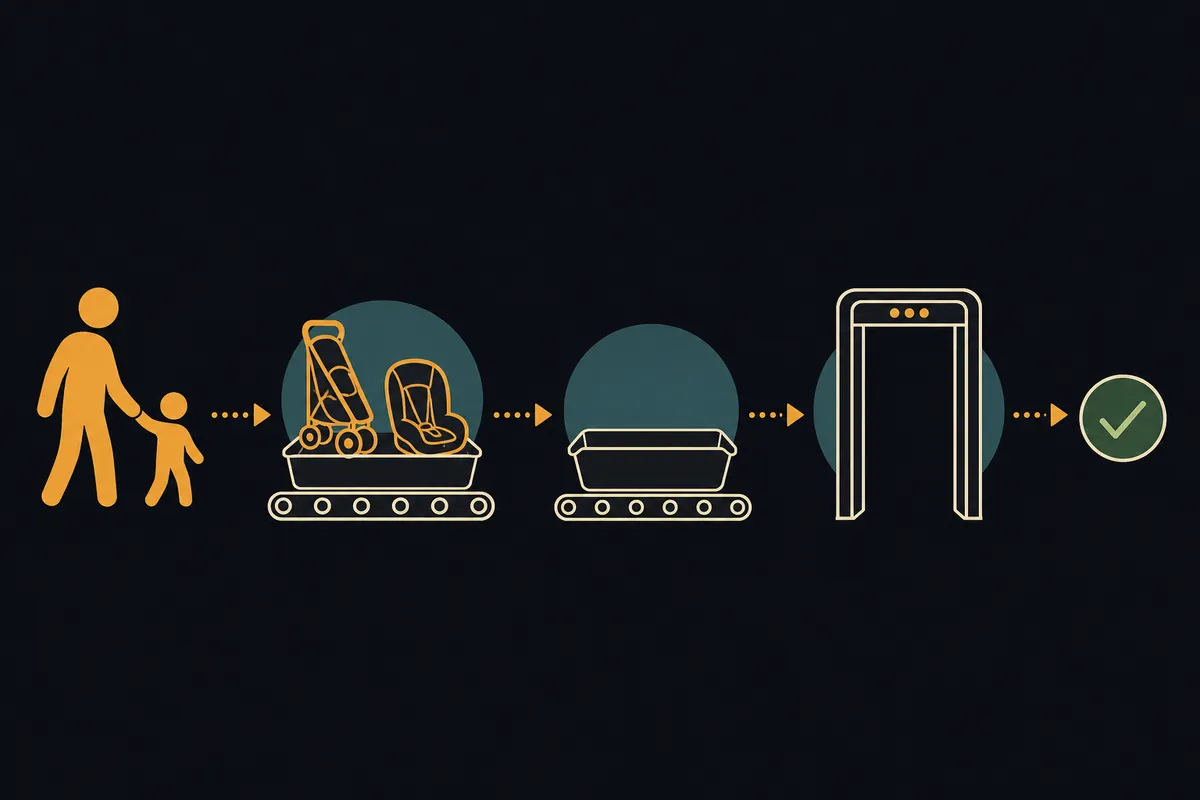
All strollers, car seats, booster seats, and blankets must be placed on the X-ray belt or undergo a physical pat-down — there are no exceptions. Fold your stroller completely before you approach the conveyor so you're not the bottleneck at the checkpoint. Gate-checking the stroller happens at the aircraft door after security, not at the security lane, so it still passes through X-ray on the way in. A soft carrier or baby wrap worn on your body goes through the metal detector with you and triggers a secondary hand-swab test on both you and your child.
- Collapse the stroller early — practice at home if it's a new model
- Car seat on the belt: lay it sideways if it fits, or ask an officer for guidance on a physical screen
- Baby in soft carrier: use the metal detector lane, not the body scanner — you will both receive a hand swab
- Baby in arms: walk through the metal detector; officer will guide you
How to use family lanes and TSA PreCheck to cut your checkpoint time in half
Many large and mid-size airports designate family screening lanes — look for signs at the checkpoint entrance marked “Families” or “Special Needs.” These lanes are staffed by officers accustomed to extra gear and slower-moving groups. TSA PreCheck is the biggest single upgrade for traveling families: the lane is shorter, laptops and liquids stay in bags, and shoes stay on for everyone — kids 12 and under travel free under a parent's Known Traveler Number (KTN) with no separate membership required until age 13. For a full breakdown of your options, see PreCheck vs. CLEAR vs. Global Entry.
- TSA PreCheckadult membership: ~$78 for 5 years; children 12 and under are free on a parent's KTN
- CLEAR: children under 18 travel free with a subscribed parent — gets you to the front of the ID-check line, not the X-ray line
- Global Entry includes PreCheck; children need their own Global Entry at any age (but can use parent's PreCheck lane)
- At busy airports (ATL, LAX, JFK, ORD) PreCheck can save 20–30 minutes on peak travel days
Put adults through the scanner first — then guide kids through one at a time
The best tactic for moving a family through the body scanner or metal detector without a scene is to send adults first so children see that walking through is uneventful. One adult proceeds through, turns around, and calls the child by name to walk toward them — this frames the scanner as a doorway, not an obstacle. If a child becomes distressed at any point, you can request a private screening room and TSA is required to provide one. Officers are trained in modified, child-appropriate screening procedures.
- Adult goes first — child follows, walking toward the waiting adult on the other side
- Never send a child through alone while both parents are still in the queue
- Request a private room the moment a child becomes frightened — do not wait for the situation to escalate
- TSA Cares helpline (855-787-2227) can be called 72 hours before travel to arrange passenger support for children with disabilities or sensory sensitivities
What to pack where: a family security-screening carry-on strategy
The single biggest time-waster at family security is digging for items that need to come out of bags. Pack baby liquids in the outer pocket or top-zip of your diaper bag so they can be pulled in one motion. Keep kids' tablets and portable gaming devices in their own mesh pouch since they require a dedicated bin in standard lanes (PreCheck exempts them). Solid snacks — crackers, fruit, granola bars — have no quantity restriction and need no bin.
- Outer pocket: formula, breast milk, juice, ice packs
- Separate mesh pouch: tablets, handheld gaming consoles (standard lanes only)
- Waist belt or jacket pocket: your ID and boarding passes — don't bury them
- Stroller footrest or under-seat basket: clear it completely before security — it all goes on the belt
- Easy-off shoes for adults — children 12 and under never need to remove theirs
One more common question at the checkpoint:
What if my child gets upset during TSA screening?
Ask any TSA officer for a private screening room at any point — the agency is required to provide one. You can also call TSA Cares (855-787-2227) up to 72 hours before your flight to arrange advance passenger support, especially helpful for children with disabilities or sensory needs.
Know your leave-by time before you leave home
The Leave-By Time calculator stacks today's live TSA wait at your airport, your drive, and parking into one exact time to walk out the door — so you're never guessing whether you have enough runway.
Calculate your Leave-By Time →Sources: TSA — Formula & breast milk FAQ; TSA — Traveling with Children. Last verified .
Keep planning
Security
How long does airport security really take?
Most travelers clear standard screening in 15 to 30 minutes — but the hour you pick changes everything.
SecurityWhat you can (and can't) bring through security
Liquids, laptops, snacks, and the things that surprise people — a plain-language packing check before you go.
SecurityCarry-on liquids: the 3-1-1 rule, explained
3.4 ounces, one quart bag, one per traveler — plus the exceptions for medications and baby formula.
SecurityAirport security tips for seniors and travelers with mobility aids
Pacemakers, hip replacements, wheelchairs — TSA has specific procedures for medical devices. Here is what to expect.