Baggage
Flying with a stroller and car seat: what to know
By the TSA Wait Times team · Updated · Published June 2026
The good news: strollers and car seats are always free to check on every major US airline — they do not count toward your baggage allowance and are never subject to bag fees regardless of fare class. The surprise most families hit on their first trip is where the stroller ends up after landing: unless you ask at the gate, it goes to the baggage carousel, not back to the aircraft door. Here is everything you need to know from curb to gate — and gate back to curb.
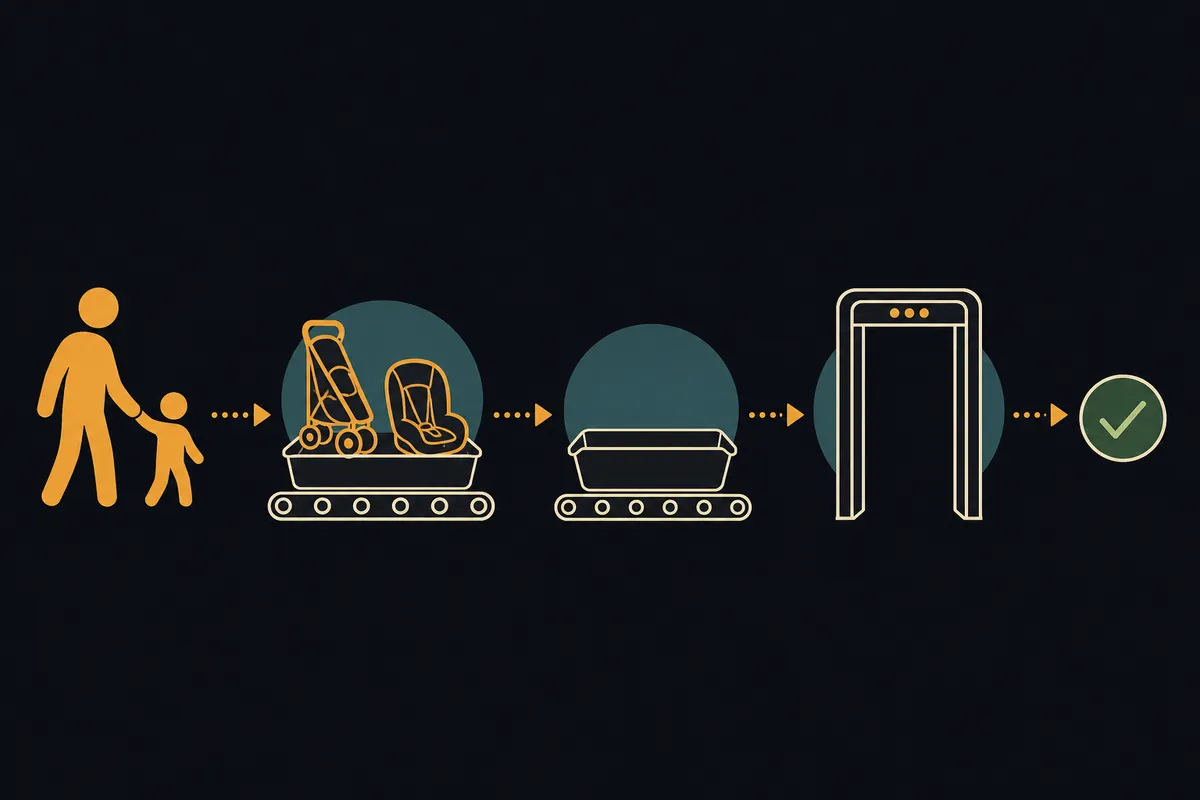
Strollers and car seats are always free to check — here is what that covers
Every major US airline exempts one stroller and one car seat per child from standard baggage fees. This applies whether you check at the curb, ticket counter, or gate. The items do not count toward your checked-bag allowance and you are not charged even on basic-economy fares. Both items are transported under a limited liability release, which is why protective bags and photos before hand-off matter.
- One stroller per child + one car seat per child = free on all carriers
- Free at curb, ticket counter, or gate on most airlines
- Limited-release liability means airlines cap what they reimburse for damage — document gear before check-in
| Airline | Gate check? | Default return / notes |
|---|---|---|
| American | Yes — under 20 lbs / collapsible only | Baggage claim; 20 lbs+ must go at ticket counter |
| Delta | Yes | Baggage claim; request jet bridge if no connection |
| Southwest | Yes | Baggage claim by default — ask agent for jet-bridge return |
| United | Yes | Baggage claim; compact collapsible may go in overhead |
| JetBlue | Yes | Baggage claim; verify seat compatibility in advance |
| Frontier | Yes | Baggage claim; car seats must go in window seat if used onboard |
| Alaska | Yes | Baggage claim; lap-infant with open adjacent seat may use car seat free |
Fees and policies verified June 2026. For a full breakdown of airline bag fees, see airline baggage fees compared.
Gate check vs. ticket-counter check: which should you choose?
Gate-checking is the right move for most families with a compact stroller — you use the stroller all the way to the aircraft door, hand it off, and (if you ask) retrieve it the moment you step off the plane at your destination. Counter-checking removes the stroller from your hands at check-in and sends it to the oversized-baggage carousel, which adds 10–20 minutes at pickup. However, counter-checking offers better protection for expensive gear because the bag goes through standard handling rather than last-minute gate-side loading.
- Gate check best for: lightweight umbrella strollers, quick domestic trips, families who need the stroller through the airport
- Counter check best for: large travel-system strollers, jogging strollers, expensive gear you want bagged and protected
- Jogging strollers and frames over 20 lbs (per American) typically must go at the ticket counter or curbside as oversized
Does your gate-checked stroller come back at the jet bridge — or baggage claim?
This is the most common surprise for first-time traveling parents: on most airlines, a gate-checked stroller goes to the baggage carousel by default, not back to the aircraft door. You must tell the gate agent at departure that you want it returned to the jet bridge at your destination. Confirm again with the flight attendant after boarding. At connecting airports the same request applies — without it, the stroller is checked through to your final destination's carousel.
- Always ask: “Can you tag this for jet-bridge return at [destination]?”
- At connections, specify which city: “Return to jet bridge in Dallas, not final destination”
- Southwest explicitly confirms: gate-checked items go to baggage claim unless you request the jet bridge
FAA rules for using a car seat on the plane
To use a car seat onboard, your child must have a paid seat — lap infants cannot sit in a car seat unless an adjacent seat happens to be empty and the crew approves. The car seat must carry the label “This restraint is certified for use in motor vehicles and aircraft.” Car seats must always go in a window seat so they do not block other passengers' emergency egress. Infant-seat bases are generally not approved for aircraft use; bring only the infant carrier shell. Most coach seats are 16 inches wide, so confirm your seat's dimensions against your car seat's manual before flying.
- Label to look for: “This restraint is certified for use in motor vehicles and aircraft” (usually red lettering, on the seat side or back)
- Window seat only — center and aisle seats are prohibited
- Car seats are never allowed in emergency exit rows
- Delta One flatbed seats: federal regulation prohibits child safety seats there
- Bring the infant carrier shell, not the base — most bases lack aircraft certification
Which car seats are NOT FAA-approved? Boosters and rotating seats
Booster seats — including all-in-one seats used in booster mode — are not FAA-certified for aircraft use. Children who normally ride in a booster should sit in the airplane seat with the standard lap belt fastened. Several rotating/swivel convertible seats also lack aircraft approval: the Nuna REVV, CYBEX Sirona S, Safety 1st Turn and Go 360, and the Graco Turn2Me and Baby Jogger City Turn in rear-facing mode (forward-facing mode only is permitted). Always check the physical label on your car seat; do not rely solely on the model name.
- Booster seats: NOT FAA-approved in any configuration
- Nuna REVV: NOT approved
- CYBEX Sirona S: NOT approved
- Graco Turn2Me / Baby Jogger City Turn: rear-facing NOT approved; forward-facing only permitted
- CARES harness (Kids Fly Safe): FAA-approved alternative for children 22–44 lbs and up to 40 inches tall — no seat purchase required, but no use at destination
How to protect your stroller and car seat from airline damage
Airlines transport gate-checked gear with limited liability, meaning reimbursement is capped and claims require documentation. Take clear photos of your stroller and car seat — including any existing scratches — before handing them off. For car seats being counter-checked, a padded travel bag is the most effective protection; the JL Childress padded backpack bag ($52–53) fits most convertible seats and folds small enough to pack in luggage on the return. For strollers, brand-specific bags from Nuna and UPPAbaby include damage guarantees. Label all items with your name, phone, and flight number before drop-off.
- Photo documentation is required for any damage claim — do it at the gate, not the parking garage
- JL Childress padded backpack bag (~$52): fits most convertible seats, backpack straps, folds compactly
- JL Childress wheeled bag (~$63): easier to roll through airports for heavier seats
- UPPAbaby Rove bag (~$139): highly padded, wheeled, fits broad range of brands including Cybex
- GoGo Kidz TravelMate: attaches car seat to wheeled base for airport transit — popular for travel systems
- Label gear at the gate, not at home — attach name, phone, email, and flight number directly to the item
Know your Leave-By Time before you pack
Traveling with kids adds time at every step — stroller drop-off, car-seat installation, security lines. The Leave-By Time calculator folds in today's live TSA wait at your airport plus your drive so you can leave home with the right amount of cushion.
Calculate your Leave-By Time →Policies and data verified . Sources: Southwest stroller policy, Delta children's baggage, FAA child safety seats, Safe in the Seat FAA approvals, American Airlines traveling with children.
Keep planning
Baggage
Airline baggage fees, compared
What every major airline charges for carry-on and checked bags in 2026 — including Southwest, which dropped free bags.
BaggageHow to avoid checked bag fees
Credit card waivers, airline status perks, and packing tricks that keep bag fees off your bill.
BaggageOversize and overweight baggage fees by airline (2026)
Bags over 50 lbs or 62 linear inches cost $100–$200 extra — here is what each major US airline charges.
BaggageCarry-on size limits by airline (2026)
Maximum carry-on and personal item dimensions for every major US airline — and which base fares include a carry-on.