Guide
How long does airport security really take?
By the TSA Wait Times team · Updated · Published June 2026
Most travelers clear standard security in about 15 to 30 minutesat a big U.S. airport. The early-morning and late-afternoon rushes can push that past 40, while a quiet midday can drop it under 10. Here's what to expect by the hour, and how much PreCheck, Global Entry, and CLEAR really save.
The short answer: 15 to 30 minutes, most of the time
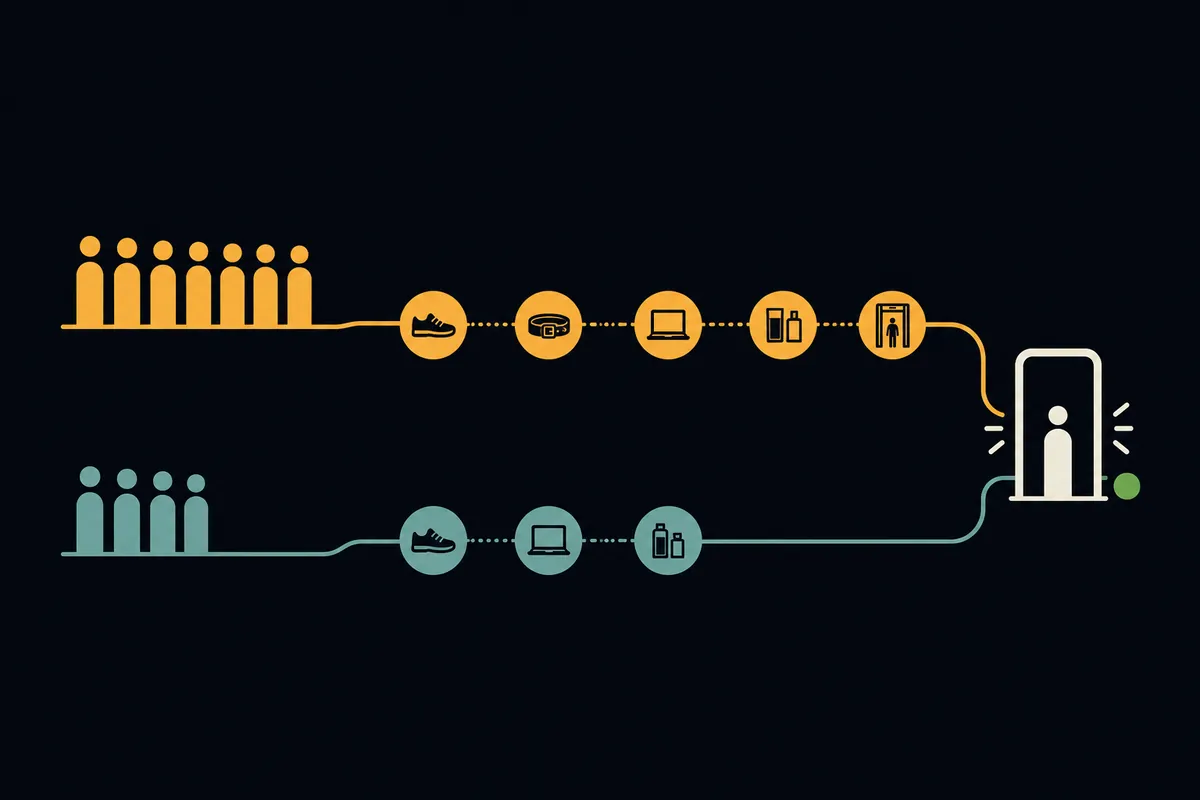
For a typical domestic trip, plan on about 15 to 30 minutes in the standard line. That covers the queue, the ID check, and the scanner. With TSA PreCheck, most people are through in under 10 minutes any time of day.
Those are averages, though. The line you actually stand in depends on the hour you walk up, your airport, and how many checkpoints are open. That's why a live number beats any rule of thumb — you can see today's wait and forecast for your airport on its hub page, like Atlanta (ATL), Los Angeles (LAX), or Chicago O'Hare (ORD).
Quick take:standard line, 15–30 min. PreCheck, under 10. Check your airport's live wait before you trust either.
Typical security waits by time of day
The hour you pick matters more than the day of the week. Big hubs fill up around two daily peaks — the early-morning bank (when the first wave of flights pushes out) and the late-afternoon bank. Here is the pattern you can expect at a large airport on a normal day:
| Time of day | Standard line | PreCheck |
|---|---|---|
| 5–7 AM (early rush) | 20–40 min | 5–15 min |
| 7–10 AM | 15–35 min | 5–10 min |
| 10 AM–2 PM (lull) | 10–20 min | under 5 min |
| 2–6 PM (afternoon build) | 15–30 min | 5–10 min |
| 6–9 PM (evening rush) | 20–35 min | 5–10 min |
| After 9 PM | 5–15 min | under 5 min |
These are typical ranges, not promises. Holidays, weather, and a single closed checkpoint can stretch any row. We show live waits where airports publish them and a forecast everywhere else, so you always see the real shape of the day.
How much do PreCheck, Global Entry, and CLEAR really save?
All three skip part of the wait, but in different ways and at different prices. Here's the 2026 lay of the land:
| Program | Price | What it does |
|---|---|---|
| TSA PreCheck | ~$77–$85 5 years | Faster lane; keep shoes, belt, laptop, and liquids packed. Usually under 10 min. |
| Global Entry | $120 5 years | Everything PreCheck does, plus a quick kiosk through customs on the way home. Includes PreCheck. |
| CLEAR Plus | $209 per year | Verifies your ID at a kiosk and walks you to the front of the screening line. You still go through the scanner. |
For most domestic flyers, PreCheck is the best value: roughly $16 a year, and it's the piece that shrinks the actual screening. If you fly internationally even once a year, Global Entry is the smarter buy — it costs a little more and folds PreCheck in for free. CLEAR Plus moves you past the ID-check line, which helps most at airports where that line is long; many travelers pair it with PreCheck rather than choosing one. Want the full breakdown? See PreCheck vs CLEAR — which is worth it.
What still slows the line down in 2026
Screening is faster than it used to be — newer 3D scanners are now in most major hubs, and the shoes-off mandate ended in July 2025. Still, a few rules decide how quickly your bag clears:
- Liquids (the 3-1-1 rule). Containers of 3.4 oz (100 ml) or less, in one quart-size clear bag, one bag per traveler. Unchanged for 2026.
- Laptops. In the standard line you usually still pull a laptop into its own bin. At airports with the newer CT scanners, and in the PreCheck lane, it can stay packed.
- Shoes stay on. Since July 2025 you keep your shoes on at standard checkpoints. An officer may still ask you to remove them if something needs a second look.
- A valid ID. Have your ID and boarding pass in hand before you reach the podium — a fumble at the front holds up everyone behind you.
Pack the quart bag where you can reach it, and you'll glide through almost any line. For the full list, read our flight-day guides.
Set your arrival by today's real number
The old advice — arrive two hours early for domestic, three for international — is a safe floor, not an answer. Some mornings two hours is barely enough; some midday flights need far less. Set your arrival by today's live wait, not a generic rule.
That's exactly what your Leave-By Time does. It counts backward from your flight using the drive with live traffic, today's security wait, and the walk to your gate — so you leave with room to breathe instead of a guess. Not sure how much cushion to give yourself? See how early you should really arrive.
Frequently asked questions
How long does airport security take on average?
At a busy U.S. airport, standard security usually takes 15 to 30 minutes. Early-morning and late-afternoon rushes can push it past 40 minutes, while a quiet midday often drops under 10. The only sure number is today's live wait at your airport.
Does TSA PreCheck really save time?
Yes. TSA says about 99% of PreCheck travelers wait under 10 minutes, and you keep your shoes, belt, laptop, and liquids bag where they are. On a busy morning that can save 20 to 30 minutes over the standard line.
Do I still take my shoes off at security?
No. Since July 2025, you can keep your shoes on at standard TSA checkpoints nationwide. An officer may still ask you to remove them if a scanner flags something or you go to secondary screening.
What is the 3-1-1 rule for liquids?
Liquids, gels, and aerosols in your carry-on must be 3.4 ounces (100 ml) or less, all fitting in one quart-size clear zip-top bag, one bag per traveler. The rule has not changed for 2026.
How early should I get to the airport?
TSA suggests arriving two hours early for domestic flights and three hours for international. The smarter move is to set your arrival by today's real security wait, then count backward to your Leave-By Time.
You know the typical wait. Now get the exact minute to walk out your door — built from today's live security number and drive time.
See your Leave-By Time →Keep planning
Security
What you can (and can't) bring through security
Liquids, laptops, snacks, and the things that surprise people — a plain-language packing check before you go.
SecurityCarry-on liquids: the 3-1-1 rule, explained
3.4 ounces, one quart bag, one per traveler — plus the exceptions for medications and baby formula.
SecurityAirport security tips for families with kids
From stroller gate-checks to formula at the X-ray belt — everything parents need to know to move a family through TSA quickly.
SecurityAirport security tips for seniors and travelers with mobility aids
Pacemakers, hip replacements, wheelchairs — TSA has specific procedures for medical devices. Here is what to expect.