Baggage
How to gate-check a bag: when, how, and what to expect
By the TSA Wait Times team · Updated · Published June 2026
Gate-checking is free on most U.S. airlines — even for Basic Economy fares on Delta and American — but United Basic Economy passengers must pay a carry-on fee at the gate, making it the one major carrier where the gate-check benefit disappears. Knowing when it happens, how the handoff works, and where to collect your bag turns a potential boarding-area scramble into a non-event.
What does it mean to gate-check a bag?
Gate-checking means handing your carry-on to airline staff at the jet bridge entrance — after security, after the gate area — where it is tagged and loaded into the aircraft's cargo hold rather than the overhead bin. Unlike a bag dropped at the ticket counter, a gate-checked bag is processed at the last possible moment before you board. The key practical difference is that on most flights your bag is returned to you at the aircraft door upon arrival, not at the baggage carousel.
When will an airline ask you to gate-check your bag?
Three distinct situations trigger a gate check: you are boarding a small regional aircraft (ERJ-145, CRJ-200, Dash 8) whose overhead bins are physically too narrow for a standard rolling carry-on; the bins on a mainline flight fill before you board and the airline needs to clear space; or the gate agent calls for volunteers before the boarding groups begin scanning. On regional jets the announcement is essentially automatic — crew will direct nearly every passenger with a rolling bag to leave it at the jet bridge.
- Regional jets (ERJ-145, CRJ-200, Q400 Dash 8): overhead bins too small for most rolling carry-ons — gate check is automatic for almost all passengers
- Full mainline flights: airline calls for volunteers early, then involuntary gate checks begin with lower boarding groups
- Voluntary gate check: you can ask any gate agent to tag your bag before final boarding call — free on most carriers
- Pro tip: if you are boarding last, offer to gate-check preemptively rather than wait to be asked mid-jetbridge
Which airlines charge for gate-checking — and which don't?
Most major U.S. carriers gate-check carry-ons for free regardless of fare class, with one important exception: United Basic Economy fare holders do not receive overhead bin access and must pay a carry-on fee (approximately $25–35) even at the gate. Southwest has never charged a gate-check fee under any fare. Delta and American allow Basic Economy passengers to gate-check at no additional charge when bins are full or they volunteer. Spirit Airlines ceased operations in May 2026 and is no longer relevant.
| Airline | Fare classes | Gate-check fee |
|---|---|---|
| Southwest | All fare classes | Always free |
| Delta | All fare classes including Basic Economy | Free |
| American | All fare classes including Basic Economy | Free |
| United (standard fares) | Main Cabin and above | Free |
| United Basic Economy | No overhead bin access included | ~$25–35 at gate |
| Frontier | Perks bundle or above includes carry-on | Fee may apply (lowest bundles) |
For the full picture of what each carrier charges for checked and carry-on bags, see airline baggage fees compared, or strategies to avoid checked bag fees.
How does the gate-check process actually work?
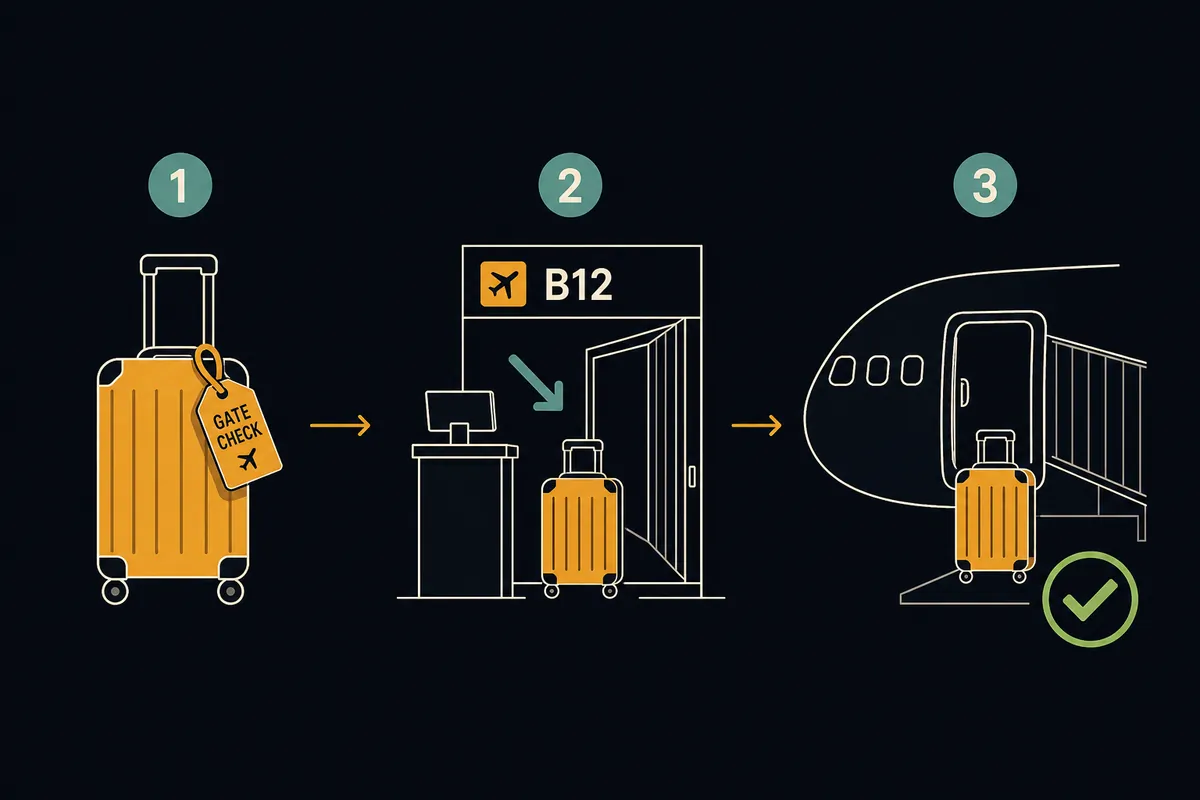
When gate checks are called, approach the podium or the jet bridge entrance before your group scans. An agent will attach a bright gate-check tag — usually a large paper or plastic band — to your bag's handle and hand you a tear-off stub: keep it. You carry the bag down the jet bridge yourself and leave it in the designated area just outside the aircraft door; ground crew then load it into the cargo hold. The entire handoff takes under a minute and you board normally.
- Step 1: Approach gate podium or jet bridge entrance when gate checks are announced
- Step 2: Agent attaches a gate-check tag — keep your tear-off claim stub
- Step 3: Carry bag down jet bridge and leave it at the marked spot outside the aircraft door
- Step 4: Board the aircraft — do not carry the bag on yourself
- Remove any loose straps or fragile attachments before handing over the bag
Where and when do you get your gate-checked bag back?
On most domestic flights a gate-checked bag is returned planeside — you wait just outside the aircraft door on the jet bridge for roughly 5–10 minuteswhile ground crew unload the hold. This is the standard return method for regional jets and any flight where the airline promises planeside return. On a minority of high-volume routes, or if your connection requires the bag to transfer to another aircraft, the airline may route it to the baggage claim carousel instead; always listen for the crew's landing announcement.
- Standard: bag returned at aircraft door (jet bridge) within 5–10 minutes of landing
- Exception: some routes or connections send gate-checked bags to baggage claim — crew will announce this on final approach
- Your tear-off stub is your proof of ownership — have it ready
- If the bag does not appear within 15 minutes planeside, ask the flight attendant or call the airline's baggage service desk
What should you never put in a gate-checked bag?
A gate-checked bag travels in the cargo hold under conditions identical to any checked bag — temperature fluctuation, pressure change, and rough mechanical handling are all possible. Never gate-check prescription medications, medical devices, travel documents (passport, boarding pass, ID), laptops, cameras, or anything fragile or irreplaceable. The TSA and every major airline explicitly recommend keeping valuables and anything you need in-flight in your personal item inside the cabin.
- Prescription medications and medical devices
- Passport, boarding pass, driver's license, and other travel documents
- Laptops, tablets, cameras, and other electronics
- Jewelry, cash, and high-value items
- Fragile items: bottles, glassware, souvenirs
- Anything you may need during the flight: snacks, headphones, neck pillow, charger
Does gate-checking damage bags — and what are your rights?
Gate-checked bags carry the same legal liability as standard checked luggage under DOT rules — airlines are responsible for damage up to $3,800 per passengeron domestic itineraries (the 2026 DOT-adjusted figure). Gate-checked bags are handled quickly and sometimes roughly, especially under time pressure on tight turns. Photograph your bag's condition before handing it off, and if you discover damage after collecting it planeside, report it to the airline's baggage service desk before leaving the airport — claims filed after you exit are almost universally denied.
- Liability cap: up to $3,800 domestic (DOT), up to ~$1,700 international (Montreal Convention)
- Photograph the bag before handing it to staff
- Report any damage at the baggage service desk before leaving the terminal
- Airlines exclude fragile, perishable, and high-value items from liability — document and remove these before gate-checking
If your bag is lost or damaged, how to file a damaged baggage claim walks through the full DOT complaint process. For oversize situations, see oversize and overweight baggage fees.
Quick answers about gate-checking:
What does it mean to gate-check a bag?
Gate-checking means handing your carry-on to airline staff at the jet bridge just before you board. They tag it and load it into the aircraft cargo hold. On most flights it is returned to you at the aircraft door upon arrival — not at baggage claim — typically within 5–10 minutes of landing.
When will an airline ask you to gate-check your bag?
Three scenarios: (1) You are on a small regional jet (ERJ-145, CRJ-200, Dash 8) where overhead bins are physically too small for a rolling carry-on — this is essentially automatic. (2) A mainline flight is full and bins run out of space before your boarding group. (3) You voluntarily ask a gate agent to take your bag before boarding begins, which is allowed on virtually all U.S. carriers.
Which airlines charge for gate-checking — and which don't?
Southwest, Delta, and American gate-check carry-ons for free across all fare classes including Basic Economy. United is the key exception: United Basic Economy passengers do not receive overhead bin access and must pay a carry-on fee (around $25–35) at the gate. Frontier's policy depends on fare bundle — the lowest bundles may carry a fee. Spirit Airlines ceased operations in May 2026.
Where and when do you get your gate-checked bag back?
On most flights your bag is returned planeside — you wait just outside the aircraft door on the jet bridge for 5–10 minutes while ground crew unload the hold. On some high-volume routes or connecting itineraries the airline may route gate-checked bags to the baggage carousel instead; listen for the crew's announcement before landing and keep your gate-check stub.
What should you never put in a gate-checked bag?
Never gate-check prescription medications, medical devices, your passport or travel documents, laptops, cameras, jewelry, cash, or anything fragile. These items should stay in your personal item inside the cabin. A gate-checked bag travels in the cargo hold under the same rough-handling conditions as any checked bag, and airlines exclude fragile and high-value items from damage liability.
Does gate-checking damage bags — and what are your rights?
Gate-checked bags have the same DOT liability protection as standard checked luggage — up to $3,800 on domestic flights. Photograph your bag before handing it over, and report any damage to the airline's baggage service desk before you leave the terminal. Claims filed after you exit the airport are almost always denied. Soft-sided bags generally fare better than hard shells because they can absorb impact.
Related baggage and airline guides
More on what you can bring, what you'll pay, and how to pack smarter:
- Carry-on size limits by airline — exact dimensions before you pack
- Airline baggage fees compared — first-bag fees across every major U.S. carrier
- How to avoid lost luggage — trackers, packing tips, and what the data shows
- Airline check-in and baggage hub — per-airline policies in one place
Airline policies verified . Carrier rules are subject to change; confirm directly with your airline before travel.
See live security wait times at your airport
Get your Leave-By Time — factoring in today's TSA wait, your drive, and your airline's check-in cutoff — in one calculation.
Get my Leave-By Time →