Security
Flying with a wheelchair: DOT rights and how it works
By the TSA Wait Times team · Updated · Published June 2026
Airlines are legally required to provide free wheelchair assistance from curb to seat under the Air Carrier Access Act. A sweeping DOT final rule published December 2024 — phasing in through 2026 — adds mandatory hands-on staff training and stronger liability protections when your chair is damaged or not returned on time.
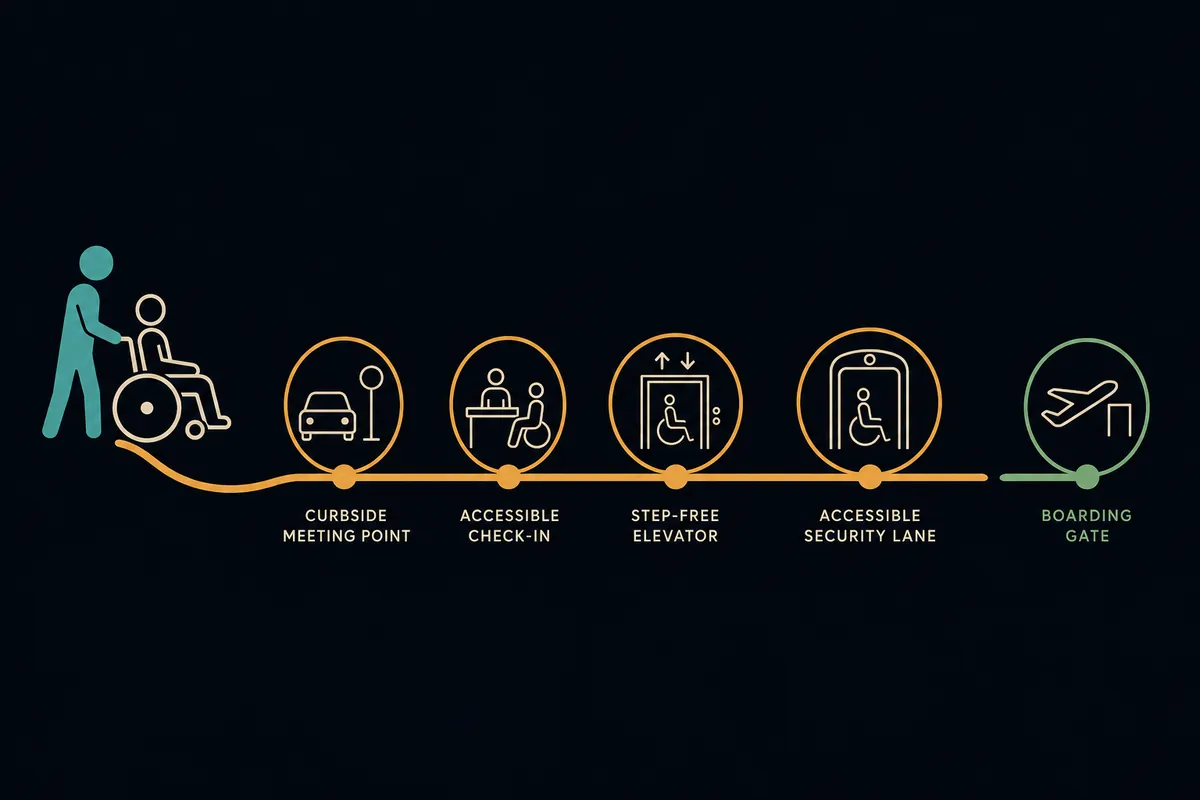
What rights do you have under the Air Carrier Access Act?
The Air Carrier Access Act prohibits disability discrimination on all flights to, from, and within the United States. Airlines must provide wheelchair assistance at no charge — from the terminal curb through security, to the gate, and onto the aircraft. You have the right to pre-board before general boarding begins, and the airline must supply an aisle wheelchair (a narrow transfer chair) to move you from the jet bridge door to your seat on aircraft with more than 60 seats. Airline staff must take direction from you on how to handle your personal wheelchair.
- Wheelchair assistance is free — airlines cannot charge any fee for pushing, lifting, or loading
- Pre-boarding before general boarding groups is a guaranteed right, not a favor
- You direct staff on how to handle your chair — staff must follow your instructions
- On-board aisle wheelchair must be available on aircraft with more than 60 seats
- Covers US airlines and foreign airlines on all flights touching US airports
How should you book and confirm wheelchair assistance?
Request wheelchair assistance at the time of booking — by phone when possible, not only through online forms, which often lack space to describe complex mobility needs fully. Confirm 24 to 48 hours before departure. If you use a power wheelchair, call at least 48 hours in advance so the airline can verify battery compliance and arrange appropriate loading equipment. Getting a written confirmation number for your request protects you if anything is missed at the gate.
- Call the airline directly — do not rely solely on the online accessibility checkbox
- Confirm the assistance request 24–48 hours before the flight
- Power wheelchair users: call at least 48 hours ahead with battery model and watt-hour rating
- Reconfirm at check-in, at the gate, and again when boarding begins
- Best practice: note the name of every agent you speak with and the time of the call
How does TSA screening work when you use a wheelchair?
TSA cannot require you to transfer out of your wheelchair to pass through a checkpoint. You may remain seated while officers conduct a thorough pat-down; the pat-down substitutes for the walk-through metal detector and is standard procedure, not a sign of suspicion. An ETD (explosive trace detection) swab of the wheelchair frame and wheels is also routine. You can request a same-gender officer for any part of the screening at any time.
- Remain seated — you cannot be required to stand or transfer for screening
- Pat-down is standard; ask for a private screening room if you prefer
- ETD swab of the wheelchair is routine — frame, wheels, and armrests are all typical swab points
- Request a same-gender officer at any time; this is your right, not a special accommodation
- Power wheelchairs: power off at the checkpoint; removable batteries go through X-ray in carry-on
- TSA Cares (1-855-787-2227): call at least 72 hours before travel for advance checkpoint coordination
TSA PreCheck does not eliminate the wheelchair pat-down, but dedicated PreCheck lanes typically move faster. See TSA PreCheck vs. CLEAR and PreCheck vs. CLEAR vs. Global Entry to decide what makes sense for your travel style. You can also check today's live wait at your departure airport — for example ATL or ORD — before you leave home.
What are the rules for flying with a power or electric wheelchair?
Power wheelchairs are subject to FAA and airline battery rules regardless of how you book. Lithium-ion batteries are capped at 300 watt-hours— any battery exceeding that threshold is not permitted on any commercial flight. Removable batteries must travel in carry-on baggage, never in checked luggage, and you must advise the airline of the battery's location. Non-removable batteries must remain securely attached with terminals protected from short circuits. Lithium metal (non-rechargeable) batteries are prohibited entirely under all circumstances.
| Battery type | Limit | How to transport |
|---|---|---|
| Removable lithium-ion | Max 300 Wh | Carry-on only; notify airline of location |
| Non-removable lithium-ion | Max 300 Wh | Stays attached; terminals must be protected from short circuit |
| Single spare battery | Max 300 Wh | Carry-on only — never checked |
| Two spare batteries | Max 160 Wh each | Carry-on only — never checked |
| Lithium metal (non-rechargeable) | Prohibited | Not permitted under any circumstances |
What happens to your wheelchair at the gate and upon arrival?
You use your own wheelchair all the way to the aircraft door — airlines cannot require you to transfer to a loaner chair earlier than necessary. At the aircraft door your chair is gate-checked and loaded into the cargo hold. At your destination the airline must return it to you at the aircraft door, not at the baggage carousel. Inspect the chair immediately and completely before leaving the jet bridge area.
- Use your personal wheelchair to the aircraft door — no early surrender required
- Chair is returned at the aircraft door at destination, not the baggage carousel
- If the aircraft door return is not possible, the airline must notify you before departure
- Folding manual wheelchairs may fit in the overhead bin — ask the gate agent before boarding
- Inspect the chair at the jet bridge immediately; note any damage before leaving the aircraft door area
What do you do if the airline damages your wheelchair?
File a written damage report before leaving the baggage area — this step cannot be done retroactively and is essential for any claim. Airlines must repair or replace a damaged wheelchair at no charge and must supply a loaner wheelchair during the repair period. The December 2024 DOT final rule requires airlines to return your chair in the condition they received it; a provision specifically addressing liability for untimely returns activates December 31, 2026.
- File the damage report before leaving the baggage area — this is the critical first step
- Take photos immediately and document serial number and estimated replacement cost
- The airline must repair or replace at no charge; a loaner must be provided while repairs are made
- Ask for the airline's Complaint Resolution Official (CRO) — one must be reachable on every flight
- Escalate unresolved claims to DOT Aviation Consumer Protection at airconsumer.dot.gov
For damaged or missing luggage more broadly, see how to file a damaged baggage claim.
What is the DOT's new wheelchair rule and how does it affect you?
DOT published a major final rule in December 2024 — the most significant overhaul to wheelchair air-travel protections in decades — with key provisions rolling out through 2026. By June 17, 2026, all airline employees and contractors who physically assist wheelchair users or handle wheelchairs must complete mandatory hands-on training covering safe transfers, aisle chair technique, and taking direction from passengers. New performance standards for on-board aisle wheelchairs apply to twin-aisle aircraft purchased after October 2, 2026. Four provisions — including liability for delayed wheelchair returns and pre-departure notifications of your right to file a complaint — are delayed until December 31, 2026 while DOT develops a second rulemaking.
- June 17, 2026: mandatory hands-on training deadline for all staff who assist wheelchair users
- Training includes: safe transfers, aisle chair use, competency assessment or certification exam
- October 2, 2026: improved aisle wheelchair performance standards for twin-aisle aircraft
- December 31, 2026: airline liability for untimely wheelchair return activates
- December 31, 2026: airlines must notify passengers pre-departure of their right to file a complaint
- DOT Wheelchair Rule II proposed rulemaking expected August 2026
Common questions about flying with a wheelchair:
What rights do you have under the Air Carrier Access Act?
Under the ACAA, airlines must provide free wheelchair assistance from curb to seat on all US flights. You have the right to pre-board before general boarding, use your own chair to the aircraft door, be transported to your seat via an aisle wheelchair, and direct staff on how to handle your equipment. No fees can be charged for any part of this assistance.
How does TSA screening work when you use a wheelchair?
You may remain seated in your wheelchair throughout the entire screening process — TSA cannot require you to stand or transfer out. A pat-down replaces the walk-through detector, and an ETD swab of the wheelchair is standard. You can request a same-gender officer at any time. For power wheelchairs, power off before the checkpoint and place a removable battery in carry-on for X-ray separately.
What are the rules for flying with a power or electric wheelchair?
Lithium-ion batteries are capped at 300 Wh total. Removable batteries must travel in carry-on baggage only and the airline must be notified of the battery location. Non-removable batteries stay attached to the chair with terminals protected. Lithium metal (non-rechargeable) batteries are completely prohibited. Call the airline at least 48 hours before your flight to confirm your specific battery meets their requirements.
What happens to your wheelchair at the gate and upon arrival?
Your wheelchair is gate-checked free at the aircraft door — you are not required to give it up at the ticket counter or early in the terminal. At your destination the airline must return it to you at the aircraft door, not the baggage carousel. Inspect the chair fully before leaving the jet bridge and report any damage on the spot.
What is the DOT's new wheelchair rule and how does it affect you?
A December 2024 DOT final rule is rolling out through 2026. By June 17, 2026, all airline staff who physically handle wheelchair users must complete hands-on certified training. Improved aisle wheelchair standards take effect for twin-aisle aircraft in October 2026. Stronger airline liability for damaged or delayed wheelchairs and mandatory pre-departure complaint notifications activate December 31, 2026.
Information verified . Sources: DOT Air Carrier Access Act guidance, DOT December 2024 final rule (Federal Register), TSA wheelchair screening policy, FAA hazmat and mobility device regulations.
Allow extra time for wheelchair screening
TSA wheelchair screening takes longer than a standard walk-through. The Leave-By Time calculator folds today's live security wait at your airport into one time to walk out the door — so you're never cutting it close.
Check your Leave-By Time →Keep planning
Security
How long does airport security really take?
Most travelers clear standard screening in 15 to 30 minutes — but the hour you pick changes everything.
SecurityWhat you can (and can't) bring through security
Liquids, laptops, snacks, and the things that surprise people — a plain-language packing check before you go.
SecurityCarry-on liquids: the 3-1-1 rule, explained
3.4 ounces, one quart bag, one per traveler — plus the exceptions for medications and baby formula.
SecurityAirport security tips for families with kids
From stroller gate-checks to formula at the X-ray belt — everything parents need to know to move a family through TSA quickly.