Security
TSA liquid rules: the complete 3-1-1 guide
By the TSA Wait Times team · Updated · Published June 2026
The 3-1-1 rule: each liquid must be 3.4 ounces (100ml) or less, all containers must fit in one quart-size clear zip-top bag, and you get one bag per person. Place the bag in a bin at the security checkpoint. Items that do not fit in the bag must go in your checked luggage.
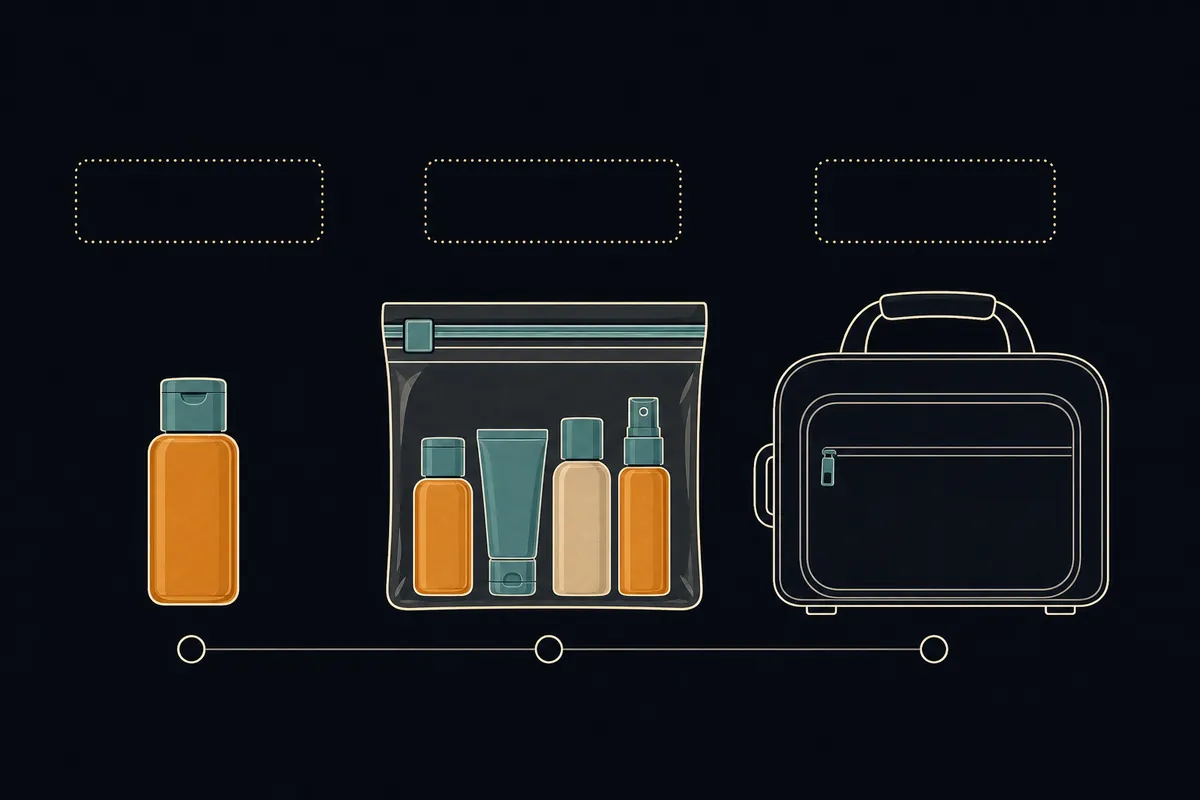
The 3-1-1 rule, broken down
Each digit stands for a specific constraint. All three must be met simultaneously — meeting two out of three is not enough.
3
3.4 oz (100ml) — the container size limit
This is roughly the size of a hotel-size shampoo bottle. The number printed on the bottle is what counts — even if the bottle is only half full, an 8 oz bottle does not qualify.
1
1 quart-size clear zip-top bag
All your liquids must fit in one bag. A standard gallon Ziploc is too large. TSA sells them at checkpoints, but they are available at every grocery store for cents. If your liquids do not fit, they do not fly in the cabin.
1
1 bag per person
Each traveler in your party gets their own bag. You cannot consolidate two people's liquids into one bag or pool bags with a travel companion.
What counts as a liquid?
TSA's definition is broader than most people expect. Any substance that can be poured, pumped, squeezed, or spread is classified as a liquid — regardless of whether it feels like one.
Counted as liquid — must follow 3-1-1
- Shampoo, conditioner, body wash
- Lotion, sunscreen, hand cream
- Liquid makeup — foundation, serum, concealer
- Perfume and cologne
- Mouthwash and toothpaste (yes — toothpaste is classified as a gel)
- Hairspray, aerosols, dry shampoo spray
- Deodorant — gel or spray form only
- Contact lens solution and saline rinse
- Hand sanitizer
- Lip gloss and liquid lipstick
Not a liquid — no carry-on restrictions
- Solid deodorant (stick form)
- Solid shampoo bar
- Pressed powder makeup
- Wax (solid block)
- Lip balm stick
- Mascara in solid/wand form
- Crayons and solid markers
Gray area — often confiscated
- Peanut butter, hummus, dips, and spreads — their gel/paste consistency puts them in the liquid category. A jar over 3.4 oz will be confiscated.
- Applesauce, yogurt, and spreadable cheeses — same reasoning: soft and spreadable equals liquid by TSA's definition.
- Snow globes — any liquid inside means they follow the 3-1-1 rule. Most snow globes are larger than 3.4 oz and will not make it through.
- Canned goods — opaque to X-ray scanners and prohibited in carry-on regardless of their contents.
Medical and family exemptions
The following items are exempt from the 3-1-1 rule— they are allowed in reasonable quantities beyond 3.4 oz and do not need to fit in your quart bag. You do not need a prescription or doctor's note for any of these. You are expected to declare them at the checkpoint.
Prescription and over-the-counter medications
Liquid medications in any reasonable quantity. Declare them at the checkpoint — an officer may inspect them. Pills and tablets are unrestricted entirely.
Baby formula
Any reasonable amount. Juice and milk for infants also exempt. Your child does not need to be traveling with you — the exemption applies to the formula regardless.
Breast milk
Any amount. TSA cannot require you to taste or open breast milk for screening. Remove it from your bag for separate screening and inform the officer at the start of the process.
Ice packs and gel packs (for medical use)
Exempt in reasonable quantity when used to keep medications or breast milk cold. Must be completely frozen solid at screening — a partially thawed pack may be treated as a liquid.
Other medically necessary liquids
Insulin, saline solution, nasal spray, contact lens solution in quantities greater than 3.4 oz when medically required. Declare at screening.
How to get through security faster with liquids
- 01Pack your quart bag the night before. Fumbling with it at the bin costs you time and backs up the line for everyone behind you.
- 02Place the quart bag at the top of your carry-on. It should be the first thing you can grab when you reach the bin — no digging required.
- 03Switch to solid formats where possible. Solid shampoo bars, solid deodorant, and powder sunscreen eliminate the most common quart-bag items entirely.
- 04Buy liquids after security. Duty-free shops and airport stores sell full-size toiletries landside. The 3-1-1 rule does not apply to items purchased after the checkpoint — they go straight into the overhead bin.
- 05Checked bags have no liquid size limit. Full-size bottles of any liquid are allowed in your checked bag. Only carry-on is restricted.
Common confiscated items and how to avoid them
Peanut butter
Why confiscated: Gel/paste consistency — classified as a liquid
Fix: Pack in checked bag or buy individual travel packets airside
Toothpaste over 3.4 oz
Why confiscated: Most full-size tubes are 4–6 oz — over the limit
Fix: Buy a 3 oz travel tube or transfer into a small container before you fly
Full-size sunscreen
Why confiscated: Any bottle over 3.4 oz regardless of how much is inside
Fix: Transfer to a 3.4 oz bottle, or buy a travel size at the airport after security
Snow globe
Why confiscated: Liquid inside — virtually all snow globes exceed 3.4 oz
Fix: Ship it home or check it
Full-size shampoo or body wash
Why confiscated: Over the 3.4 oz container size — even if nearly empty
Fix: Decant into a reusable travel bottle or buy hotel amenities on arrival
Gel ice pack (partially thawed)
Why confiscated: Melted gel equals a liquid — fails the 3-1-1 rule
Fix: Use frozen solid hard packs or declare gel packs as medically necessary
International flights: does the rule change?
The 3-1-1 rule is a US TSA standard — it applies equally to international departures from US airports. Other countries follow equivalent rules under the ICAO 100ml standard, though enforcement strictness varies.
EU airports enforce the 100ml / 1-litre bag rule strictly — the standard matches the US version almost exactly.
Duty-free liquids at connecting international airports
Liquids bought in duty-free after the US checkpoint are not subject to the 3-1-1 rule on departure. However, if you have a connection at an international airport, that airport may apply its own rules to your duty-free purchase — the item must be in the original sealed tamper-evident bag from the store. Check your transit airport's rules before you travel.
Planning what to pack? See TSA prohibited items: the complete list for everything that can be confiscated beyond liquids. If you are enrolling in TSA PreCheck to speed up screening, the PreCheck enrollment guide walks through every step. Traveling carry-on only? How to pack carry-on only covers the full strategy.
Common questions
Does the 3.4 oz limit apply to the total amount of liquid or to each container?
Each individual container must be 3.4 oz (100ml) or less. The bag can hold multiple containers, but each one must meet the limit individually. A half-empty 8 oz bottle does not qualify — the size printed on the bottle is what counts.
Can I bring a water bottle through security?
Empty water bottles are allowed. Full water bottles are liquid and must be 3.4 oz or less — which is essentially nothing. Empty your bottle before the checkpoint and fill it at a water fountain or bottle-filling station after you clear security.
Do medications have to go in the quart bag?
No. Liquid medications are exempt from the 3-1-1 rule and should be kept separate from your quart bag. Declare them to the TSA officer at the beginning of screening. An officer may ask to inspect them, but they will not be confiscated due to their size.
What happens if TSA finds a prohibited liquid?
A TSA officer will ask you to discard it at the checkpoint or return it to your car. You cannot mail items from the checkpoint. If you have time before your flight, you may be able to check the bag instead. Some larger airports have last-chance mail stations near the security entrance — check your departure airport's website in advance.
Packed and ready? Now nail the timing.
Run your Leave-By Time and we'll count backward from your flight — today's live security wait, the drive, and the walk to your gate — so you leave with room to breathe.
Get your Leave-By Time →