Baggage
How to fly carry-on only: the complete strategy
By the TSA Wait Times team · Updated · Published June 2026
Flying carry-on only saves $90–$200 per round trip for two people and lets you skip baggage claim entirely. The strategy: a 40–45 liter bag, a capsule wardrobe of 7 items that mix and match, and ruthless cuts on anything liquid. Here is the full system.
Choose the right bag size
The carry-on sweet spot is 22 × 14 × 9 inches (45 linear inches) — the standard domestic US carry-on limit across American, Delta, United, JetBlue, and Alaska. A 40–45 liter bag fills these dimensions without wasted space. Most airlines also allow a personal itemunder the seat (roughly 15–18 × 11 × 8 in) — use this for a daypack, large tote, or packable personal bag to double your total carry-on capacity at no extra cost.
Budget airline exception
Frontier and Allegiant base fares do not include a carry-on — only a personal item is free. A carry-on added at booking runs $30–$60; added at the gate, $60–$100. Factor this into your total ticket cost before booking.
See exact dimensions for every US carrier in the carry-on size limits by airline guide.
The capsule wardrobe system (7 items for 7 days)
Build around neutrals that mix and match. Every item must work with at least three other items in your bag — if it only pairs with one thing, leave it home. Lay your full selection on the bed before packing and apply this test to every piece.
- Tops (3): 2 casual tops — one with a collar — plus 1 light cardigan or zip fleece for layering
- Bottoms (2): 1 versatile dark pants (jeans or chinos), 1 shorts or dress/skirt depending on destination
- Shoes (2): 1 versatile walking shoe that works for dinner, 1 sandal or flip-flop
- Outerwear (1): 1 packable jacket or fleece — wear it on the plane so it takes zero bag space
Merino wool tops earn their reputation here: they resist odor and can be worn two to three days between washes, effectively halving the number of tops you need to pack.
The liquids strategy
Liquids are the number one carry-on failure point. A heavy, over-packed quart bag is the fastest way to slow down at security and eat bag space. The fix is shifting to solid or powder formats wherever possible.
- Switch to solids: solid shampoo/conditioner bars (Lush, HiBar), solid deodorant, powder sunscreen — no size restriction, no quart-bag space used
- Unavoidable liquids: decant into 1-oz silicone travel bottles instead of flying full-size containers
- Buy at destination: shampoo, conditioner, sunscreen, and lotion are available everywhere — flying heavy bottles is optional
- Hotels provide shampoo, conditioner, and body wash — for many trips you need nothing liquid beyond toothpaste and face wash
- The quart bag should feel light when you lift it — if it feels heavy, you have too many liquids
Packing cubes — the space multiplier
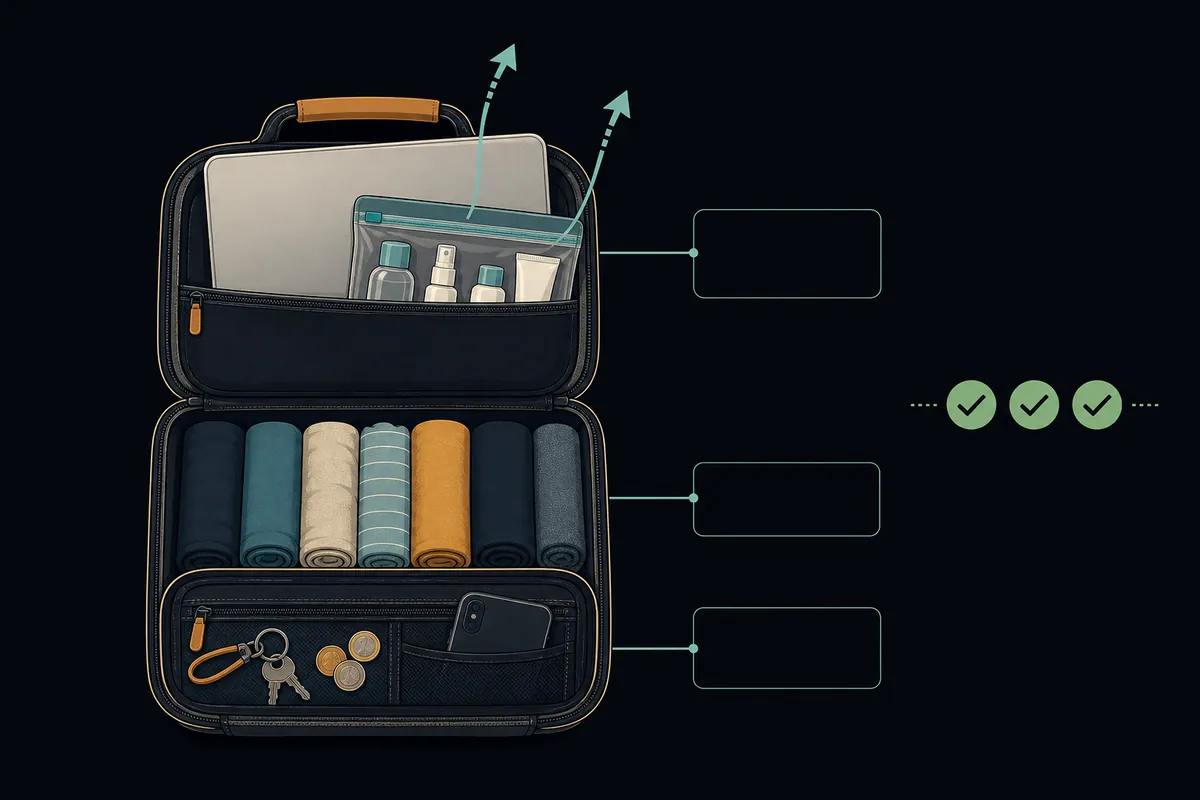
Compression packing cubes (Eagle Creek, Peak Design, Away) reduce soft-clothing bulk by 30–40% by eliminating the dead air that forms when loose clothes shift in transit. Rolling beats flat folding for most soft items — tighter cylinders, fewer wrinkles, easier to see contents at a glance.
- Large cube: tops and bottoms rolled (not folded)
- Medium cube: underwear, socks, and gym clothes
- Small pouch: electronics and cables
- Separate 1-quart clear bag: liquids — pack in the most accessible pocket for fast security screening
What to wear on the plane
Wear your bulkiest items on travel day. Clothes worn on your body do not count toward your bag allowance on any major US airline. This single habit frees 20–30% of bag space before you pack a single item.
- Heaviest shoes (sneakers, boots, or anything with thick soles)
- Heaviest jacket or fleece
- Heaviest pants (denim or thick chinos)
What to cut
These are the most common items that add weight and volume without earning their space:
- Full-size bottles of shampoo, conditioner, or sunscreen — buy them at your destination
- Hair dryer — every hotel room has one
- Physical books — use the Kindle app on your phone
- Workout clothes for every day — pack 2 sets, handwash one
- “Just in case” outfits — they are never used
- Towels — every accommodation provides them
The pre-packing checklist
- 01Lay everything you plan to pack on the bed
- 02Put back 30% of it — the first edit is never deep enough
- 03Pack the rest into your bag using rolling and compression cubes
- 04If it does not zip easily: remove 1–2 more items and do not force it — a visibly bulging bag gets flagged at the gate
- 05Weigh it: personal item plus carry-on together should be under 25 lbs for comfortable overhead-bin lifting
Frequently asked questions
Can you really do carry-on only for a 2-week trip?
Yes — with laundry (most hotels have a laundry service or guest laundry, or you handwash a few items) a 7-item wardrobe works for 14 days. Merino wool tops that resist odor and can be worn two to three days between washes reduce your item count further.
What if I need formal clothes?
Pack one versatile outfit that converts — dark pants and a dress shirt for men; a wrap dress for women that works day and night. Avoid packing a full suit. If you genuinely need one, rent or buy at your destination.
What about buying things at my destination?
It is the best carry-on strategy. Plan to pick up heavy liquids (sunscreen, shampoo, conditioner) on arrival. Many frequent travelers do this intentionally to skip TSA quart-bag stress entirely.
Which airlines give the most carry-on space?
JetBlue (22x14x9 in, all fares except Blue Basic) and United (22x14x9 in) are generous. Southwest allows 24x16x10 in. Frontier and Allegiant base fares include only a personal item — not a full carry-on — so factor that in before booking.
Related guides
- How to pack a carry-on bag: tips to fit more and move faster — the technique companion (rolling, load order, packing cubes in depth)
- Carry-on size limits by airline — every US carrier’s exact dimensions in one table
- How to avoid checked bag fees — credit cards, elite status, and booking tactics that waive fees entirely
Know your Leave-By Time before you pack
Packing carry-on only saves money — but only if you make the flight. Use the Leave-By Time calculator to fold your airport’s live security wait, your drive, and your airline’s check-in cutoff into one exact time to leave home.
Calculate your Leave-By Time →Verified as of . Sources: NerdWallet, The Points Guy, SmarterTravel.