Security
TSA prohibited items: what you cannot bring on a plane
By the TSA Wait Times team · Updated · Published June 2026
TSA confiscates around 6 million prohibited items every year. Most are liquids over 3.4 oz — but the full list includes sharp objects, firearms in the cabin, and certain batteries. Here is what gets confiscated and why.
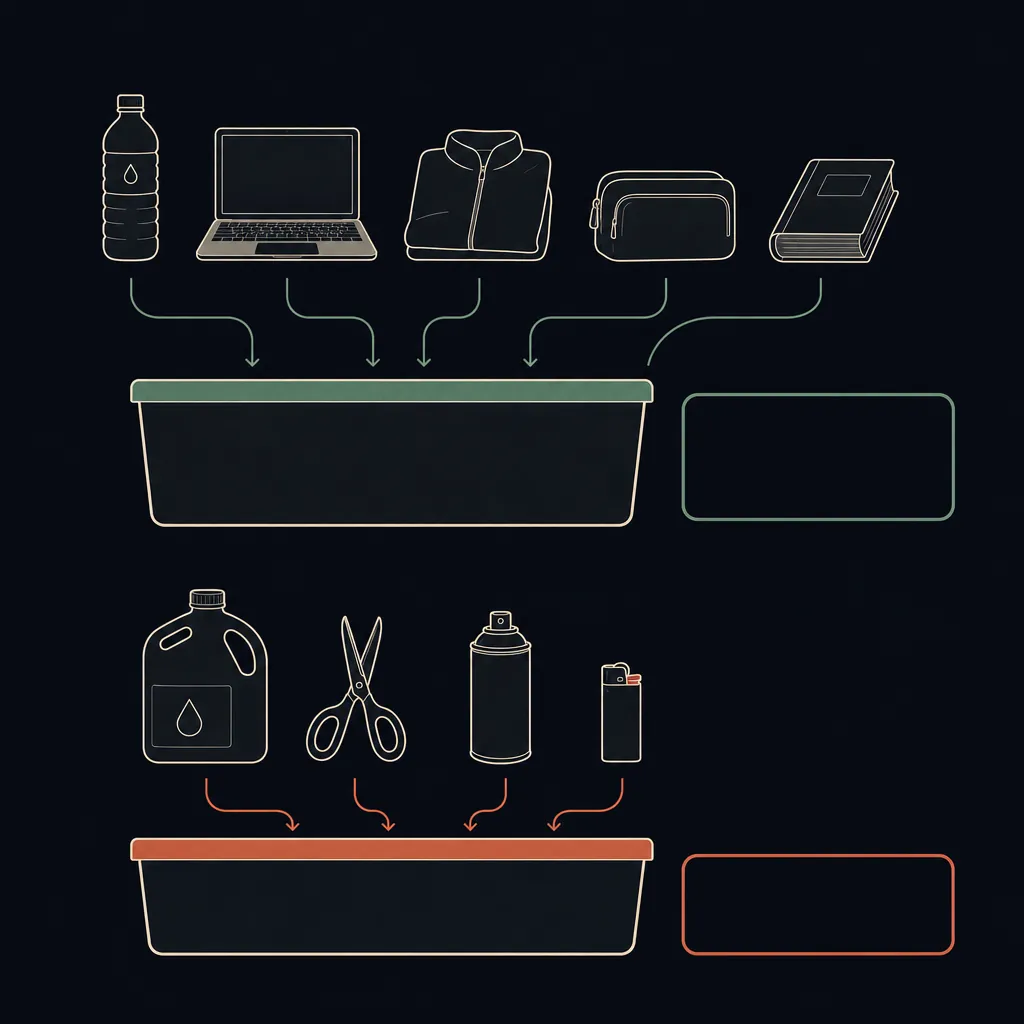
Always prohibited — carry-on and checked bag
A short list of items are banned from every bag on every flight. There is no exception for checked luggage, and no way to declare your way through.
- Explosives and flammables — fireworks, flares, gunpowder, lighter fluid, aerosol paint cans (pressurized), and chlorine.
- Radioactive materials and infectious substances — no exceptions, regardless of quantity or packaging.
- Oxidizers and organic peroxides — bleach, pool chemicals, and similar compounds are prohibited in any bag.
- Loose lithium batteries over 160Wh — the carry-on limit is 100Wh without airline approval, 160Wh with approval. Batteries over 160Wh are banned entirely.
Prohibited in carry-on (allowed in checked bags only)
These items can travel with you — but only below deck, properly packed and declared where required.
- Firearms — must be declared at the airline counter, unloaded, and locked in a hard-sided case. Carry-on is never permitted.
- Ammunition — same rules as firearms; must be in the original packaging or a manufacturer-approved container.
- Sharp objects — knives with blades over 2.36 inches, any locking blade, box cutters, razor blades, and scissors with blades over 4 inches. Small rounded scissors are allowed in carry-on.
- Sporting equipment — baseball bats, hockey sticks, ski poles, golf clubs, and cricket bats are all carry-on prohibited.
- Tools over 7 inches — wrenches, hammers, drills, and screwdrivers longer than 7 inches from end to end.
- Axes, hatchets, meat cleavers, swords, and spears — all bladed weapons of any blade length go to checked bags only.
- Gel candles and snow globes over 3.4 oz — treated as liquids/gels, same as any other gel product.
- Pepper spray — checked bag only, limited to one container no larger than 4 oz with no more than 2% major irritant. Bear spray is prohibited in all aircraft baggage.
- Realistic toy weapons and replicas — if it could be mistaken for a real weapon during X-ray screening, it belongs in a checked bag.
Liquids — the 3-1-1 rule confiscates millions of items each year
Any liquid, gel, cream, paste, or aerosol in your carry-on is subject to the 3-1-1 rule. The rule governs the container size, not how much is left inside — a half-empty 8 oz bottle of shampoo still gets pulled.
3
3.4 oz (100 ml) or smaller per container. Container size is what matters — not how full it is.
1
1 clear quart-size zip-top bagholds all your liquids. If they don't fit in one bag, they don't fly in the cabin.
1
1 bag per traveler. You cannot pool bags with a travel companion.
Three categories are exempt from the 3.4 oz limit: prescription medications (declare them at the checkpoint), baby formula and breast milk, and duty-free liquids purchased at an international airport and sealed in a tamper-evident bag.
Common surprises confiscated as "gels"
- Peanut butter in jars over 3.4 oz
- Hummus, yogurt, and jelly
- Salad dressing and maple syrup
- Aerosol dry shampoo over 3.4 oz
- Snow globes with liquid base over 3.4 oz
Gray-area items often confiscated
Some items fall in a gray zone — technically allowed by category but frequently pulled at the checkpoint due to screening ambiguity or officer discretion.
- Peanut butter — its gel/spread consistency puts it in the liquids category. Jars over 3.4 oz are confiscated at carry-on even though it is food.
- Canned foods — opaque to X-ray scanners and prohibited in carry-on. Pack them in checked luggage.
- Leaking containers — even a container within the 3.4 oz limit can be confiscated if it is actively leaking at the checkpoint.
- Powders over 12 oz— subject to additional screening and may be confiscated at the officer's discretion if the contents cannot be identified. Protein powder, flour, and talc all apply.
- Ice packs and gel packs — allowed only if completely frozen solid when you reach the scanner. A slushy or partially melted pack counts as a liquid.
What happens to confiscated items
Most items surrendered at the checkpoint go to state surplus programs, which auction them to the public — that is how airport-surplus stores stay stocked. TSA does not keep or return confiscated property. Some larger airports have last-chance mail stationsnear the security entrance, before the checkpoint, where you can ship an item home rather than surrendering it. Check your departure airport's website before you travel to see if one is available.
For a full breakdown of what you can pack without worry, see our guide on what you can bring through security. Packing toiletries and cosmetics? The carry-on liquids 3-1-1 rule guide walks through every liquid category in detail.
Common questions
Can TSA confiscate my medication?
No. Medications are exempt from the 3-1-1 rule and have no size limit. Declare them at the checkpoint if they are liquid — an officer may ask to inspect them, but they will not be confiscated solely because of their size.
What fines can TSA impose for prohibited items?
Civil penalties range from $390 to $15,000 per violation depending on severity. Undeclared firearms carry a minimum penalty of $3,090 per violation and can result in criminal referral. The amount scales with whether the offense was intentional and how many prior violations exist.
Can I retrieve a confiscated item?
No. Once you surrender an item to TSA at the checkpoint, it cannot be returned. Some larger airports have last-chance mail stations near the security entrance where you can ship items home before you proceed — check the airport's website before you travel.
Are e-cigarettes and vapes allowed on planes?
Carry-on only — they contain lithium batteries which are prohibited in checked bags because of fire risk. Do not use or recharge them while onboard. Vaping on an aircraft is federally prohibited.
Packed and ready? Now nail the timing.
Run your Leave-By Time and we'll count backward from your flight — today's live security wait, the drive, and the walk to your gate — so you leave with room to breathe.
Get your Leave-By Time →