Health & medical
Traveling with medication: TSA rules and how to get through security smoothly
By the TSA Wait Times team · Updated · Published June 2026
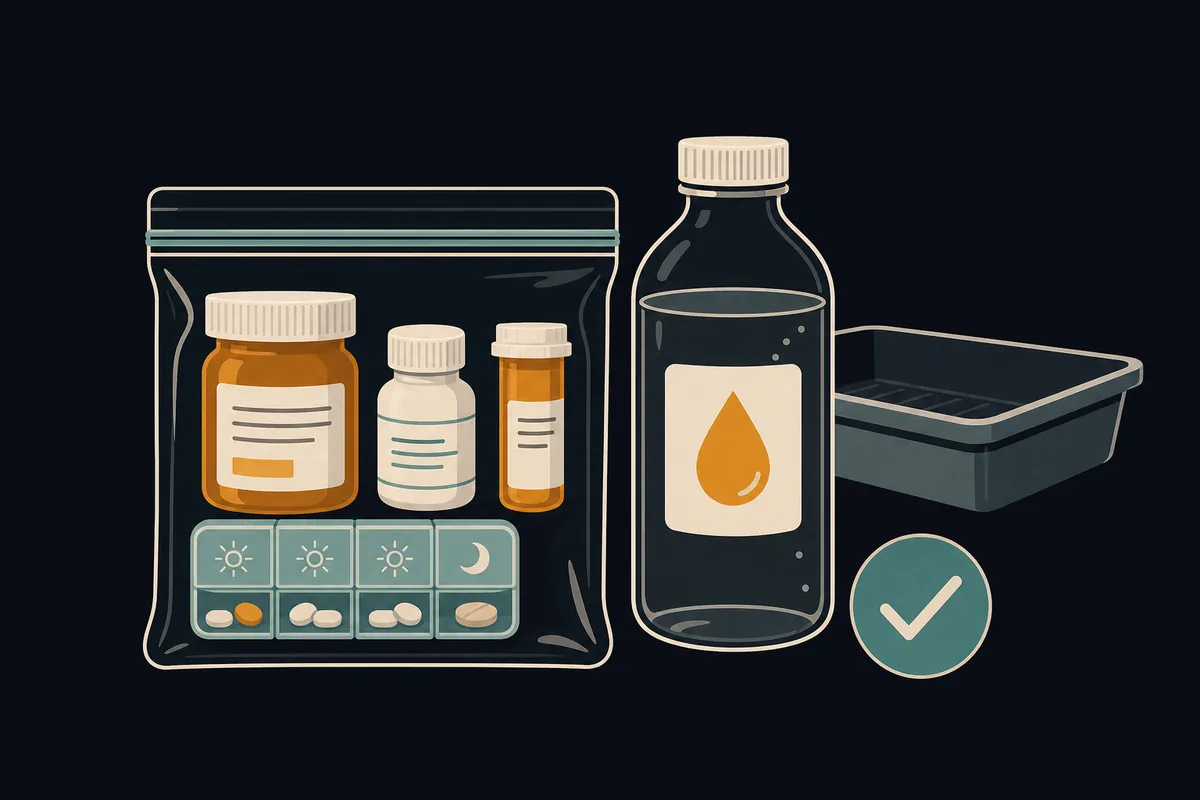
TSA allows medications in your carry-on bag — including liquids over 3.4 oz if they are medically necessary. You are not required to have medications in their original prescription bottle for domestic US travel. Here is what the rules actually say.
General TSA medication rules
Both prescription and over-the-counter medications are permitted in carry-on and checked bags with no quantity restrictions. TSA's primary mission is security, not drug enforcement — these rules are designed to be practical for travelers who need their medication on hand.
- Medications are allowed. Prescription and over-the-counter medications are permitted in both carry-on and checked bags. Carry them in your carry-on whenever possible — checked bags can be delayed, lost, or exposed to temperature extremes in the cargo hold.
- No prescription label required (domestic). For domestic US flights, TSA does not require medication to be in a labeled prescription bottle. However, having the original label speeds up any questions and is strongly recommended.
- Declare if asked. TSA may ask you to remove medications for separate screening — this is routine. You have the right to request a private screening if you need to handle medication privately.
- Controlled substances. Allowed if legitimately prescribed and in the prescribed amount for your trip. TSA is not primarily a drug-enforcement agency — they are looking for security threats. However, if you are traveling internationally, always carry your prescription to show at customs.
What TSA officers focus on at the checkpoint
- Security threats — not whether your medication is in the right container
- They may swab medication bottles for explosive trace detection — this is routine, not a flag
- You can always ask for a supervisor if you feel a screening decision is incorrect
- Private screening rooms are available on request at all TSA checkpoints
Liquid medications — the 3-1-1 exception
The standard 3-1-1 rule limits liquids to containers of 3.4 oz (100 ml) or less, all fitting inside a single quart-size bag. Medically necessary liquid medications are explicitly exempt from this rule and may travel in any quantity needed.
- What qualifies for the exemption. Liquid prescription medication, insulin, saline solution, liquid nutrition, medical-grade eye drops, contact lens solution (if medically necessary), cough syrup, and liquid OTC medication are all exempt.
- What to do at the checkpoint. Declare your liquid medications to TSA before placing items in the bin — tell the officer before loading the belt. The officer will set them aside for separate screening.
- Explosive trace screening. Liquid medications may be tested with explosive trace detection (a swab of the outside of the bottle). This is routine procedure and does not mean anything is wrong with your medication.
- What is NOT exempt. Regular beverages, standard eye drops, cosmetics, and toiletries do not qualify — only medications and medically necessary liquids are exempt from the 3-1-1 rule.
Insulin and diabetes supplies
Insulin and all diabetes-related supplies are fully permitted through security in any quantity needed for your trip. Notify the TSA officer when you approach the checkpoint so they can route your items correctly without delay.
Insulin
Insulin pens and vials — any quantity. Allowed in carry-on in any amount needed for your trip. No prescription label is required for domestic travel. Keep insulin with you rather than in checked baggage, as cargo hold temperatures can damage it.
Syringes
Syringes with medication are allowed. Unused syringes without medication are also permitted but may trigger questions — having them paired with your insulin helps officers screen quickly. Lancets and test strips are allowed without restriction.
Pump
Insulin pumps — stay on your body. You may keep your insulin pump on through screening. Alert the TSA officer before you approach the scanner. You are not required to remove it. If the scanner alarms, you may request a pat-down instead of a hand-wand inspection.
CGM
Continuous glucose monitors — compatible with body scanners. You do not need to remove a CGM. If the scanner alarms, you may request a pat-down instead of a hand-wand inspection. Notify the officer before entering the scanner lane.
Ice
Ice packs and coolers are allowed. Gel-type ice packs may trigger additional screening if they are partially frozen — pack them fully frozen or switch to dry ice (declared separately). Hard-sided coolers are permitted in carry-on and checked bags.
Other medical devices and supplies
Most common medical devices are permitted in carry-on baggage with no fee and no liquid restrictions. Airlines generally do not count medical devices toward your bag allowance — confirm with your airline at booking.
- CPAP / BiPAP machines. Allowed in carry-on at no extra charge — most airlines do not count them toward your bag limit. You may be asked to remove it from its case and place it in a bin for X-ray separately. A disposable cover or clear bag keeps it clean on the belt.
- EpiPen / auto-injectors. Allowed in carry-on. Carry with the medication attached — a syringe without medication may trigger additional questions. EpiPens count as carry-on medications under the 3-1-1 exemption.
- Liquid nutrition (Ensure, tube feeding). Allowed in quantities exceeding 3.4 oz as a medically necessary liquid. Declare at the checkpoint before placing items on the belt.
- Supplemental oxygen. You cannot bring your own pressurized oxygen tank on a plane. FAA-approved portable oxygen concentrators (POCs) are allowed — check with your airline at booking, as they require advance notice and specific FAA-approved models only.
- Prosthetics and orthotics. You may keep prosthetics on your body through screening. Alert the TSA officer before the scanner. You may request a private screening for prosthetics that contain metal or that you cannot easily remove.
Tips for getting through security with medication
Preparation before your trip eliminates almost every checkpoint complication. These five practices cover the most common friction points travelers encounter.
- 01Carry all medications in your carry-on. Checked bags can be delayed, lost, or exposed to extreme temperatures in the cargo hold. Never put medication you depend on in checked luggage.
- 02Carry a medication list. A typed or printed list from your doctor with generic names, brand names, doses, and diagnoses is useful at customs internationally and in emergencies. It takes seconds to produce and can resolve hours of questions.
- 03Check destination rules for international travel. Some medications legal in the US are controlled substances in other countries. Adderall (amphetamine) is a controlled substance in Japan and several other countries — travelers have had it confiscated at customs without advance documentation. Check the destination country's embassy website before you fly.
- 04Pack extra medication. Bring at least 2–3 days of extra supply beyond your trip length to cover delays, diverted flights, or lost luggage. For controlled substances, work with your prescriber in advance — some pharmacies cannot fill early.
- 05Request a direct aisle seat for temperature-sensitive medication. An aisle seat lets you monitor your overhead bin and retrieve medication quickly if needed — useful when traveling with insulin or other items that should not sit in a warm overhead compartment for hours.
International travel with prescription medication
International travel adds a customs layer that domestic rules do not require. Rules vary significantly by country — do not assume US rules apply at your destination.
- Customs declaration.Some countries require you to declare prescription medications on arrival. Always carry the original prescription or a doctor's letter for controlled substances — a typed note on letterhead works better than a printout.
- Quantity limits.Many countries limit how much of a controlled substance you can bring in — often 30 to 90 days' supply. Check the destination country's embassy website or INCB (International Narcotics Control Board) guidance before your trip.
- Translation. If traveling to a non-English speaking country, consider having your prescription translated. Many pharmacists can read English, but documentation in the local language helps in an emergency or at a customs secondary inspection.
- Import permits — apply months in advance. Countries including Japan, Indonesia, China, and the UAE require an official import permit for certain medications — especially opioids, benzodiazepines, and stimulants such as Adderall or Ritalin. Apply through the destination country's health ministry. Processing can take 4–8 weeks.
Quick checklist before an international flight with medication
- Original prescription or signed doctor's letter in your carry-on
- Verified destination country rules for each controlled substance you carry
- Import permit applied for (if required) at least 6–8 weeks before travel
- Translation of prescription if traveling to a non-English speaking country
- Extra supply beyond trip length packed in carry-on (not checked bag)
If any of your medications are liquids, the TSA 3-1-1 liquid rules guide explains exactly what the exemption covers and how to declare items at the checkpoint. If you also travel with mobility aids, a CPAP, or other accessibility equipment, the flying with a disability guide covers your rights under the Air Carrier Access Act and how to request TSA Cares support.
Common questions
Do I need a prescription bottle to fly with medication?
Not for domestic US travel — TSA does not require medication to be in its original labeled bottle. However, for international travel or controlled substances, keeping the prescription label is strongly recommended.
Can I bring liquid medication over 3.4 oz through security?
Yes — medically necessary liquid medication is exempt from the 3-1-1 rule. Declare it separately to TSA at the checkpoint before placing your items in the bin.
Can I bring an EpiPen on a plane?
Yes — EpiPens and all auto-injectors with medication are permitted in carry-on bags. Do not separate the auto-injector from its medication, as an unused syringe without medication may trigger additional questions.
Is my insulin pump safe through the body scanner?
Insulin pumps are generally compatible with airport body scanners. Notify the TSA officer before scanning — you may choose a pat-down instead if you prefer not to put your pump through the scanner.
Ready to go? Make sure you leave on time.
Run your Leave-By Time and we'll count backward from your flight — today's live security wait, the drive, and the walk to your gate — so you have time to handle medical screening without rushing.
Get your Leave-By Time →