Accessibility
Flying with a disability: your rights and how to request help
By the TSA Wait Times team · Updated · Published June 2026
The Air Carrier Access Act requires airlines to provide wheelchair assistance, accessible seating, and on-board wheelchairs for free. TSA Cares provides a security escort. Here is everything you are entitled to and how to request it.
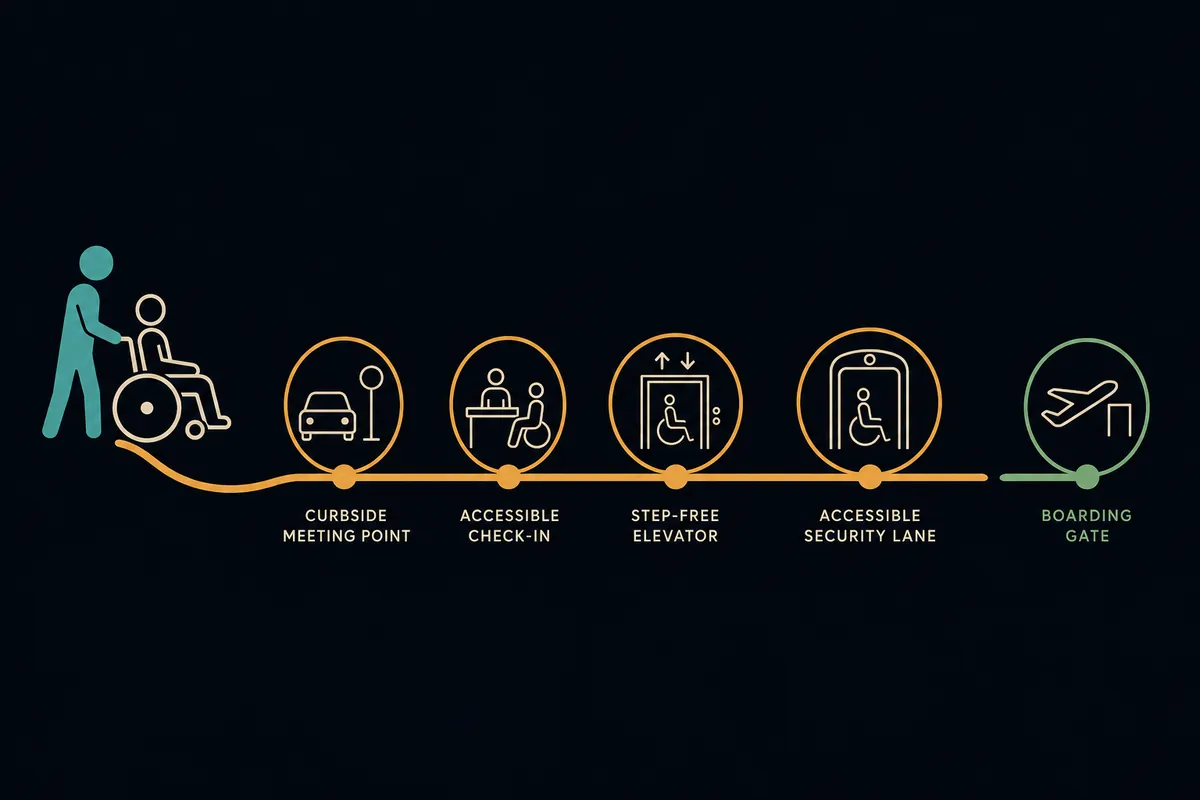
Your rights under the Air Carrier Access Act (ACAA)
The ACAA prohibits airlines from discriminating against passengers with disabilities. These protections apply to all US and foreign carriers operating flights to, from, or within the United States.
- Wheelchair assistance — free. Airlines must provide wheelchair assistance from the curb through boarding and from the gate to the curb on arrival. Request it when booking or at check-in — do not wait until you arrive at the airport.
- Accessible seating — no upcharge. If you need a seat with specific features (bulkhead row, aisle seat, seat with moveable armrests), airlines must assign you one at no charge, even if that seat is in a higher-priced category.
- On-board aisle wheelchair. Airlines operating aircraft with 30 or more seats must carry an on-board aisle wheelchair to help passengers reach the lavatory. Request one through the flight attendant before or during the flight.
- Boarding and deplaning assistance. Airlines must assist you boarding and deplaning — via jet bridge, ramp, or mechanical lift. No passenger with a disability may be left waiting on an aircraft after other passengers have deplaned.
- Aircraft accessibility disclosure. Airlines must tell you at booking whether your aircraft has an accessible lavatory. Many older narrow-body planes do not — ask before you book if this matters to your trip.
- No advance notice required for most accommodations. Airlines must provide wheelchair assistance and boarding help even on same-day requests. That said, 48 hours of advance notice allows them to better prepare for complex needs such as a ventilator or stretcher.
- Complaint Resolution Official (CRO). Every airline must have a CRO available at every airport it serves — in person or by phone — at all times it operates. If any agent denies you an accommodation, ask for the CRO by name before leaving the counter or gate.
How to assert your rights at the airport
- State your accommodation need clearly at check-in or the gate — you are not required to explain your diagnosis
- If refused, say: "I would like to speak with the Complaint Resolution Official"
- Ask for written documentation of any denial of boarding or accommodation
- File a DOT complaint at airconsumer.dot.gov — airlines must respond within 30 days
TSA Cares — your security escort
TSA Cares pairs you with a dedicated Passenger Support Specialist for your entire time at the security checkpoint. It is free and designed for travelers with disabilities, medical conditions, or other circumstances that make standard screening difficult.
- How to request. Call TSA Cares at 1-855-787-2227 at least 72 hours before your flight. TTY users dial 711. You may also submit a request via tsa.gov.
- What they provide. A trained TSA officer meets you at the checkpoint, explains each step of the screening process, and stays with you through the entire lane — you do not need to wait for a supervisor to locate someone available.
- Companions come through with you. Family members and travel companions may accompany you through the screening lane to assist — even if they are ticketed for a different flight or have already cleared separately.
- Medical equipment screening. CPAP machines, oxygen concentrators, insulin pumps, prosthetics, and cochlear implants can all be screened without being removed from your person or from their packaging. Declare them at the checkpoint before loading the belt.
- Private screening available on request. If removing medical equipment, a garment, or a prosthetic is required for screening, you have the right to do so in a private room with a same-gender officer present. Ask any TSA agent at the checkpoint.
Mobility aids and wheelchairs
Both airline-provided wheelchairs and your own personal mobility device are fully covered under the ACAA. The rules below apply to all US domestic flights.
Free
Airport wheelchairs at no charge. Airlines provide manual wheelchairs from curbside check-in through the gate and back. Request at check-in, or call the airline ahead. Airline-employed pushers are provided — you do not need to bring someone to assist.
Own
Your personal wheelchair — free checked baggage. Airlines must transport your wheelchair as the first piece of checked baggage at no charge and outside your bag allowance. It must be returned planeside on arrival whenever operationally feasible.
PWC
Power wheelchairs — call 48 hours ahead. Airlines must accept power wheelchairs. Contact the airline with your model and battery type 48 hours before departure so they can stage the correct handling equipment. Lithium batteries over 300 Wh may need to travel in the cabin rather than the hold.
$
Airline liability for damage — up to $3,800. Airlines are liable for damage to mobility aids caused during transport. The DOT maximum liability cap on domestic flights is $3,800. Photograph your wheelchair before check-in. If it arrives damaged, file a claim at the baggage desk before leaving the arrivals area — do not leave without a written acknowledgment.
Scoot
Scooters are treated identically to wheelchairs. Checked free, no bag-allowance impact, airline liable for damage up to the same $3,800 domestic cap.
Traveling with a service animal
A 2021 DOT rule update narrowed which animals airlines are required to accommodate in the cabin. Here is the current standard.
- Only trained service dogs are required. Under the 2021 DOT final rule, airlines are only required to transport trained service dogs — psychiatric or physical — in the cabin at no charge. Other species, including miniature horses, are no longer required to be accepted.
- Documentation airlines may require.For flights of 8 hours or longer, or for international routes, airlines may require the DOT Service Animal Air Travel Form, completed by a licensed veterinarian or certified trainer, confirming the animal's training and behavior standards.
- Space on board. Your service dog must fit under the seat in front of you or in your foot space. If the dog does not fit, the airline may require it to occupy an adjacent seat — which the passenger pays for at standard fare if available.
- Emotional support animals.No longer required to be accommodated in the cabin as service animals under the 2021 rule. ESAs now travel as pets and are subject to each airline's pet policy and applicable fees.
Booking tips
Online booking systems frequently cannot capture complex accessibility needs. A direct call to the airline at the time of booking prevents nearly every common airport accommodation problem before it starts.
- Call to book. Call the airline directly rather than booking online when you have specific accommodation needs — wheelchair assistance, accessible seating, supplemental oxygen, a hearing loop, or verification of an accessible lavatory on your aircraft type.
- What to tell them. Type of assistance needed (wheelchair, bulkhead seating, hearing loop, visual impairment assistance), medical equipment you are traveling with (CPAP, oxygen concentrator, insulin pump), your mobility aid model and battery type, and service animal details if applicable.
- Request an accessible seat. Ask for a bulkhead row (extra legroom and no seat in front to block transfers), an aisle seat (easier to move to and from), or a window seat (more privacy) — whichever fits your needs. Airlines must accommodate this at no upcharge.
- Arrive earlier than usual. Even with pre-arranged accommodations, wheelchair handoffs and boarding assistance add time. Arrive 30–45 minutes earlier than your normal lead time to absorb coordination delays without rushing.
Medical equipment on flights
Most common medical equipment is permitted in carry-on baggage with no fee. TSA treats it outside the standard 3-1-1 liquids rule.
Carry-on at no charge, no liquid limits. CPAP and BiPAP machines, insulin pumps, syringes (with labeled medication), hearing aids, cochlear implants, portable oxygen concentrators (FAA-approved models), and other personal medical devices may all travel in your carry-on.
Portable oxygen concentrators (POCs). FAA-approved POC models are allowed in the cabin. Personal oxygen tanks are not permitted on board. If you require supplemental oxygen, some airlines supply it for a fee on certain routes — ask at booking. Not all airlines offer this service.
Power wheelchair batteries. Lithium batteries over 300 Wh, or wet-cell batteries, may need to be removed and carried in the cabin rather than in the cargo hold. Verify specific requirements with both TSA and your airline at least 48 hours before departure.
TSA screening process. Declare all medical devices at the checkpoint before loading the belt. You may request a physical pat-down inspection instead of sending a device through the X-ray. TSA officers may swab equipment for explosive trace residue — this is standard procedure, not a flag on your specific device.
If your rights are violated
You have several avenues for recourse — at the airport and after the flight. Use them in order.
- Ask for the CRO at the airport. The Complaint Resolution Official must be available in person or by phone during all operating hours. They have authority to override gate agents on any ACAA matter.
- Request written documentation. If you are denied boarding or an accommodation is refused, ask for a written explanation before leaving the counter or gate. Airlines are required to provide it.
- File a DOT complaint. Submit at airconsumer.dot.gov. Airlines must acknowledge within 30 days and resolve or state their position within 60 days. DOT tracks complaint patterns and uses them in enforcement action.
- Wheelchair damage claim — file immediately. Go directly to the baggage desk before leaving the arrivals area. Many airlines have a 24–48 hour window for mobility aid damage claims, and leaving the airport without filing weakens your case significantly.
Before you fly, review the full TSA 3-1-1 liquid rules so medical liquids and gels clear the checkpoint without issue. If you are traveling abroad, the international travel checklist covers documentation, customs, and passport requirements. To speed up security on every trip, the TSA PreCheck enrollment guide explains eligibility, cost, and the application process — PreCheck lanes are generally shorter and less physically demanding than standard lanes.
Common questions
Does wheelchair assistance cost extra at the airport?
No — wheelchair assistance from curbside to your gate (and the reverse on arrival) is provided free by the airline as required by the Air Carrier Access Act.
Can I bring my power wheelchair on a plane?
Yes — airlines must accept power wheelchairs as checked baggage for free. Contact the airline 48 hours in advance to ensure they have the right equipment to handle it safely.
What is TSA Cares?
TSA Cares is a free helpline (1-855-787-2227) that provides a Passenger Support Specialist to accompany you through security. Call at least 72 hours before your flight.
Do service dogs fly free?
Yes — trained service dogs are permitted in the cabin at no charge on all US airlines. Documentation (DOT Service Animal Air Travel Form) may be required for long flights.
Ready to go? Make sure you leave on time.
Run your Leave-By Time and we'll count backward from your flight — today's live security wait, the drive, and the walk to your gate — so you have plenty of buffer for any accommodation handoffs without rushing to the gate.
Get your Leave-By Time →