Flight day
Red-eye flight tips: how to actually sleep on the plane
By the TSA Wait Times team · Updated · Published June 2026
A red-eye flight can save you a hotel night and let you arrive ready to go — or it can leave you wrecked for 2 days. The difference is the seat, the gear, and what you do before and during the flight. None of these require a business-class ticket.
Choose the right seat
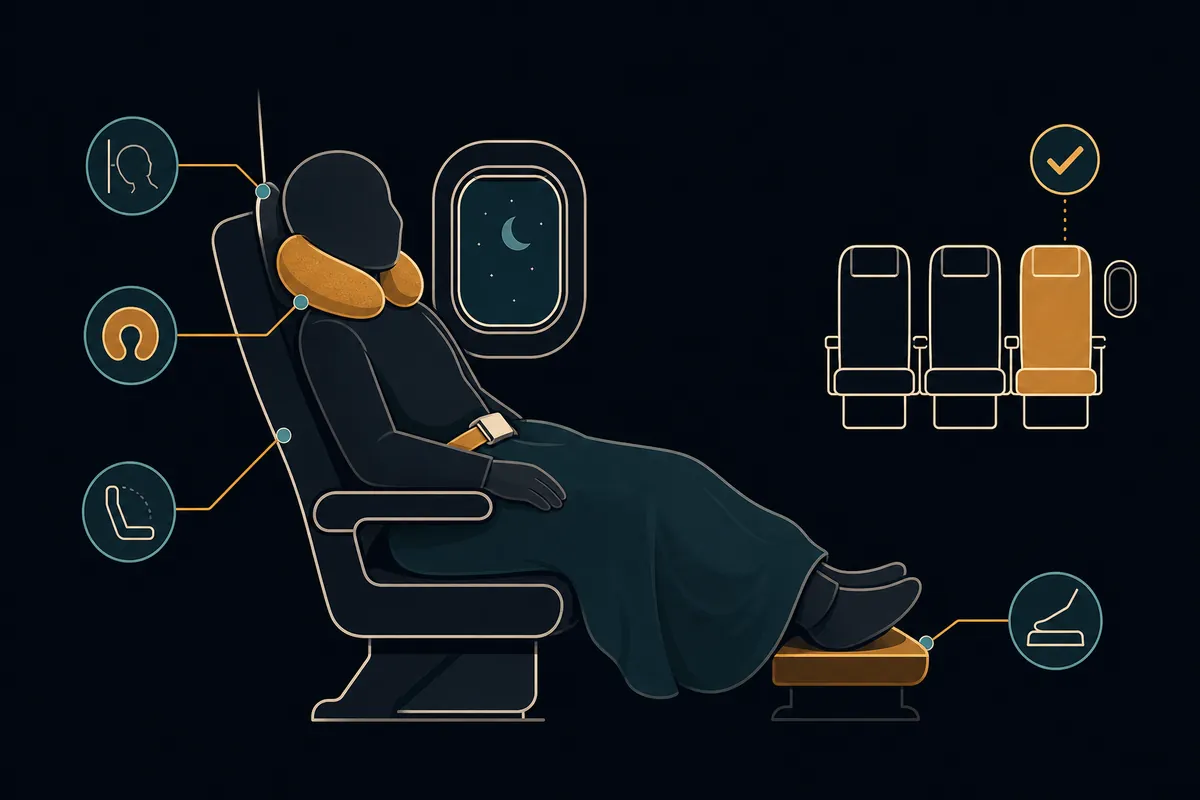
Seat selection is the highest-leverage decision you make before boarding. Get it wrong and no amount of melatonin will fix it.
- Window seat only. It is the only seat where you can lean against something solid and sleep without being interrupted by a neighbor who needs to get up. Middle and aisle seats guarantee you will be woken at least once.
- Avoid the last row. Seats in the final row of the cabin do not recline — the wall is right behind them. A non-reclining seat on a red-eye is a miserable 5–6 hours.
- Avoid the bulkhead. There is no seat in front of you to tuck bags under, and the open space becomes a gathering spot for passengers and flight attendants throughout the flight.
- Avoid the row directly in front of an exit row. These seats also do not recline — airlines lock them to keep the exit row accessible.
- Upgrade if the math works. Economy extra-legroom rows cost $30–$80 more and give you significantly more room to shift positions. Business class with a lie-flat seat is transformative on long-haul red-eyes — worth pricing out on miles.
Verify before you book
Use SeatGuru.com or your airline’s own seat map to check for seat-specific issues — obstructed windows, proximity to galleys, seats with reduced recline — before you select. Maps vary by aircraft type on the same route.
The essential gear
You do not need much, but the right items make the difference between broken sleep and 5 solid hours.
- Noise-canceling headphones.The single most impactful item for sleeping on a plane. Aircraft engine drone sits at a constant 85–95 dB — active noise-canceling cuts this dramatically. The Sony WH-1000XM5 and Bose QuietComfort 45 are the standard benchmarks. Even budget ANC headphones are a massive upgrade over foam earplugs alone.
- Eye mask.Blocks cabin lighting, neighboring passengers’ screens, and sunrise on eastbound red-eyes (which can arrive at dawn with blinding cabin light). 3D contoured masks that do not press against your eyelids are more comfortable for extended wear.
- Neck pillow. The standard U-shape works for upright sleeping. The Trtl pillow wraps around the neck and supports lateral lean — better if you sleep tilted to one side. Memory foam inflatable pillows are a good space-saving middle ground.
- Compression socks. On flights over 4 hours, cabin pressure and immobility cause lower-leg swelling. Compression socks reduce this significantly. Not directly about sleep, but your post-flight recovery will be noticeably faster.
- Lip balm and eye drops. Cabin air humidity runs at 5–12% — far drier than a typical indoor environment. Overnight you will wake with dry, scratchy eyes and cracked lips. Apply before you sleep.
Before the flight
What you do in the 8 hours before boarding matters as much as anything you do on the plane.
- Cut caffeine 6–8 hours out. Caffeine’s half-life is 5–6 hours. A coffee at 6 pm still has half its caffeine circulating at midnight. If your red-eye departs at 10 pm, your caffeine cutoff is 2–4 pm.
- Skip alcohol. Counterintuitive but consistent in the research: alcohol accelerates sleep onset but severely degrades sleep quality. You wake up 2–3 hours later, dehydrated, with elevated heart rate, and unable to fall back asleep. Save it for the return trip.
- Eat light near departure. A heavy meal close to sleep time raises your core body temperature and increases metabolism — both disrupt sleep. Eat something substantial 2–3 hours before the flight, then keep anything on board light.
- Take melatonin correctly.0.5–1 mg of melatonin taken 30 minutes before your target sleep time is effective for most people. The standard 5–10 mg over-the-counter doses are 5–10× stronger than needed and cause next-morning grogginess. Low dose, well-timed, is the method.
- Hydrate the full day before. The cabin environment starts dehydrating you the moment you board. Arriving well-hydrated gives you a buffer. Drink a full extra liter of water during the day before travel.
During the flight
- Sync to destination time.If you are arriving in the morning local time, go to sleep as soon as service ends — even if it is only 9 pm at home. Your circadian goal is to arrive rested, not to follow your home timezone.
- Dress warm. Planes are cold, and cold temperature fragments sleep. Bring a light packable jacket and put it on before you try to sleep — do not wait for the blanket cart.
- Recline immediately after service. Waiting until the cabin quiets down costs you 20–30 minutes of sleep time. If you plan to sleep, recline as soon as the seatbelt sign goes off post-takeoff.
- Skip the in-flight screen. Blue light from screens suppresses melatonin production for 30–60 minutes after viewing. If you need ambient sound, use an audio app with the screen off or use blue-light blocking glasses.
- Skip the snack service. The galley lights come on and the cart wakes light sleepers reliably. Put in your earplugs and eye mask before service reaches your row if you are already asleep or nearly there.
Jet lag recovery on arrival
A red-eye that lands you at 7 am local time is a gift — if you use the next 24 hours correctly.
- Live on local time immediately. The single most effective jet-lag technique. Eat, sleep, and exercise on the destination schedule from the moment you land. Do not adjust incrementally.
- Get morning sunlight. Natural light in the morning at your destination is the strongest circadian-clock reset available. Go outside for 30 minutes within an hour of waking on day 1.
- No nap rule (flying east).Resist the urge to nap when arriving eastbound — it delays your clock reset. Flying west: a single 20-minute nap before 3 pm local is acceptable without disrupting nighttime sleep.
- Melatonin at destination bedtime. 0.5 mg at local bedtime for the first 2–3 nights helps anchor your sleep cycle to the new timezone. Combined with morning sunlight, this is the two-lever reset.
- Keep hydrating. Jet lag symptoms are partly dehydration. Drink water consistently through arrival day — avoid the temptation to treat fatigue with heavy caffeine loads, which pushes your sleep cycle later.
Is a red-eye worth it?
Take the red-eye if
- You need to save a hotel night and the math works
- You have a meeting the next morning and need to arrive
- You are flying economy long-haul and want to sleep through most of it
- Fares are significantly cheaper and you have gear
Skip it if
- You have a high-stakes event the morning you arrive
- You genuinely cannot sleep upright or semi-reclined
- You have a short connection at arrival and need to be sharp for immigration
Frequently asked questions
Can melatonin help with red-eye flights?
Yes — 0.5mg taken 30 minutes before your target sleep time is effective for most people. Avoid higher doses (5–10mg) which can cause next-day grogginess and are far stronger than needed.
Is it better to drink alcohol to sleep on a plane?
No. Alcohol helps you fall asleep faster but significantly degrades sleep quality — you wake up earlier, dehydrated, and unable to get back to sleep. Avoid it before and during a red-eye.
Which seat is best for sleeping on a red-eye?
Window seat, not the last row (seats do not recline), not the bulkhead (people stand there constantly), and not the row directly in front of an exit row (also non-reclining). Verify your specific seat on SeatGuru before selecting.
How do I avoid jet lag after a red-eye flight?
Sync to destination time immediately on arrival — eat, sleep, and exercise on local time. Get outdoor sunlight within the first hour of waking. Take 0.5mg melatonin at local bedtime for 2–3 nights to reset your sleep cycle.
Related guides
- How to fly carry-on only: the complete strategy — one bag, no checked fees, skip baggage claim on arrival
- International travel checklist — passport, visa, Global Entry, and what to do 48 hours before departure
- How to upgrade your flight — miles, cash upgrades, and when to ask at the gate
Know your Leave-By Time before you head to the airport
Red-eyes board on time — but security on late-night flights can back up fast. Use the Leave-By Time calculator to factor in live security wait, your drive, and check-in cutoffs into one exact time to leave home.
Calculate your Leave-By Time →Verified as of . Sources: Sleep Foundation, The Points Guy, NerdWallet.