Baggage
How to pack a carry-on bag: tips to fit more and move faster
By the TSA Wait Times team · Updated · Published June 2026
Most major US airlines cap carry-ons at 22 × 14 × 9 inches — a standard 40-liter bag. Packed right with rolling or bundle technique and a pair of compression cubes, that volume holds a full week of clothes while skipping the $45–$90 round-trip bag feethat Delta, United, American, and now Southwest all charge in 2026. Here’s what actually matters: size limits by airline, the packing method that wins on volume, the load order that gets you through security fast, and exactly how much money you save.
What Are the Actual Carry-On Size Limits for US Airlines in 2026?
Carry-on dimensions have not changed for the major carriers in 2026, but enforcement has tightened. Airlines are measuring bags more consistently at the gate — and some airports (starting in Canada) are piloting laser scanners that cannot be squeezed past like a metal sizer bin. Never use your bag’s expansion zipper: a visibly bulging bag gets flagged first. Budget carriers like Frontier and Allegiant charge $60–$100 at the gatefor a full carry-on; their only free bag is a personal item capped around 18 × 14 × 8 inches. On JetBlue’s Blue Basic fare, the carry-on is blocked entirely.
| Airline | Carry-On Max (in, incl. wheels/handles) | Personal Item Max (in) |
|---|---|---|
| American | 22 × 14 × 9 | 18 × 14 × 8 |
| Delta | 22 × 14 × 9 | 18 × 14 × 8 |
| United | 22 × 14 × 9 | 17 × 10 × 9 |
| JetBlue | 22 × 14 × 9 (Blue Basic: personal item only) | 17 × 13 × 8 |
| Alaska | 22 × 14 × 9 (except Basic) | 17 × 13 × 6 |
| Southwest | 24 × 16 × 10 | 18.5 × 13.5 × 8.5 |
| Frontier / Allegiant | Paid add-on only ($60–$100 at gate) | 18 × 14 × 8 (free) |
All dimensions include wheels and handles. Spirit Airlines is not listed: it ceased operations in May 2026.
Rolling vs. Folding vs. Bundle Packing: Which Method Saves the Most Space?
Rolling — especially the tight military-style Ranger Roll — saves more bag volume than traditional flat folding and produces fewer wrinkles under compression. A May 2026 head-to-head test used an 11-liter bean-displacement method to measure dead air space across four packing methods: Ranger Roll won decisively. Bundle packing (wrapping garments around a central soft core) works best for wrinkle-prone dress clothes because there are no fold lines to crease. Flat folding is the slowest method and leaves the most dead space.
- Ranger Roll (tight military roll): highest volume efficiency for casual clothes, fewest wrinkles
- Bundle wrap: best for dress shirts, slacks, blazers — zero fold lines
- Standard roll: good balance of speed and space, works for nearly anything
- KonMari stand-up fold: efficient for drawers at home, slower with limited space advantage in a packed bag
- Flat fold: avoid in a carry-on — creates the most wasted dead space
What Is the Right Order to Load a Carry-On Bag?
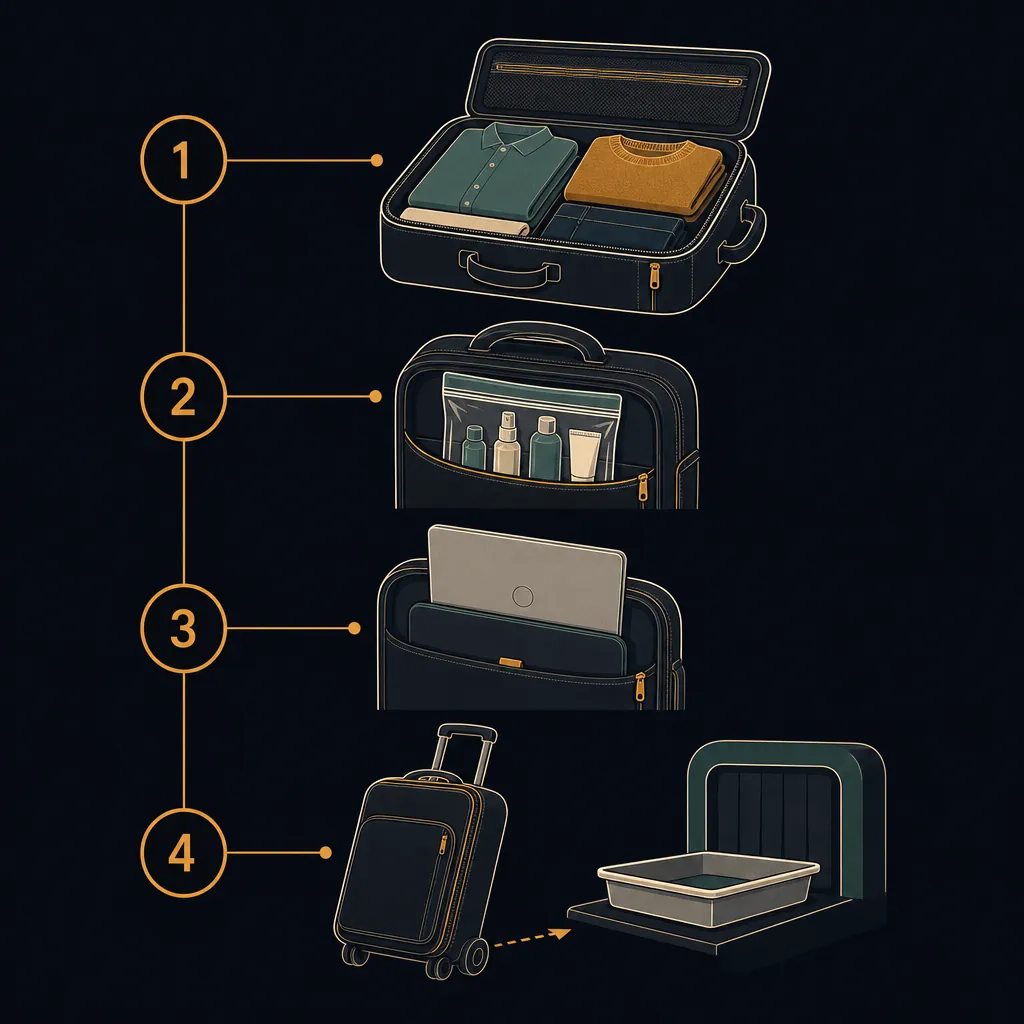
Start with the heaviest items near the wheels so the bag rolls balanced and its weight stays low. Put shoes along the bottom or side edges with soles facing outward inside a shoe bag or shower cap to keep soles off clothes. Stuff rolled socks and small accessories inside the shoe cavities — dead space that most travelers waste. Layer rolled or compressed clothes next, with heavier items (denim, sweaters) closer to the wheels and lighter layers toward the top. Reserve the very top for your electronics pouch and your TSA quart-bag of liquids so both come out at the checkpoint in one pull without unpacking the whole bag.
- Bottom / near wheels: shoes in shoe bags, heaviest clothes
- Inside shoes: rolled socks, chargers, small accessories
- Middle layers: rolled clothes, heaviest first
- Top: electronics pouch (keep cables together), TSA quart-bag for liquids
- Jackets and bulky sweaters: wear on the plane — they do not count against your bag allowance
Do Packing Cubes Actually Help You Fit More?
Packing cubes do not add volume to your bag, but they eliminate the air pockets that form when loose clothes shift around — and that wasted space is what causes most travelers to feel like they cannot fit everything. Compression packing cubes, which have a secondary zipper that squeezes out air, can reduce soft-clothing bulk by 30–40%. Standard (non-compression) cubes are better for wrinkle-prone items because compression smashes delicate fabrics. Avoid bulky vacuum-seal compression bags for carry-on travel; they cannot be resealed without a vacuum pump.
- Standard cubes: organize and prevent shifting, safe for delicate fabrics
- Compression cubes: reduce soft-clothing bulk 30–40%, ideal for T-shirts, activewear, pajamas
- One cube per category (tops / bottoms / underwear-socks) for fast access and quick repacking at a hotel
- Skip vacuum-seal bags — impossible to reseal on the return trip without equipment
How Do You Handle Toiletries and Liquids Without Checking a Bag?
TSA’s 3-1-1 rule is unchanged for 2026: all liquids must be in containers of 3.4 oz (100 ml) or less, all fitting inside one clear quart-sized zip-top bag, one bag per person. Many US airports now have advanced CT scanners that may not require removal of the liquids bag at the checkpoint — but always pack it at the top of your bag anyway, since connecting airports may use older equipment. The most effective way to shrink your liquid footprint is to switch some products to solid form: shampoo bars, conditioner bars, and solid sunscreen have no size restriction and take zero quart-bag space. See the full rules in our carry-on liquids 3-1-1 rule guide.
- 3.4 oz / 100 ml max per container — no exceptions; pack quart-bag at the very top for fast checkpoint access
- Solid shampoo bars and conditioner bars: no size limit, no quart-bag space used
- Solid deodorant, solid sunscreen stick: both exempt from 3-1-1
- Power banks must be in your under-seat personal item, NOT the overhead-bin carry-on (TSA rule since 2025)
- Buy heavy liquid toiletries (shampoo, conditioner, lotion) at your destination for trips of 5 days or more
Can You Fit a Full Week of Clothes in One Carry-On?
Yes — a standard 40-liter bag(the size that fits 22 × 14 × 9 inches) holds seven days of clothes for most travelers when packed with rolling or bundle packing and compression cubes. The strategy is versatility over volume: plan five to seven bottoms and seven tops in neutral colors that mix-and-match into multiple outfits, rather than packing an outfit per day. Merino wool tops are the highest-leverage item — they resist odor and can be worn two to three days between washes, effectively cutting your top count in half. Limit yourself to two pairs of shoes maximum: wear the bulkier pair on travel day, since a jacket, coat, or shoes worn on your body do not count toward your bag allowance on any major US airline.
- 7 tops, 5–7 bottoms, 7 underwear/socks fits most 40L bags with rolling
- Merino wool tops: rewear 2–3 days, cutting the number of items needed
- Neutral/dark colors create more outfit combinations from fewer pieces
- 2 shoes max: wear the bulkier pair on travel day
- Jacket, bulky sweater, heavy boots worn on the plane = not counted against your bag
How Much Money Does Carry-On-Only Save in 2026?
Delta, United, and American all charge $45 for the first checked bag each way, $55 for the second — a round trip with one bag costs $90 on any of the three. Southwest eliminated its famous “two bags fly free” benefit in May 2025 and now charges comparable fees. If you wait until the gate to check a bag, the fee rises to $35–$65 on legacy carriers and up to $100 on budget airlines. On Frontier or Allegiant, the carry-on itself costs $60–$100 at the gate — so fitting everything into the free personal item saves even more. See the full 2026 fee breakdown in our airline baggage fees compared guide.
- Delta / United / American: $45 first checked bag each way ($90 round-trip)
- Southwest:ended “two bags fly free” in May 2025 — now charges $35–$45 per bag
- Gate-check fee if carry-on is rejected: $35–$65 legacy, up to $100 budget airlines
- Frontier / Allegiant carry-on fee: $60–$100 if added at the gate
- 10 round-trips/year × $90 saved = $900+ annually
See all airline check-in and baggage policies for fees, carry-on rules, and check-in cutoffs by carrier.
Know your Leave-By Time before you pack
Packing carry-on-only only saves money if you make the flight. Use the Leave-By Time calculator to fold your airport’s live security wait, your drive, and your airline’s check-in cutoff into one exact time to leave home.
Calculate your Leave-By Time →Verified as of . Sources: SmarterTravel, Skyscanner, YouTube packing method study (May 2026, 472k views).
Keep planning
Baggage
Airline baggage fees, compared
What every major airline charges for carry-on and checked bags in 2026 — including Southwest, which dropped free bags.
BaggageHow to avoid checked bag fees
Credit card waivers, airline status perks, and packing tricks that keep bag fees off your bill.
BaggageOversize and overweight baggage fees by airline (2026)
Bags over 50 lbs or 62 linear inches cost $100–$200 extra — here is what each major US airline charges.
BaggageCarry-on size limits by airline (2026)
Maximum carry-on and personal item dimensions for every major US airline — and which base fares include a carry-on.