Security
Medications through airport security: TSA rules for pills, liquids, and devices
By the TSA Wait Times team · Updated · Published June 2026
Prescription pills face zero restrictions at TSA checkpoints — no quantity limits, no declaration, and no prescription required at security. Liquid medications, insulin, GLP-1 injectables, syringes, EpiPens, and most medical devices are all allowed in carry-on with simple steps that take under a minute. Here is exactly what to carry, what to declare, and what to skip worrying about.
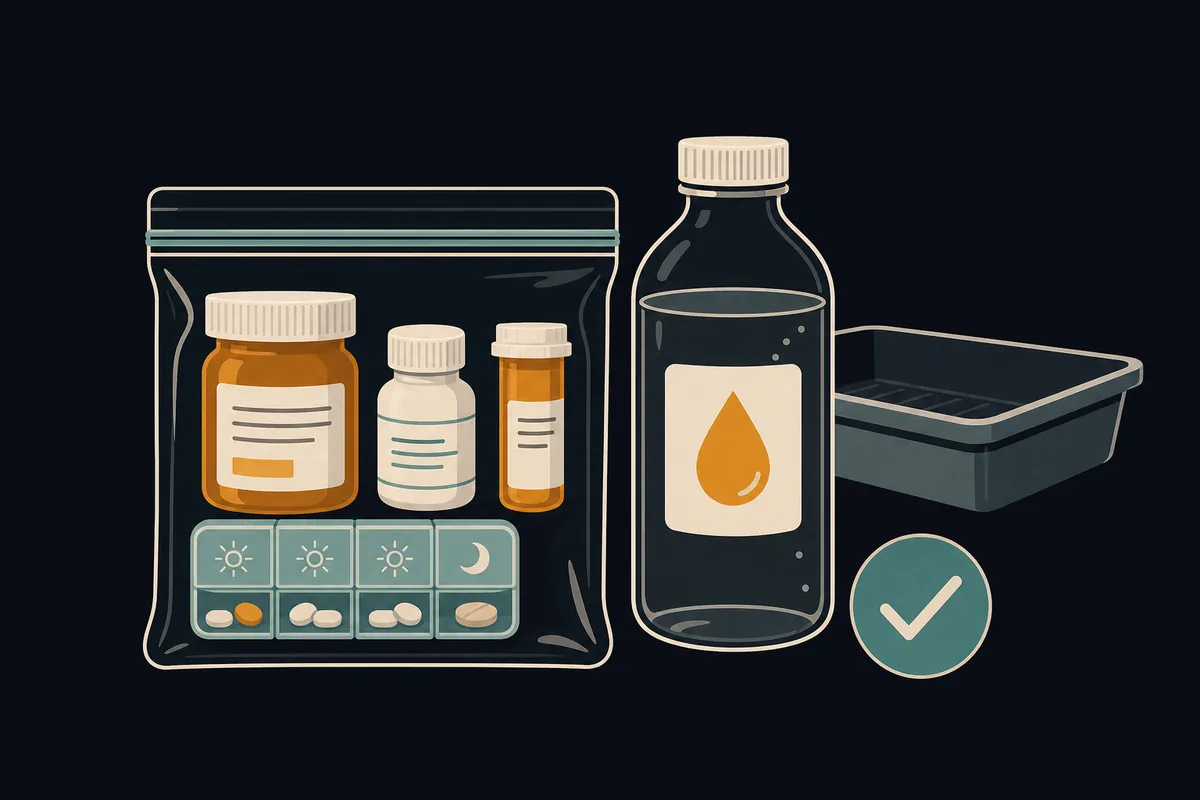
Pills, tablets, and solid medications: no limits, no declaration needed
Solid medications — pills, tablets, capsules, vitamins, and supplements — are subject to zero TSA quantity restrictions and do not need to be declared. You do not need a prescription label at the checkpoint, though keeping medications in original pharmacy containers helps if you face additional screening. Loose pills in a pill organizer are technically allowed but may prompt a closer look from officers — labeled original bottles are the path of least resistance.
- No quantity limit for personal-use pills or tablets
- No declaration required before screening
- No prescription required at the checkpoint
- Original labeled pharmacy bottles speed up additional screening
- Pill organizers are allowed — label them if possible to avoid delays
Liquid medications are exempt from the 3-1-1 rule — but you must declare them
Medically necessary liquid medications are fully exempt from TSA's 3-1-1 limit (3.4 oz / 100 ml per container), and any quantity is allowed in carry-on. This covers liquid antibiotics, cough syrup, liquid nutritional supplements, and other prescription or OTC liquid medicines. The declaration step is simple: remove liquid medications from your bag before the X-ray belt, place them in a separate bin, and tell the officer. Officers may swab-test the liquid for explosives residue — this is standard procedure and does not indicate suspicion.
- Any bottle size allowed — the 3.4 oz cap does not apply
- Remove from carry-on and place in a separate bin before X-ray
- Declare verbally to the TSA officer before screening starts
- May be swab-tested for explosives residue — normal and quick
- Keep in original labeled container when possible to confirm medical purpose
Insulin, syringes, and injectable medications including Ozempic and GLP-1s
Insulin, syringes, and GLP-1 injectable medications — including Ozempic, Wegovy, Zepbound, and Saxenda — are all allowed in carry-on bags. Per TSA.gov, insulin pumps and supplies must be accompanied by insulin, and insulin in any form must be clearly identified. Notify the TSA officer that you have diabetes or are carrying injectable supplies; you do not need to remove an insulin pump or continuous glucose monitor (CGM) from your body. Ice packs and freeze packs used to keep insulin at temperature qualify as medically necessary and are also exempt from the 3-1-1 rule.
- Insulin in any form or dispenser: allowed in carry-on and checked bags
- Insulin pump must travel with insulin; pump supplies (tubing, batteries, catheters, infusion kits) all allowed
- Continuous glucose monitors (CGMs): do not need to be removed from body
- GLP-1 pens (Ozempic, Wegovy, Zepbound, Saxenda): same rules as insulin
- Unlimited used syringes allowed in a hard-surface Sharps disposal container
- Ice packs for insulin temperature control: medically necessary exemption applies
EpiPens, inhalers, CPAP machines, and implanted medical devices
EpiPens are allowed in carry-on and recommended to keep there rather than checked bags; bring a prescription label or doctor's note if possible, though not required. Inhalers pass through security with no special steps. CPAP and BiPAP machines are carry-on items and do not count against your carry-on allowance on most airlines; remove the device from its bag for X-ray. For implanted devices such as pacemakers, spinal cord stimulators, or cochlear implants, tell the TSA officer before approaching any metal detector — a pat-down alternative can be arranged. Portable nebulizers with built-in batteries must go in carry-on, not checked baggage, per battery safety rules.
- EpiPen: allowed carry-on; prescription label helpful but not required
- Inhaler: no special steps at security
- CPAP/BiPAP: carry-on; remove from case for X-ray; does not count as extra bag on most airlines
- Pacemaker or implanted device: notify TSA officer before screening; manual pat-down available
- Portable nebulizer with battery: carry-on only — battery rules prohibit checked bags
- A medical device ID card can speed up alternative screening for implanted devices
Medical marijuana at airport security: what the updated 2026 TSA policy actually says
TSA security officers do not actively search for drugs — their focus is aviation security, not drug enforcement. However, the TSA's medical marijuana page (last updated April 27, 2026) states that if any illegal substance is discovered during screening, TSA will refer the matter to a law enforcement officer. Marijuana remains a Schedule I controlled substance under federal law regardless of state medical marijuana programs or cards. In a 2026 language update, TSA removed a blanket statement calling marijuana federally illegal from this page, but the referral-to-law-enforcement policy is unchanged. CBD products derived from hemp with less than 0.3% THC are federally legal and generally allowed; verify the label before travel.
- TSA does not actively search for marijuana or drugs
- If found during screening, TSA will refer to local law enforcement — outcome varies by jurisdiction
- Federally illegal regardless of state MMJ card or prescription
- TSA page updated April 27, 2026 — no change to core referral policy
- Hemp-derived CBD under 0.3% THC: federally legal and generally allowed; check label
- Do not bring marijuana — including state-legal medical marijuana — to a checkpoint
Medication types and TSA rules at a glance
Use this quick-reference table to plan what to declare and how to carry your medications. The most common traveler mistake is not declaring liquid medications before screening, which triggers a bag search and slows the entire lane. Declaration takes ten seconds and eliminates that risk.
| Medication or item | Carry-on allowed | Must declare to TSA |
|---|---|---|
| Pills, tablets, capsules | Yes — any quantity | No |
| Liquid medication (any size) | Yes — exempt from 3-1-1 | Yes — remove from bag and notify officer |
| Insulin (vial, pen, pump) | Yes | Yes — notify officer of diabetes |
| GLP-1 injectables (Ozempic, Wegovy, etc.) | Yes | Yes — notify officer |
| Syringes and needles | Yes (must be with medication) | Yes |
| EpiPen | Yes — carry-on recommended | Recommended |
| Inhaler | Yes | No |
| CPAP or BiPAP machine | Yes — carry-on only | Yes — remove from case for X-ray |
| Ice packs for medication | Yes — medically necessary | Yes — declare as medical |
| Medical marijuana | No — federally illegal | N/A — do not bring |
TSA Cares: how to get extra help before you fly with medical needs
TSA Cares is a free program for passengers with disabilities, medical conditions, or complex medical equipment. Call 855-787-2227 at least 72 hours before your flight to request a Passenger Support Specialist who will meet you at the checkpoint and guide you through the entire screening process. The program is consistently praised by travelers with insulin pumps, CPAP machines, wheelchairs, and other equipment. You can also request assistance via email through TSA's website. For international travel, note that other countries have independent rules — common US medications including pseudoephedrine (Sudafed) and ADHD medications such as Adderall are banned in some countries; check destination requirements separately.
- Hotline: 855-787-2227
- Call at least 72 hours before your flight
- A Passenger Support Specialist meets you personally at the checkpoint
- Free — no cost to use
- Also helpful for wheelchair users, amputees, and travelers with anxiety about screening
- International travel: check destination country rules — some US medications are banned abroad
If you are flying through a busy hub, knowing your security wait time before you leave can make the difference between a calm checkpoint experience and a stressful one. TSA PreCheck, CLEAR, and Global Entry can significantly cut your wait, which matters most when you are carrying medical equipment that requires extra screening time.
Know your Leave-By Time before you pack
Add your airport, flight time, and whether you need extra screening time — the calculator folds in today's live security wait and your drive to give you one exact time to leave home.
Calculate your Leave-By Time →Facts verified . Sources: TSA medical items, TSA medical marijuana (updated Apr 27, 2026), TSA Cares.
Keep planning
Security
How long does airport security really take?
Most travelers clear standard screening in 15 to 30 minutes — but the hour you pick changes everything.
SecurityWhat you can (and can't) bring through security
Liquids, laptops, snacks, and the things that surprise people — a plain-language packing check before you go.
SecurityCarry-on liquids: the 3-1-1 rule, explained
3.4 ounces, one quart bag, one per traveler — plus the exceptions for medications and baby formula.
SecurityAirport security tips for families with kids
From stroller gate-checks to formula at the X-ray belt — everything parents need to know to move a family through TSA quickly.