Family travel
How to get seats together on a plane in 2026
By the TSA Wait Times team · Updated · Published June 2026
Since the FAA Reauthorization Act of 2024, US airlines are required to seat children under 13 adjacent to an accompanying adult at no extra charge — no family should have to pay for seat selection just to sit with their young child. Here is what the law says and how each airline handles it.
The 2024 DOT family seating rule
The FAA Reauthorization Act of 2024 (signed May 2024) required DOT to establish a rule prohibiting airlines from charging parents extra fees to sit with children under 13. DOT issued a proposed rule in August 2024 requiring airlines to seat a child under 13 adjacent to an accompanying adult at no additional charge when adjacent seats are available. Airlines must make a good-faith effort to assign these seats during booking.
What it means. If you book early enough and adjacent seats are available, airlines must assign them together. The rule does not require airlines to upgrade seats (e.g., exit rows) or guarantee specific seat categories.
Airlines must make a good-faith effort. Adjacent seats must be assigned during booking when available. Airlines cannot structure fares (such as making basic economy consist only of middle seats) to avoid compliance.
Enforcement. If you are charged extra to sit with a child under 13 in standard economy seats, you can file a complaint with DOT at airconsumer.dot.gov.
Per-airline family seating policies (2026)
Each airline approaches family seating differently. Some handle it automatically at booking; others require you to take action.
Southwest — open boarding, families board early
- Family Boarding (child 6 or under). Southwest's open boarding model is one of the easiest for families. Book Family Boarding and you board between the A and B groups — before most other passengers — and choose any remaining seats together.
- Older children (7–12). Purchase EarlyBird Check-In ($15–25/person) for a better boarding position. Southwest's open-boarding model generally makes sitting together easy even without it.
Delta — automatic family seat assignment
- Delta automatically assigns families with children under 14 adjacent seats during booking when possible. Comfort+ and Main Cabin both auto-assign.
- If not assigned together. Call Delta or request at check-in — gate agents can often reassign. Basic Economy has more limited seat assignment flexibility.
Alaska — automatic, no extra charge
- Alaska assigns families with children under 13 adjacent seats at no extra charge during booking. One of the most proactive carriers on this issue.
- If not assigned together. Call ahead. Alaska's customer service proactively resolves family seating issues before travel day.
JetBlue — same row, no charge (except Blue Basic)
- JetBlue assigns families with children 13 and under adjacent seats in the same row at no charge when available.
- Blue Basic caveat. Blue Basic restricts seat selection. Families on Basic should upgrade to Blue to ensure adjacent seating is handled automatically.
United — compliant; Basic Economy requires proactive steps
- United complies with the DOT rule for children under 13 in economy cabins.
- Basic Economy. United's Basic Economy limits seat selection. If you booked Basic Economy, upgrade to a regular economy fare or call United before the flight to request family seating as an accommodation.
- Pro tip. Book early so adjacent seats are still available when the airline makes automatic assignments.
American — compliant; call for Basic Economy
- American complies with the DOT rule for children under 13. Main Cabin fare allows seat selection; adjacent seats are held for family assignments.
- Basic Economy. Call American to request family seating explicitly if adjacent seats were not assigned. They are required to accommodate if seats are available.
Frontier and Allegiant — call to request; DOT rule applies
Both Frontier and Allegiant charge for seat selection on all fares — but adjacent seats for children under 13 must be provided at no extra charge under the DOT rule. If the booking system tries to charge you for seats to sit with your child, call the airline directly to request complimentary family seating.
How to guarantee adjacent seats without paying extra
The DOT rule is your backstop, but these steps make it easy before you ever need to invoke it.
- 1Book early. The earlier you book, the more adjacent seats are available and the more likely automatic assignment works. Book as soon as your itinerary is set.
- 2Book everyone on the same reservation. Split reservations between adults and children make automatic family seating assignment impossible. All travelers should be on one booking.
- 3Call the airline. If you did not get adjacent seats automatically, call. Explain you are traveling with a child under 13. Airlines are legally required to try to accommodate this at no fee.
- 4Check in early. At the 24-hour mark, more passengers have checked in and adjacent seats sometimes free up as the seat map firms up. Verify your seat assignment at check-in.
- 5At the gate. Ask the gate agent. They can often move passengers to create adjacent seats for families. Other passengers are usually also willing to swap when asked politely.
What if another passenger will not move?
You cannot force another passenger to give up their assigned seat. However, you have more options than you might think.
- Ask politely — most people will swap a comparable seat for a family with a young child. Framing it as a swap (not a request to give up a good seat for nothing) helps considerably.
- Ask the gate agent to help facilitate a swap. They can often find an alternative pair of adjacent seats elsewhere on the plane.
- DOT complaint. If the airline made no effort to seat a child under 13 with a parent and adjacent seats were available, document the interaction and file a complaint at airconsumer.dot.gov.
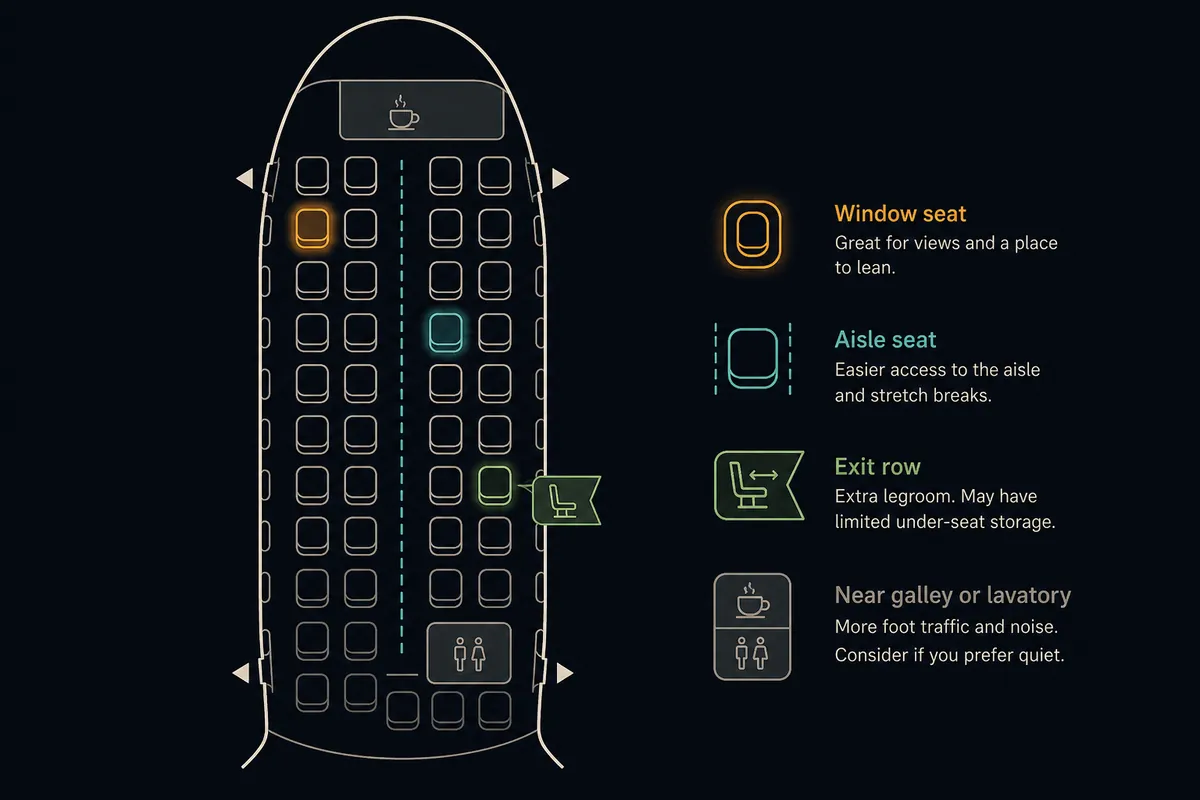
Which seats are best for families?
Once adjacent seats are confirmed, seat choice still matters for how smooth the flight goes.
Bulkhead row. More floor space, no seat in front — useful with lap infants and toddlers. Downside: no under-seat storage, so carry-ons must go overhead only.
Exit row — avoid. Children under 15 and lap infants are prohibited from exit rows on all US carriers. Do not request exit rows for families.
Window + middle. On a 3-seat row, a parent at the window and child in the middle keeps the child away from aisle traffic and gives them something to look at.
Rear of the plane. Closer to lavatories, easier aisle access, and often quicker boarding for families on Southwest since rear seats are usually still open.
Bulkhead aisle. Best of both worlds — aisle access for bathroom runs plus proximity to lavatories without the confinement of a middle seat.
For a full breakdown of everything involved in flying with children, see our complete flying-with-kids guide. If your child is flying solo, the unaccompanied minor guide covers airline policies and fees for children traveling alone. New to flying? The first-time flyer guide walks through every step from booking to landing.
Common questions
Can airlines charge to seat families with young children together?
Not in the US for children under 13 — the DOT rule from the FAA Reauthorization Act of 2024 requires airlines to seat children under 13 adjacent to an accompanying adult at no extra charge when possible.
What do I do if we are not assigned seats together?
Call the airline before the flight and explain you are traveling with a child under 13. If that fails, speak to the gate agent on the day of travel — they have the most flexibility.
Does the family seating rule apply to basic economy?
The DOT rule applies to all fare classes. However, airlines must make a good-faith effort — if no adjacent seats are available (e.g., a sold-out flight where all adjacent seats were already taken), the obligation is harder to enforce.
At what age can children sit separately from parents on a plane?
The DOT rule covers children under 13. Children 13 and older are treated as adults for seating purposes — airlines have no legal obligation to seat a 14-year-old with their parent.
Seats sorted — now nail the timing.
Run your Leave-By Time and we'll count backward from your flight — today's live security wait, the drive, and the walk to your gate — so your family arrives with room to breathe instead of running for the gate.
Get your Leave-By Time →