Getting started
First time flying: everything you need to know (2026)
By the TSA Wait Times team · Updated · Published June 2026
Flying for the first time can feel overwhelming — but the process is straightforward once you know what to expect. This guide walks through every step from the night before your flight to landing at your destination.
On this page
- Before you leave home
- At the airport: step by step
- The 3-1-1 rule for liquids
- Boarding the plane
- On the plane
- Arriving and getting your bag
- Handling delays and changes
- What not to bring
- Common questions
Before you leave home
01
Confirm you have the right ID
You need a REAL ID-compliant driver's license (marked with a gold or black star) or a passport to fly domestically. Since May 7, 2025, standard state IDs without the star are no longer accepted at TSA checkpoints. A passport always works.
02
Check in online — 24 hours before departure
Open your airline's app or website exactly 24 hours before departure and check in. Download your boarding pass to your phone or print it. Checking in early often lets you pick a better seat and skips the counter line.
03
Pack your carry-on with the essentials
Keep in your carry-on: photo ID, boarding pass, phone charger, medications, valuables, and a change of clothes if you are checking a bag. Anything you cannot afford to lose stays with you in the cabin.
04
Pack your liquids correctly the night before
All liquids, gels, and aerosols must be in 3.4 oz (100ml) or smaller containers, all fitting in a single quart-sized clear zip-lock bag — one bag per person. Pack it the night before so there is no fumbling at the checkpoint.
05
Plan to arrive at the airport early
Domestic flights: arrive 2 hours before departure. International: 3 hours before. First-time flyers: add 30 more minutes as a buffer. It is always better to sit at your gate early than to sprint to it.
At the airport: step by step
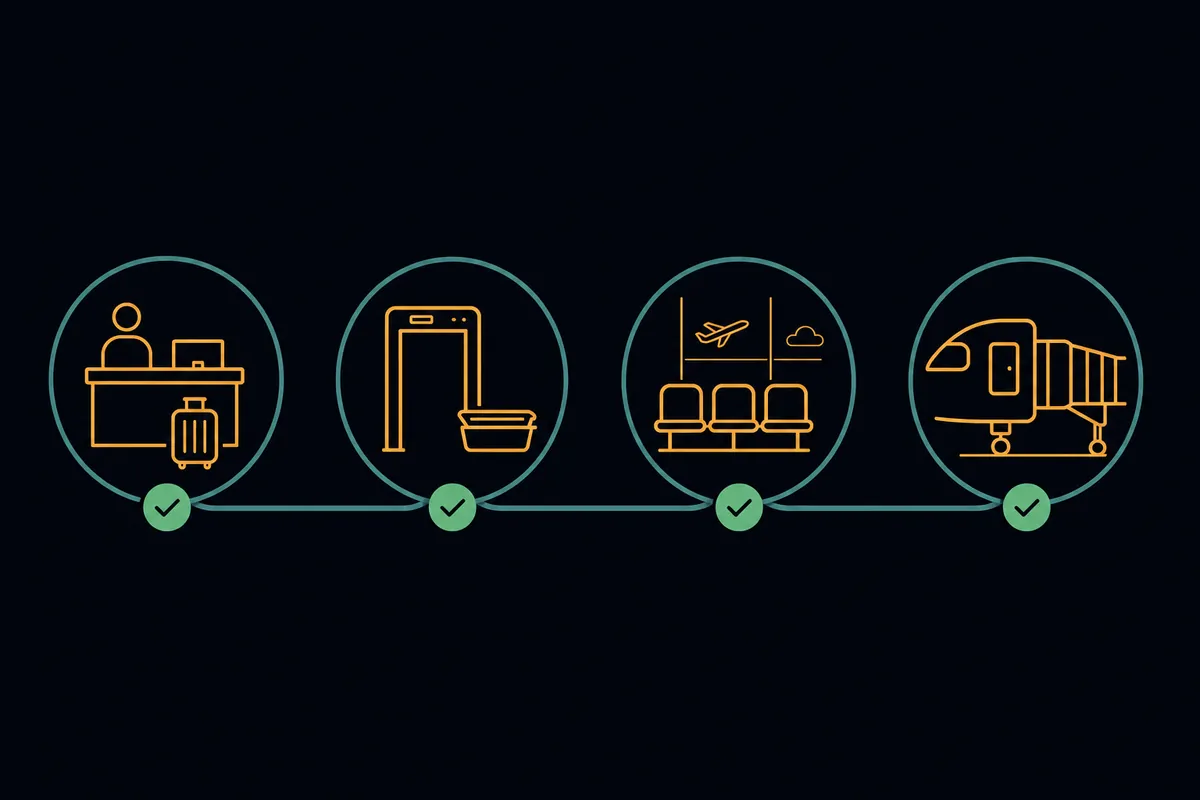
Once you arrive, these six steps take you from the terminal door to your gate.
Step 1
Check your bag (if applicable)
If you have a checked bag, find your airline's check-in counter. Show your ID and boarding pass, pay any bag fee, weigh your bag (most airlines: 50 lb limit for standard bags), and receive a bag claim ticket. Keep this tag — you will need it to claim your bag at your destination.
Step 2
Find the security checkpoint
Follow signs for "TSA Security" or "Checkpoints." Expect 10–30 minutes in line at most airports — longer during peak hours (early morning, holiday weekends).
Step 3
Wait in line — ID and boarding pass ready
Join the general screening line (or TSA PreCheck if you have it). You will show your boarding pass and ID twice: once to a TSA officer at the start of the line, and once at the document scanner.
Step 4
Prepare for the scanner
- Remove your shoes and place them in a bin
- Remove your laptop from your bag — it goes in its own separate bin
- Remove your quart-bag of liquids and place it flat in the bin
- Remove your jacket or coat
- Place your carry-on bag on the X-ray belt
- Walk through the millimeter wave scanner — arms overhead for 2 seconds
Step 5
Collect your items
Gather everything from the belt — shoes, bag, laptop, liquids, jacket. Move to a bench away from the conveyor to put your shoes back on so you do not block others.
Step 6
Find your gate
Follow signs to your terminal and gate number (shown on your boarding pass). You can sit anywhere in the gate area — listen for boarding announcements for your group.
The 3-1-1 rule for liquids
Any liquid, gel, paste, cream, or aerosol in your carry-on must meet all three conditions simultaneously — meeting two out of three is not enough.
3
.4 oz (100ml) or smaller — the container size limit
The number printed on the bottle is what counts. A half-empty 12 oz bottle fails even though it holds very little liquid. Buy travel-size or transfer into a small reusable bottle before you leave home.
1
quart-sized clear zip-lock bag — all containers go in together
A sandwich bag is too small; a gallon bag is too large. Find quart-size bags at any grocery store. Pull it out of your bag and place it flat in a bin at the checkpoint.
1
bag per person — not per group
Each traveler gets their own quart bag. You cannot combine two people's liquids into one bag.
Items exempt from the 3-1-1 rule
- Baby formula and breast milk — any reasonable quantity; child does not need to be present
- Medically necessary liquid medications — declare them at the checkpoint
- Beverages purchased after the security checkpoint — no restrictions once you are airside
Full detail in the TSA liquid rules: complete 3-1-1 guide.
Boarding the plane
Boarding groups
Airlines board by group — usually business class and frequent flyers first, then economy by zone. Your boarding pass shows your group number or letter. Wait until your group is called before joining the queue at the door.
Boarding pass scan
At the jet bridge entrance a gate agent scans your phone screen or paper boarding pass. A green light means you are cleared. Walk down the jet bridge to the plane door.
Finding your seat
Your seat number is on your boarding pass — for example, 24A means row 24, seat A. On most aircraft, A/B/C are on the left (window, middle, aisle) and D/E/F are on the right (aisle, middle, window).
Overhead bin
Place your rolling carry-on in the overhead bin above or near your seat — wheels-first, bag lying flat — to maximize space for other passengers. Your smaller personal item (backpack, purse) goes under the seat in front of you.
On the plane
Seat belt
Keep your seat belt fastened whenever you are seated. The seat belt sign can illuminate without warning during turbulence — buckle up even when the sign is off to be safe.
Turbulence
Turbulence feels jarring but is normal and rarely dangerous. Commercial aircraft are certified to withstand far more turbulence than you will ever encounter in service. The seat belt keeps you in your seat if turbulence is severe — so wear it.
Ear popping during climb and descent
Cabin pressure changes cause the sensation. Swallowing, yawning, or chewing gum helps equalize pressure in your ears. For painful ears, try the Valsalva maneuver: pinch your nose shut, close your mouth, and gently blow as if blowing your nose.
Electronics
Turn on airplane mode before the door closes. You can use phones, tablets, and laptops in airplane mode for the entire flight. Some aircraft offer paid WiFi — check the in-seat screen or the airline app for details.
Food and drinks
Most domestic flights under 3 hours offer only snacks for purchase. Bring your own solid food through security — no restrictions on food, only on liquids and gels. Long-haul and international flights, and business class on most airlines, include meal service.
Arriving and getting your bag
- 01Disembarking. Rows at the front exit first. Wait for your row to clear before standing. The aisle fills quickly — it always goes slowly, and rushing only creates congestion.
- 02Baggage claim.Follow signs for “Baggage Claim.” Find the carousel number for your flight on the overhead screens. Always check the bag tag number against your claim ticket before you lift the bag.
- 03Lost luggage.If your bag does not arrive, go to the airline's baggage service desk before leaving the airport. They will file a trace report and most bags are delivered within 24 hours. Keep your claim tag until you confirm delivery.
Handling delays and changes
Flight delayed
Check your airline app — it pushes real-time delay alerts. For long delays (3+ hours), the airline may offer food vouchers or the option to rebook on a different flight at no cost. Ask at the gate or call the airline's customer line directly.
Flight cancelled
The airline must offer you a full refund or rebooking on the next available flight at no additional cost. Use the airline app to rebook — the app is usually faster than standing in the gate line when many flights are affected at once.
Missed connection
Go immediately to the gate for your connecting flight and tell the agent you are connecting from a delayed inbound flight. If the missed connection was the airline's fault, they are required to protect you on the next available departure at no charge.
What not to bring
Never in carry-on
- Firearms or realistic firearm replicas
- Pepper spray and mace
- Scissors with blades longer than 4 inches
- Lithium batteries over 100Wh (large power stations, some e-bike batteries)
- Flammable liquids and fuels
Never in any bag — banned from all aircraft
- Explosives and explosive devices of any kind
- Fireworks, pyrotechnics, and flares
- Flammable solids and oxidizers in quantity
Checked bag only — not carry-on
- Firearms — allowed in checked baggage only, in a locked hard-sided case, declared at the check-in counter
- Large liquids over 3.4 oz — shampoo, conditioner, sunscreen — allowed freely in checked bags with no size limit
- E-cigarettes and spare lithium batteries — these must travel in your carry-on, NOT your checked bag (fire risk in cargo)
Going deeper on a specific topic? The TSA liquid rules: complete 3-1-1 guide covers every liquid exception in detail. Traveling carry-on only? How to pack carry-on only covers fitting a week into one bag. Know your departure airport? Check live wait times at JFK, LAX, ORD, or any of 32 major airports.
Common questions
What ID do I need to fly domestically?
A REAL ID-compliant driver's license (marked with a star) or a passport. Since May 7, 2025, standard state IDs without the REAL ID star are no longer accepted. Most DMVs now issue REAL ID automatically — check for the star on your card.
Can I bring food through airport security?
Yes — solid food is allowed through the security checkpoint without any restrictions. Only liquids and gels are subject to the 3-1-1 rule.
What if I am nervous about flying?
Very common. Studies show flying is significantly safer per mile than driving. If flight anxiety is severe, talk to your doctor — mild anti-anxiety medication prescribed for travel is common and effective. Noise-canceling headphones also help significantly.
When should I get to the airport?
Domestic flights: 2 hours before departure. International: 3 hours. First-time flyers: add 30 minutes to either. It is always better to have extra time.
Know the process. Now nail the timing.
Run your Leave-By Time and we'll count backward from your flight — today's live TSA wait, the drive, and the walk to your gate — so you leave home with plenty of room to breathe.
Get your Leave-By Time →