Family travel
Flying with kids: the complete guide for 2026
By the TSA Wait Times team · Updated · Published June 2026
Kids under 12 get their own TSA rules — shoes stay on, no ID required, strollers gate-check free. The hard parts are security, the gate, and the flight. Here is everything you need to know.
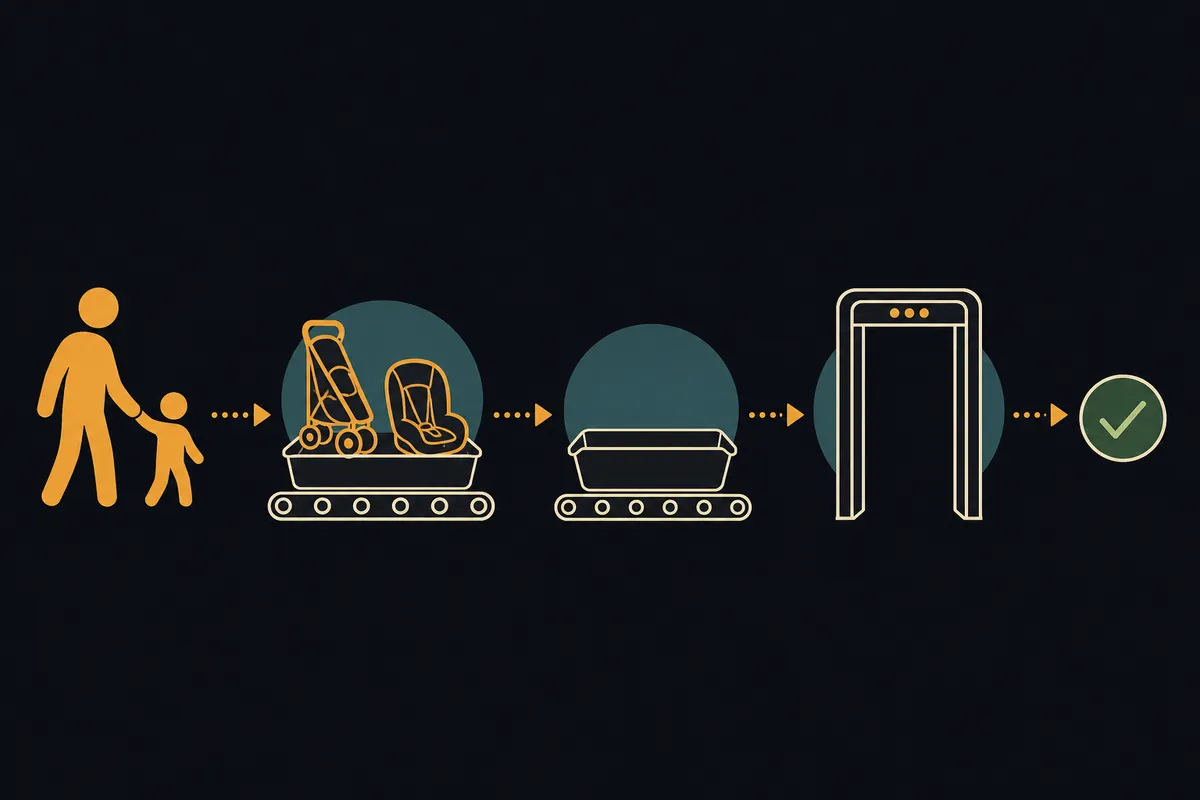
TSA rules for kids
TSA maintains modified screening procedures specifically for children 12 and under. Most parents do not know these rules going in — and that costs time at the checkpoint.
- Shoes stay on. Children 12 and under do not need to remove shoes, light jackets, or headwear at standard lanes. The same exemption applies in TSA PreCheck lanes.
- No ID required. Children under 18 do not need any ID to fly domestically — a boarding pass is sufficient. TSA will not separate a child from their parent or guardian during screening.
- Family lanes.TSA's "Families on the Fly" program provides dedicated family lanes at many major airports, staffed by officers trained to work with families at a more patient pace. Look for the lane marked "Special assistance" or ask any TSA agent to point you to the family lane.
- Strollers and car seats. Both must go through the X-ray machine. Take the child out of the stroller, fold it, and place it on the belt. Car seats go in a bin or flat on the belt. Carry the baby through the body scanner yourself — babies cannot remain seated in a stroller during screening.
- Formula, breast milk, and baby food. Exempt from the 3-1-1 rule in reasonable quantities. Declare them at the bin before you load the belt — an officer will screen them separately. Ice packs to keep them cold are also exempt.
- Juice and milk for infants. Also exempt from 3-1-1 — declare at the checkpoint. Squeeze pouches of applesauce are technically a gel and may trigger a secondary inspection even for infants; keep them accessible.
Security prep: set yourself up before the bins
- Stroller collapsed and ready to hand off to the belt before you reach the lane
- Formula/milk bag at the very top of your carry-on
- Laptops out, your shoes off — theirs can stay on
- One adult goes first through the scanner, one stays with the kids until clear
Lap infants (under 2 years)
US airlines allow children under 2 to fly domestic routes at no charge as lap infants — held by a parent throughout the flight. There is no seat and no ticket issued.
- How to book. Call the airline directly or add a lap infant at checkout — most US carriers cannot process lap infants through their standard online booking flow.
- International flights. Lap infants on international routes are typically charged 10–25% of the adult base fare, plus any applicable taxes and fees.
- Age verification.Airlines can verify the child's age at check-in. Bring a birth certificate for domestic flights and a passport for international travel.
- Safety recommendation. Most aviation safety organizations — including the FAA — recommend purchasing a seat and using an FAA-approved car seat even for infants, as lap infants are not restrained during turbulence.
Car seats and strollers
You do not have to check either. Both can travel with you to the gate and be returned at the aircraft door.
Free
Gate-check both items at no charge. All US airlines allow a stroller and car seat to be gate-checked free. You bring them down the jetway, leave them at the aircraft door, and they are returned planeside on arrival.
FAA
Car seat on the plane (purchased seat). Any FAA-approved child restraint can be brought into the cabin for a child in a purchased seat. Look for the label: "This restraint is certified for use in motor vehicles and aircraft." Install it in a window seat so it does not block aisle evacuation.
Alt
CARES harness. An FAA-approved airplane harness for children 22–44 lbs — approved for aircraft only, not car use. It weighs about one pound and fits in a carry-on, making it far easier to travel with than a full car seat.
Small umbrella strollers may fit in an overhead bin on some regional aircraft, but most passengers gate-check regardless — it is faster and easier than wrestling it into the bin.
Booking smart
A little strategy at booking prevents the most common family-travel headaches before you even reach the airport.
- Pick seats together at booking. Do not assume the airline will seat a family together automatically. Select your seats during checkout — especially for parties of three or more.
- Federal seating rule. Since 2023, federal rules require US airlines to seat children 13 and under adjacent to an accompanying adult at no extra charge. If your seats are split, contact the airline before the flight and cite this rule.
- Fly non-stop when possible. Every connection is another round of security, another gate, another boarding — with all the same logistics but less time to absorb delays.
- Early morning flights. First departures of the day are least likely to be delayed, airports are less crowded, and children are often at their calmest after a full night of sleep.
- Avoid the last row and middle seats. The last row on most aircraft does not recline. A middle seat for a restless child creates friction with two neighbors instead of one.
Day-of airport tips
The airport portion of any family trip takes longer than it looks on paper. Build in the buffer before you leave the house.
- Arrive 30 minutes earlier than usual. A child adds real time at check-in, at security, and at the gate. A domestic traveler who normally arrives 75 minutes early should plan for 105 minutes with kids.
- Curbside check-in for checked bags. If you are checking luggage, curbside agents handle the bags while you manage the kids. Tip well — it is among the most efficient uses of money on a family trip.
- Security prep before the lane. Stroller folded, formula bag at the top, laptops out, your shoes ready to come off. Getting caught unpacking at the belt with a toddler in your arms is avoidable.
- Pre-board. Every US airline offers pre-boarding to families with children under 2. Use it — overhead bin space is claimed fast, and boarding early lets you settle without the pressure of a queue behind you.
- Burn energy at the gate. Walk the terminal, find an open gate area, let them run. A child who boards tired and calm is significantly easier than one who boards wound up.
Packing for kids
The carry-on bears almost all of the burden for a family flight. Pack it as if your checked bag will not arrive — because sometimes it does not.
Change of clothes. One per day of travel for children under 3; one total for older kids. Spills, blowouts, and turbulence happen.
Entertainment.Download shows and games offline before leaving the house — in-flight Wi-Fi is unreliable and streaming burns through it fast. Kids' noise-canceling headphones reduce cabin noise for the child and improve whatever they are watching.
Snacks — more than you think. United, Delta, and American all have limited snack service. Kids eat when bored or anxious. Bring a variety: crackers, fruit pouches, granola bars, raisins.
Medicine.Children's pain reliever (acetaminophen or ibuprofen), gum or lollipops for ear pressure, diaper cream if relevant, and any prescription medication with documentation.
Surviving the flight
The plane itself is the most contained part of the trip — finite, manageable, and over faster than it feels in the moment.
- Ear pressure. The most common complaint on descent. Sucking equalizes ear pressure — a bottle, sippy cup, lollipop, or gum for older kids during both ascent and descent prevents most of the discomfort.
- Window seat. Gives children something to watch and eliminates aisle-kicking — a small thing that makes a real difference for neighbors.
- Activity rotation. Plan in 20-minute blocks — introduce a new item every 20 minutes to sustain novelty across a longer flight. A bag of small wrapped items works well for toddlers.
- Walk breaks. One parent circulates with the child for five minutes every hour or so — breaks the monotony, relieves pressure on the back and legs, and keeps a restless child from melting down in the seat.
- Brief your neighbors.A quick "she is two and we have snacks if it gets loud" at the start is disarming. Most people respond with goodwill rather than dread when given the heads-up.
For liquid rules at security, see our full breakdown of the 3-1-1 carry-on liquids rule. Skipping checked bags entirely? How to pack carry-on only covers what actually fits and what to leave behind. If you have TSA PreCheck, the PreCheck enrollment guide explains whether it is worth adding your child to your Known Traveler Number.
Common questions
Do children need a ticket to fly?
Children under 2 can fly free as lap infants on domestic US flights. Children 2 and older need their own paid seat.
What ID does a child need at the airport?
No ID is required for children under 18 — a boarding pass is sufficient. For international travel, children need their own passport.
Can I bring breast milk through TSA?
Yes — breast milk, baby formula, and infant juice are exempt from the 3-1-1 liquid rule in reasonable quantities. Declare them at the checkpoint and a TSA officer may inspect them separately, but they will not be confiscated.
Do I have to pay for a car seat on the plane?
No. You can bring an FAA-approved car seat for a child who has their own purchased seat at no extra charge. Gate-checking it at the jetway door is also free on every US airline.
Packed and ready? Now nail the timing.
Run your Leave-By Time and we'll count backward from your flight — today's live security wait, the drive, and the walk to your gate — so you leave with room to breathe (and get the kids loaded without rushing).
Get your Leave-By Time →