Guide · Flight tips
How to avoid flight delays: 8 strategies backed by data
By the TSA Wait Times team · Updated · Published June 2026
You cannot eliminate flight delays — but you can cut your personal delay exposure significantly by choosing the right flights, times, and routes. These 8 strategies, backed by Bureau of Transportation Statistics data, consistently reduce delay risk.
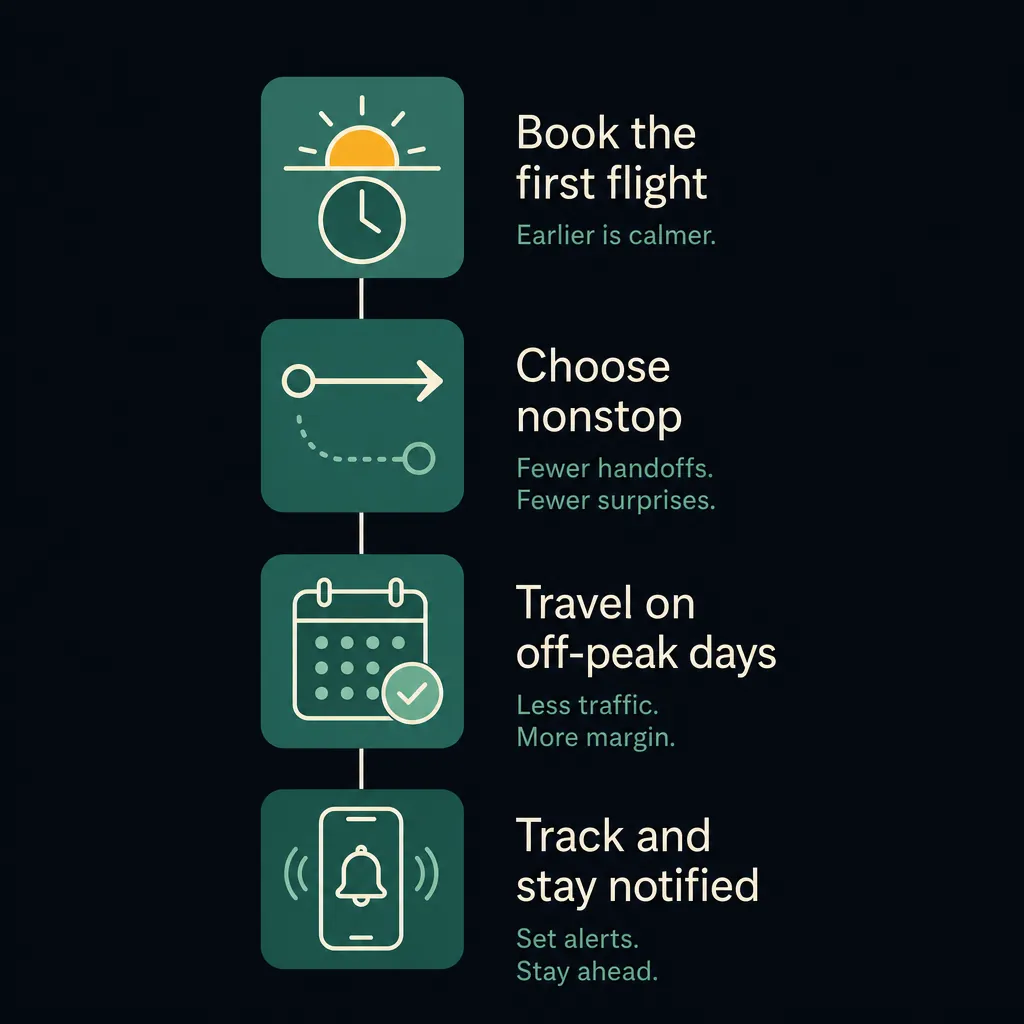
1. Fly early morning
The single most effective delay-reduction strategy: book the first flight of the day.
Why it works:
The cascade effect. A delay early in the day compounds through the fleet as the same aircraft makes multiple trips. The first flight of the day uses an aircraft that overnighted at the hub — fresh, with no prior delay to cascade from.
The data
Flights departing between 6–8 am have on-time arrival rates around 85–88%. Flights after 6 pm average 65–70%.
Trade-off: You have to wake up at 4 am. Worth it for important trips.
2. Fly direct whenever possible
Every connection is an additional chance for something to go wrong. A direct flight has one departure; a connection has two.
The risk math
If each flight has a 15% delay probability, a two-leg itinerary has a 27% chance of at least one delay. A direct flight is 15%.
When connections are unavoidable:
Give yourself maximum buffer time. See the minimum connection time guide for hub-by-hub recommendations. Never book the minimum connection time the airline allows.
3. Avoid weather-prone routes and seasons
Not all delay risk is equal by geography and season.

High-risk combinations:
- Any ORD, EWR, or LGA connection in winter (December–February): northeast winter storms cause cascading ground stops across the entire network
- Florida destinations in hurricane season (June–November, especially August–September)
- Dallas-Fort Worth (DFW) in spring/summer thunderstorm season (April–July)
- Denver (DEN) during winter blizzards (variable — check the forecast)
Lower-risk hubs:
CLT, MSP, PHX, DEN (shoulder season), and SEA have structurally lower weather delay rates than the northeast or Gulf Coast corridors.
4. Choose Tuesday or Wednesday flights
Air traffic is highest on Mondays, Fridays, and Sundays. Mid-week flights have lower congestion and fewer systemwide delays.
| Day | Delay exposure |
|---|---|
| Tuesday / Wednesday | Lowest — least congestion |
| Monday / Thursday | Moderate |
| Friday / Sunday | Highest — peak leisure travel |
Also useful: Off-peak hour flights reduce ATC congestion — but a 6 am Monday flight still beats a 7 pm Sunday flight overall.
5. Pick on-time performers by airline and route
BTS publishes on-time performance data by airline, route, and origin airport. Some airlines have structural on-time advantages on specific routes.
Consistently top-performing airlines (domestic):
- Alaska Airlines and Delta tend to perform above average across most domestic routes
- Southwest performs well on point-to-point routes (no hub dependency)
- United and American are more variable depending on the hub and route
How to check:
BTS at transtats.bts.gov or use the FlightAware airline statistics page to see historical on-time performance for specific routes before booking.
6. Avoid buying the last flight of the day
If your last flight is delayed or cancelled, there are no recovery options. You spend the night.
The strategy
When you need to reach a destination by a specific time, book the second-to-last flight. If it cancels, you still have the last flight. If it delays, you are already at the airport with a fallback option.
7. Choose the right connecting hub
If you must connect, choose your hub wisely. CLT and MSP are structurally more reliable than ORD, EWR, or LGA.
Example:
New York to Phoenix connecting options:
- Via EWR (United): higher weather and congestion exposure, northeast storm risk
- Via CLT (American): cleaner hub, shorter transit, lower structural delay probability
Often the cheaper routing is cheaper because it goes through a riskier hub — factor in delay risk when comparing prices.
8. Monitor your flight the day before
FlightAware and your airline's app show disruption patterns as they develop:
- Check the aircraft tail number the night before — if that aircraft is delayed coming into your origin city, your morning flight will be late too
- Check if the airline is issuing weather waivers for your route (means waived change fees if you need to shift flights)
- If a major storm is forecast for your hub 24–48 hours out, call the airline now to rebook proactively before everyone else does
Weather waivers
When weather affects a major hub or destination, airlines issue waivers allowing free same-day or next-day changes. Watch the airline's app notification center and their X/Twitter account for waiver announcements — they often post these before the phone agents know.
What to do when a delay is unavoidable
Even with perfect planning, some delays happen. See what to do when your flight is cancelled for your rights and rebooking steps.
Key moves during a delay:
- Open the airline app immediately and rebook proactively — do not wait in line at the gate. The app is almost always faster than the agent queue during mass delays.
- Call the elite status line if you have it — hold times are far shorter than the general customer service number during a systemwide disruption.
- Ask about standby for earlier flights to your destination — no-shows frequently open seats close to departure even on sold-out flights.
Frequently asked questions
Do morning flights have fewer delays?
Yes — first flights of the day have the lowest delay rates (85–88% on-time) because they use aircraft that overnighted at the hub, with no prior-day cascade effect. Delay rates climb steadily throughout the day, dropping to 65–70% by evening.
Which airline has the best on-time performance?
Alaska Airlines and Delta consistently rank highest in BTS data for on-time domestic performance. Southwest and American are more variable. Check transtats.bts.gov for the most current data by route before booking.
How can I avoid flight delays at O'Hare?
Give yourself more buffer time on connections, fly early morning, and avoid ORD during winter months (December–February) when northeastern weather systems cause systematic ground stops that cascade across the entire network.
What is the cascade effect in aviation?
When a plane is delayed early in the day, that same aircraft makes multiple flights — each subsequent leg starts late. By evening, delays compound across the whole network. Early morning flights use overnighted aircraft and avoid inherited delays entirely.
Related guides
- What to do when your flight is cancelled — your refund rights and fastest rebooking steps
- Best airports for connections — hub-by-hub reliability rankings and minimum connection times
- Missed connection: what to do — airline obligations and how to get rebooked fastest
Data verified . Sources: BTS Airline On-Time Statistics and Delay Causes; DOT Airline Cancellation & Delay Dashboard; Thrifty Traveler — First Flight of the Day Data Analysis.
Know exactly when to leave for the airport
Avoiding delays starts before you leave home. Your Leave-By Timecounts backward from your departure using today's live TSA wait, your drive time, and the walk to your gate — so you arrive with time to spare, not stress.
Get your Leave-By Time