Baggage
Can you fly with alcohol? TSA and customs rules
By the TSA Wait Times team · Updated · Published June 2026
You can legally fly with most alcohol, but the rules split sharply by proof. Beer and wine (under 24% ABV) face no federal quantity limit in checked baggage. Spirits between 24% and 70% ABV cap at 5 liters per traveler and must stay in original retail packaging. And anything above 70% ABV (140 proof)—including Everclear 190-proof and certain overproof rums—is banned from every bag on the plane as a hazardous flammable material. No TSA policy changes took effect in 2026; rules confirmed current.
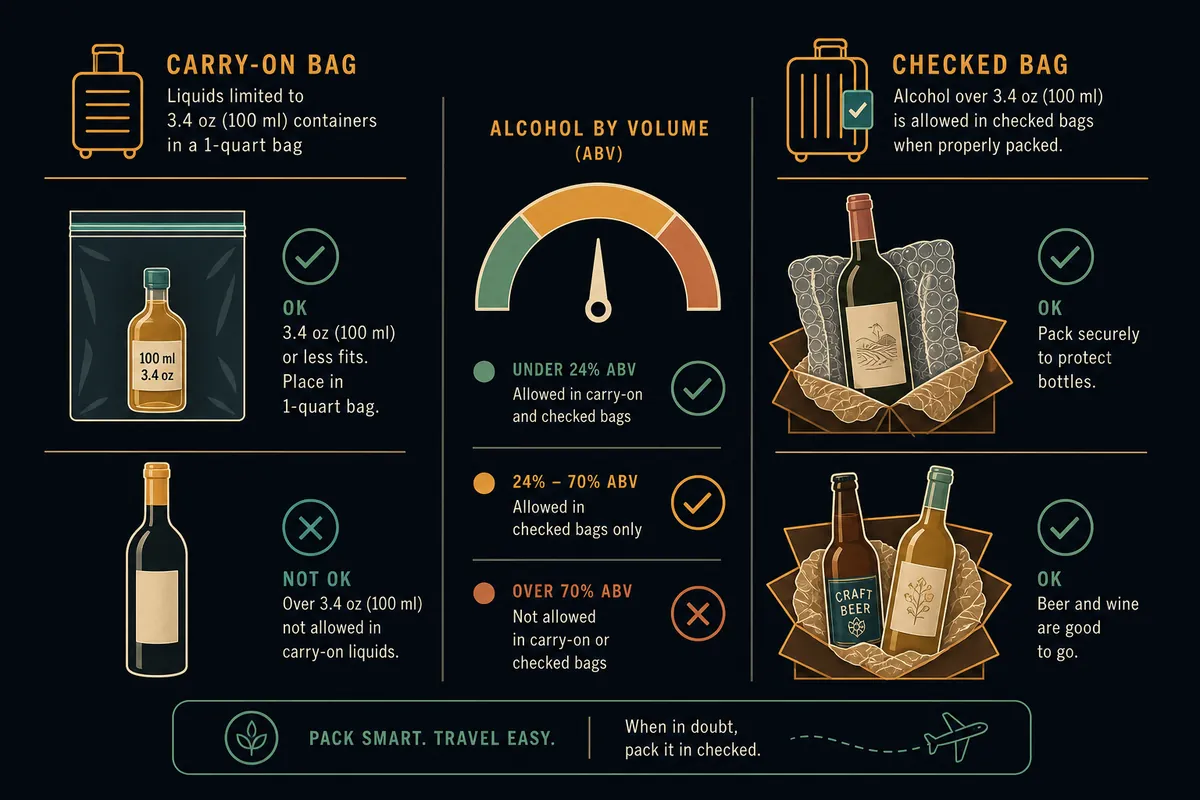
Can you bring alcohol in your carry-on bag?
The TSA 3-1-1 rule applies to alcohol exactly like any other liquid—only containers of 3.4 oz (100ml) or smaller qualify, and all of them must fit inside one quart-sized clear zip-top bag. That ceiling makes standard wine and spirit bottles (375ml–750ml) ineligible for carry-on regardless of alcohol content. The practical carry-on option is 50ml airline-style mini bottles: a single quart bag holds roughly eight of them. Alcohol strength does not change the size restriction—a 5% ABV mini can and a 151-proof mini bottle face the same 3.4oz limit.
- 50ml (1.7 oz) mini bottles allowed in carry-on if they fit inside the quart bag
- 375ml half-bottles and 750ml standard bottles are too large for carry-on liquids
- One quart-sized bag per passenger, shared with all other liquids and gels
- ABV percentage has no effect on the 3.4oz size restriction for carry-on
How much alcohol can you pack in checked baggage?
The FAA and TSA divide checked-bag alcohol into three tiers by proof. Beer, wine, hard cider, and hard seltzer (under 24% ABV) face no federal quantity ceiling—pack as many bottles as your airline weight allowance allows. Spirits and liqueurs in the 24%–70% ABV range are capped at 5 liters per traveler and must remain in original, unopened retail packaging. Anything above 70% ABV (140 proof), including Everclear 190-proof and certain overproof rums, is classified as a hazardous flammable material and is prohibited from every type of luggage.
| ABV range | Examples | Checked-bag rule |
|---|---|---|
| Under 24% ABV (under 48 proof) | Beer, wine, cider, hard seltzer | No federal limit in checked bags |
| 24%–70% ABV (48–140 proof) | Vodka, whiskey, gin, rum, most spirits | 5 liters per traveler; must be original unopened retail packaging |
| Above 70% ABV (above 140 proof) | Everclear 190, overproof rums | Banned from both carry-on and checked bags |
What are the rules for duty-free alcohol at airport security?
Alcohol bought at an airport duty-free shop is sealed at purchase in a Security Tamper-Evident Bag (STEB)—a clear plastic bag with a printed receipt locked inside. TSA allows STEB-sealed bags through subsequent security checkpoints even when bottles exceed the standard 3.4oz limit, provided the bag is completely intact, the receipt is visible inside, and the purchase was made within the past 48 hours. Opening the bag for any reason—even to show an officer the bottle—invalidates the exception at the next checkpoint and can result in confiscation. Some international airports apply a stricter 36-hour receipt window rather than 48 hours. For more on shopping duty-free, see our duty-free shopping guide.
- Bag must be completely sealed and show no signs of tampering
- Receipt must be visible inside the bag and dated within 48 hours of the next checkpoint
- Do not open the bag on the aircraft—duty-free bottles must stay sealed in-flight
- Breaking the seal at any point means the bottles revert to standard 3-1-1 rules at the next checkpoint
Can you drink your own alcohol on a flight?
FAA regulations bar passengers from consuming any personal alcohol during a flight—only alcohol served directly by the flight crew is permitted on board. This applies to mini bottles from your quart bag, cans in your personal item, and duty-free bottles in the overhead bin. Consuming self-supplied alcohol mid-flight is a federal violation that can result in fines, removal from the aircraft, or referral to federal law enforcement. Airlines are also permitted to refuse boarding or cut off service to passengers who appear intoxicated before or after departure.
- Cannot open personal mini bottles from a carry-on during the flight
- Cannot open duty-free bottles sealed in a STEB on the plane
- Flight crew can deny service and report passengers who appear intoxicated
- Federal FAA violation—potential fines and enforcement apply
What are US customs rules for bringing alcohol home from abroad?
Every adult US resident returning from a foreign trip receives an $800 duty-free personal exemption that includes 1 liter of alcohol for travelers 21 and older. Bringing more than 1 liter is legally permitted for personal use, but each additional liter above that threshold is subject to federal customs duty (typically 3%–20% depending on country of origin) plus federal excise tax. Travelers returning from Caribbean Basin Initiative countries qualify for an enhanced $800 exemption covering 2 liters of alcohol, with at least 1 liter required to be a CBI product. US Virgin Islands and eligible US territories raise both the merchandise exemption to $1,600 and the duty-free alcohol allowance to 5 liters. See also: what to expect at US customs.
| Origin | Duty-free alcohol allowance | Notes |
|---|---|---|
| Most foreign countries | 1 liter duty-free per adult 21+ | $800 merchandise exemption; over 1L subject to duty (3–20%) + excise tax |
| Caribbean Basin Initiative countries | 2 liters duty-free (1L must be CBI product) | $800 merchandise exemption |
| US Virgin Islands / eligible US territories | Up to 5 liters duty-free | $1,600 merchandise exemption |
How do you pack wine and spirits safely in checked baggage?
Checked bags are tossed, stacked, and subjected to pressure changes—packaging technique directly determines whether bottles arrive intact. Center each bottle in the middle of your suitcase surrounded by multiple layers of soft clothing, then seal the wrapped bundle inside a heavy-duty zip-lock bag to contain any leak. Glass bottles benefit significantly from dedicated foam or bubble-wrap wine travel sleeves, which absorb impact that clothing alone cannot handle. Sparkling wine and carbonated beverages pose a higher rupture risk due to cabin pressure differentials, so they warrant the most protective packaging or a purpose-built wine carrier. For more packing strategies, see how to pack fragile items in checked baggage.
- Center each bottle in the bag away from the walls and hard items
- Wrap in soft clothing, then seal inside a heavy-duty zip-lock bag as a secondary barrier
- Use foam or bubble-wrap wine travel sleeves for glass bottles
- Spirits must remain in original, unopened retail packaging per FAA rules
- Avoid packing bottles adjacent to shoes, electronics, or hard toiletry kits
- Sparkling wine and carbonated bottles need the most protective packaging due to pressure risk
Do state laws or airline policies add extra restrictions?
TSA rules are federal minimums, but individual airlines and US state laws can layer on additional limits. Several states regulate how much alcohol a resident may transport across state lines, and exceeding those amounts for personal use can violate state law independently of what TSA permitted through the checkpoint. Airlines including American, Delta, United, and Southwest each publish their own restricted-items lists for cargo alcohol, and some flag higher-proof spirits beyond FAA requirements. Always check your carrier's specific restricted items page before packing, especially for quantities above 5 liters or products approaching the 70% ABV ceiling.
- Check your airline's restricted items page—carrier rules can be stricter than TSA
- Destination state laws may limit the volume of alcohol you can import for personal use
- Some carriers add packaging or quantity requirements beyond FAA minimums
If you're also weighing what else you can pack, see our guides on how to avoid checked bag fees, carry-on size limits by airline, and oversize and overweight baggage fees.
Sources: TSA alcoholic beverages, FAA hazmat pack safe, CBP duty exemptions. Rules verified .
Know what you're packing—now know when to leave.
Once your bag is sorted, the next question is how early to get to the airport. The Leave-By Time calculator folds live TSA wait times, your drive, and your airline's check-in cutoff into one time to walk out the door.
Calculate my Leave-By Time →