Security
Can you bring food through airport security?
By the TSA Wait Times team · Updated · Published June 2026
Yes — with one big catch. Solid foods pass through the X-ray with no size restrictions whatsoever. The rule that trips people up: anything that is liquid, gel, paste, or cream — peanut butter, hummus, yogurt, jam, salsa — must follow TSA's 3-1-1 rule: containers of 3.4 oz (100 ml) or less, all fitting inside one quart-sized clear bag per person. Here is exactly what qualifies as solid, what counts as liquid, and the three exceptions that override the rule entirely.
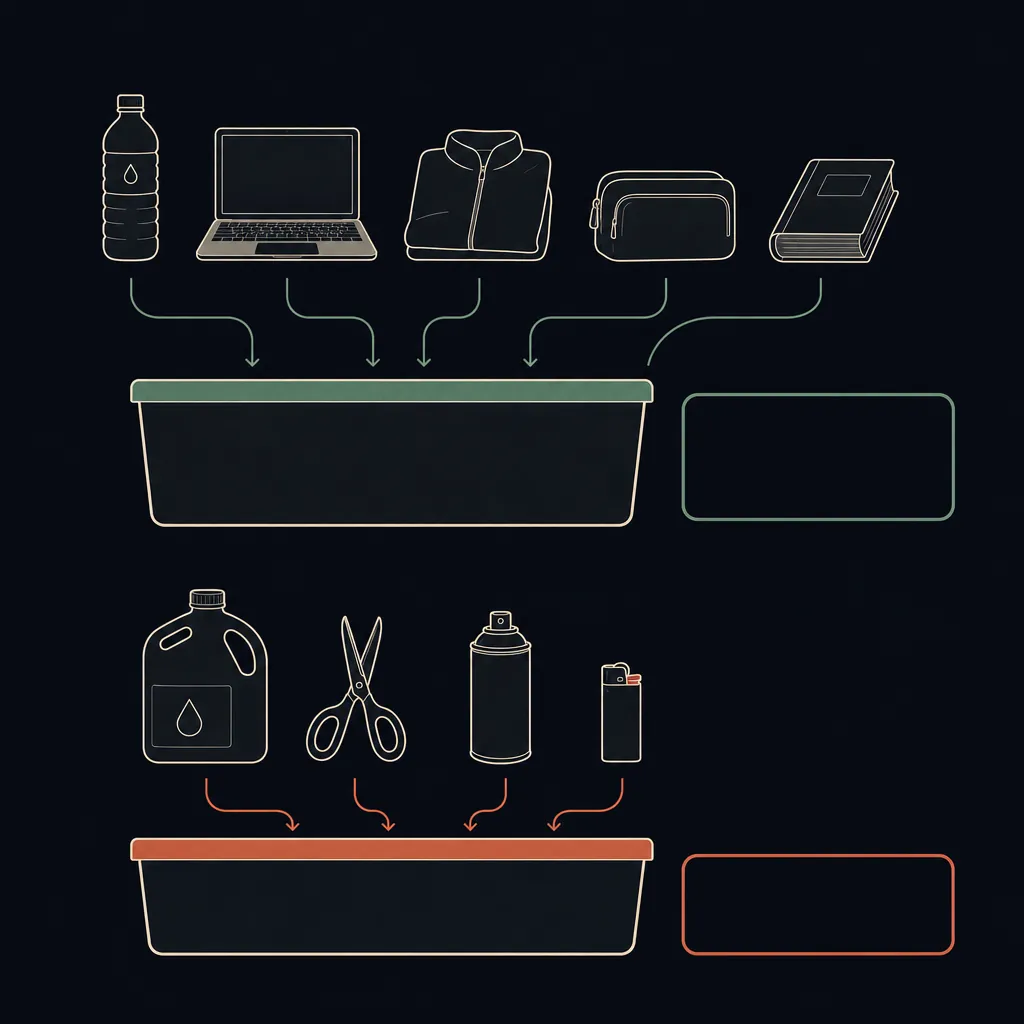
Solid foods are always allowed — here is what qualifies
TSA classifies food the same way it classifies every other carry-on item: solids have no size limit, while liquids and gels face the 3-1-1 restriction. If a food holds its shape and does not pour, spread, or ooze, it is a solid for checkpoint purposes and you can bring as much of it as fits in your bag. Cooked meats, hard cheeses, bread, muffins, trail mix, and even airport fast food — pizza, fried chicken, a full burrito — are all permitted in carry-on bags with no special preparation required.
- Sandwiches, wraps, and deli food of any size
- Whole or cut fresh fruit and vegetables (domestic flights only)
- Baked goods: cookies, muffins, bread, brownies, cake
- Candy, chocolate bars, and snack bars
- Chips, crackers, trail mix, nuts, and dry cereals
- Hard cheeses (not soft or spreadable varieties)
- Cooked meats and fried foods not packed in liquid sauce
- Fast food: pizza, fried chicken, burgers
What foods fall under the 3-1-1 liquid rule?
Any food that is liquid, gel, cream, paste, or aerosol must comply with TSA's 3-1-1 rule: each container must be 3.4 oz (100 ml) or less, all containers must fit inside a single quart-sized clear resealable bag, and each traveler is limited to one such bag. The table below shows the most commonly flagged food items at checkpoints and how they are classified. A jar of grocery-store peanut butter, a standard container of hummus, and a single-serve yogurt cup each exceed 3.4 oz and will be confiscated if found in an unscreened bag.
| Food item | TSA classification | Carry-on rule |
|---|---|---|
| Peanut butter (any nut butter) | Gel / paste | 3.4 oz max per container |
| Hummus | Gel / dip | 3.4 oz max per container |
| Yogurt | Liquid / gel | 3.4 oz max per container |
| Jam or jelly | Gel | 3.4 oz max per container |
| Salsa | Liquid / gel | 3.4 oz max per container |
| Soups and broths | Liquid | 3.4 oz max per container |
| Salad dressing | Liquid | 3.4 oz max per container |
| Cream cheese | Gel / cream | 3.4 oz max per container |
| Guacamole | Gel | 3.4 oz max per container |
| Nutella / chocolate spread | Gel / paste | 3.4 oz max per container |
| Sandwich (whole) | Solid | No size limit |
| Hard cheese (block or sliced) | Solid | No size limit |
| Fresh whole fruit | Solid | No size limit (domestic) |
Why peanut butter counts as a gel — and what other spreads are affected
TSA defines gels as anything that flows or deforms to fill its container when pressure is applied, which is why peanut butter, almond butter, tahini, and all nut butters are classified as gels despite feeling solid when scooped. The same physical-consistency test applies to cream cheese, soft brie and camembert, guacamole, Nutella, and any other spreadable food. This rule is well-established and unchanged — it has applied since the 3-1-1 system launched in 2006 and no modifications were made in 2026. The practical fix: buy travel-sized peanut butter or individual squeeze packets (typically 1–1.5 oz), or transfer any spread into a container of 3.4 oz or less before you leave home. Anything over 3.4 oz should be packed in your checked bag.
- Nut butters (peanut, almond, cashew, sunflower seed): gel — 3.4 oz carry-on limit
- Tahini: gel — 3.4 oz carry-on limit
- Cream cheese and spreadable soft cheeses: gel — 3.4 oz carry-on limit
- Guacamole: gel — 3.4 oz carry-on limit
- Nutella and chocolate hazelnut spreads: gel — 3.4 oz carry-on limit
- Fix: individual travel packets or transfer into a 3.4 oz jar before traveling
What are the exceptions to the 3-1-1 rule for food?
TSA recognizes three categories of food that are exempt from the standard 3-1-1 size limit. Breast milk and infant formula may be carried in quantities exceeding 3.4 oz without fitting in a quart bag — declare them to the officer before the X-ray and they may be subject to additional screening. Baby food and pureed food intended for infants or toddlers (applesauce pouches, pureed vegetables, jarred baby food) receive the same exemption. Medically necessary liquid foods, nutritional supplements, or specialized dietary items required for a documented medical condition are permitted in larger quantities when declared at the checkpoint; a TSA officer may ask for documentation or use additional screening equipment. In all three cases, remove the items from your bag before placing it on the belt and verbally inform the officer.
- Breast milk: any reasonable quantity, no quart bag required — must declare
- Infant formula: any reasonable quantity, no quart bag required — must declare
- Baby food and pureed food for infants or toddlers: any reasonable quantity — must declare
- Medically necessary liquid food or nutritional supplements: declare, additional screening may apply
- Gel or liquid teethers and ice packs for keeping baby food cool: also exempt when declared
Can you bring alcohol through airport security?
Small bottles of alcohol (3.4 oz or less, such as airplane miniatures) may go in your carry-on quart bag like any other liquid. Larger bottles must be placed in checked baggage: TSA and FAA allow alcoholic beverages of 24% ABV (48 proof) or less in unlimited quantities in checked bags, and beverages between 24% and 70% ABV up to 5 liters per passenger in checked bags. Alcohol above 70% ABV is prohibited on flights entirely. Duty-free alcohol purchased at an airport international terminal shop is a special carry-on exception: bottles in their original sealed, tamper-evident bag with a visible receipt may pass through subsequent security checkpoints even if they exceed 3.4 oz. Do not open the duty-free bag between connections — a broken seal makes the bottles subject to confiscation at the next checkpoint.
- Carry-on: alcohol in 3.4 oz or less containers allowed (must fit in quart bag)
- Checked: unlimited quantity at 24% ABV or below; up to 5 liters from 24–70% ABV
- Duty-free: large sealed bottles allowed in carry-on in original tamper-evident bag with receipt
- Do not break the duty-free seal before your final destination
- Alcohol above 70% ABV is prohibited on any flight
What are the rules for food on international flights?
TSA only screens passengers departing the United States and does not enforce customs or agricultural import rules. When you return to the US from abroad, US Customs and Border Protection (CBP) — not TSA — governs what food you can bring in. Fresh fruits, vegetables, meats, and many dairy products from most international origins are prohibited under USDA agricultural regulations designed to prevent plant and animal diseases from entering the country. Violations can result in fines starting at $300 for first-time offenders. When flying to a foreign country, research your destination's customs rules independently — many nations restrict even commercially packaged foods purchased at airport shops. Fresh produce is generally safe on domestic US flights but should not be assumed safe for any international border crossing.
- Returning to US: declare all food on CBP form 6059B — failure to declare is a federal violation
- Fresh fruit and vegetables from international origin: generally prohibited by USDA/CBP
- Commercially sealed packaged food: often allowed but varies significantly by country of origin
- Meats and dairy from abroad: high risk of confiscation; verify at cbp.gov before traveling
- TSA does not enforce food import rules on departure — CBP enforces them on arrival
Tips for packing food to get through the checkpoint faster
Food is one of the most common triggers for secondary bag inspection because dense or layered items can obscure other objects on the X-ray. A few preparation steps eliminate most delays: keep all food grouped in one dedicated section of your carry-on so an officer can quickly re-scan just that area. Place 3-1-1 food items in your quart bag before you reach the checkpoint so you can drop it in the bin without searching. Homemade items wrapped in foil can look opaque on the X-ray; switch to plastic wrap or a clear container. Ice packs used to keep food cold must be completely frozen solid at the checkpoint — if they are partially melted and slushy, TSA will treat them as liquids subject to the 3.4 oz limit.
- Group all food in one bag compartment for quick, isolated re-inspection if needed
- Pre-stage your quart bag before the bin area — do not dig for it at the belt
- Replace aluminum foil wrapping with clear plastic wrap or clear containers
- Ice packs must be fully frozen solid — slushy = liquid, subject to 3.4 oz rule
- When uncertain about any item, put it in checked luggage to avoid confiscation
If you want to move through security faster on every trip, see how TSA PreCheck, CLEAR, and Global Entry compare. For every other carry-on liquid question beyond food, the full 3-1-1 carry-on liquids guide covers every edge case. And if you are checking a bag, the airline baggage fees comparison can save you money before you pack.
Facts verified . Sources: TSA What Can I Bring, TSA 3-1-1 liquids rule, CBP prohibited and restricted items.
Know exactly when to leave for the airport
The Leave-By Time calculator folds today's live TSA wait at your airport, your drive time, and parking into one precise moment to walk out the door — so you clear the checkpoint with room to breathe.
Calculate my Leave-By Time →Keep planning
Security
How long does airport security really take?
Most travelers clear standard screening in 15 to 30 minutes — but the hour you pick changes everything.
SecurityWhat you can (and can't) bring through security
Liquids, laptops, snacks, and the things that surprise people — a plain-language packing check before you go.
SecurityCarry-on liquids: the 3-1-1 rule, explained
3.4 ounces, one quart bag, one per traveler — plus the exceptions for medications and baby formula.
SecurityAirport security tips for families with kids
From stroller gate-checks to formula at the X-ray belt — everything parents need to know to move a family through TSA quickly.