Data · TSA PreCheck · 2026
How much time does TSA PreCheck actually save?
By the TSA Wait Times team · Updated · Published July 2026
TSA says 99% of PreCheck passengers wait less than 10 minutes — and against our modeled standard-lane waits, that benchmark is worth roughly 11 to 30 minutes at the peak hour, depending on the airport. At Newark (EWR), the gap is about 16 minutes at the morning peak; at Honolulu (HNL), the worst case in our table, it's around 30. This page puts a number on "is PreCheck worth it" airport by airport: the official PreCheck stats, our modeled standard-lane waits at the 32 largest U.S. airports, and the break-even math on the $76.75 fee. Standard-lane figures are modeled estimates from our forecasting model, not TSA measurements.
The two numbers that answer the question
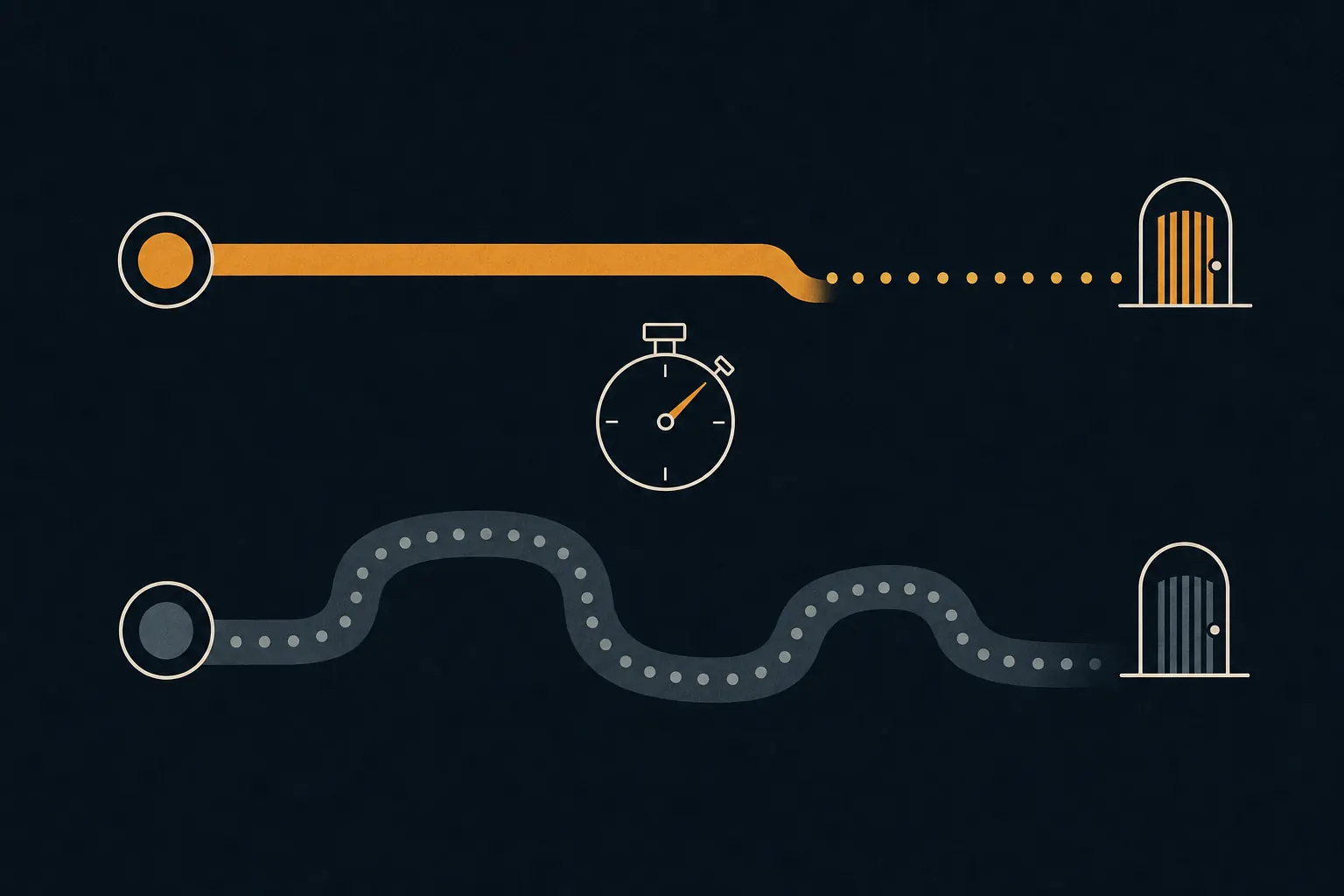
TSA publishes exactly one PreCheck wait statistic: 99% of enrolled passengers wait less than 10 minutes in PreCheck lanes (as stated April 2026). It publishes no equivalent percentage for standard lanes — only a service standard of under 30 minutes. So to quantify the saving, we compare that under-10-minute PreCheck benchmark to our own modeled standard-lane waits at the 32 largest U.S. airports. The difference is a derived estimate of what PreCheck buys you: if the standard lane runs a modeled 36 minutes at 8 AM and PreCheck holds you under 10, the saving is roughly 26 minutes.
Two honest caveats before the table. First, our standard-lane numbers are modeled estimates from tsawaittimes.app's forecasting model — the same model behind our live airport pages — not TSA measurements. Second, the saving is not constant: at 5 AM, standard lanes are short too, and the gap shrinks toward zero. PreCheck earns its fee at the peaks.
PreCheck time savings by airport: modeled standard wait vs the 10-minute benchmark
All 32 airports, sorted by the estimated peak-hour saving. "Est. peak saving" is the modeled standard-lane peak wait minus TSA's 10-minute PreCheck benchmark — derived arithmetic, and slightly conservative, since 99% of PreCheck waits come in under 10 minutes.
| Airport | Avg standard | Peak standard | Peak hour | Est. peak saving |
|---|---|---|---|---|
| Honolulu (HNL) | 25 min | 40 min | 6 PM | ~30 min |
| Baltimore (BWI) | 24 min | 38 min | 6 PM | ~28 min |
| Phoenix (PHX) | 24 min | 38 min | 6 PM | ~28 min |
| Austin (AUS) | 23 min | 36 min | 6 PM | ~26 min |
| Los Angeles Int'l (LAX) | 23 min | 36 min | 8 AM | ~26 min |
| San Francisco (SFO) | 23 min | 35 min | 8 AM | ~25 min |
| Tampa (TPA) | 23 min | 35 min | 6 PM | ~25 min |
| Washington · Reagan (DCA) | 22 min | 35 min | 8 AM | ~25 min |
| Chicago · Midway (MDW) | 22 min | 34 min | 8 AM | ~24 min |
| Boston (BOS) | 21 min | 34 min | 6 PM | ~24 min |
| Washington · Dulles (IAD) | 21 min | 33 min | 6 PM | ~23 min |
| Detroit (DTW) | 21 min | 32 min | 7 PM | ~22 min |
| Denver (DEN) | 20 min | 30 min | 8 AM | ~20 min |
| Fort Lauderdale (FLL) | 20 min | 30 min | 8 AM | ~20 min |
| Chicago O'Hare (ORD) | 19 min | 30 min | 6 PM | ~20 min |
| Portland (PDX) | 19 min | 30 min | 8 AM | ~20 min |
| Raleigh–Durham (RDU) | 19 min | 30 min | 6 PM | ~20 min |
| Atlanta (ATL) | 19 min | 29 min | 6 PM | ~19 min |
| Miami (MIA) | 19 min | 29 min | 6 PM | ~19 min |
| Houston · IAH (IAH) | 18 min | 28 min | 8 AM | ~18 min |
| Las Vegas (LAS) | 17 min | 28 min | 6 PM | ~18 min |
| New York · LGA (LGA) | 17 min | 27 min | 8 AM | ~17 min |
| Minneapolis–St. Paul (MSP) | 17 min | 27 min | 6 PM | ~17 min |
| Dallas/Fort Worth (DFW) | 16 min | 26 min | 6 PM | ~16 min |
| Newark (EWR) | 16 min | 26 min | 8 AM | ~16 min |
| Orlando (MCO) | 16 min | 26 min | 6 PM | ~16 min |
| Salt Lake City (SLC) | 16 min | 26 min | 7 PM | ~16 min |
| Nashville (BNA) | 16 min | 25 min | 8 AM | ~15 min |
| Charlotte (CLT) | 15 min | 25 min | 6 PM | ~15 min |
| New York · JFK (JFK) | 15 min | 24 min | 8 AM | ~14 min |
| San Diego (SAN) | 15 min | 24 min | 6 PM | ~14 min |
| Seattle–Tacoma (SEA) | 14 min | 21 min | 8 AM | ~11 min |
Standard-lane waits are modeled estimates from the tsawaittimes.app forecasting model (July 2026 snapshot). Saving = modeled peak wait − 10-minute PreCheck benchmark. On the modeled average across the day, savings run about 4–15 minutes per screening.
A concrete read: at Newark (EWR), the model puts the standard lane at 26 minutes at the 8 AM peak, so PreCheck saves you roughly 16 minutes at peak. At Honolulu (HNL) and Phoenix (PHX) — the top of the savings table — the peak gap is close to half an hour. Where the full standard-lane ranking comes from, best to worst, is our 2026 TSA Wait Index.
The 7-minute counterpoint
One independent data point cuts the other way, and it deserves a fair hearing. A March 2025 Upgraded Points survey of 1,500+ travelers found self-reported security time averaged 36 minutes with PreCheck vs 43 minutes without — a 7-minute average saving. That is much smaller than the peak-hour gaps above, for two reasons: it measures recalled time through the whole security process(not stopwatch queue waits, so it's not comparable to TSA's queue metric), and it averages across all hours, including the quiet ones where PreCheck saves little. The same survey found the clearer win may be psychological: security stress rated 3.3 out of 10 with PreCheck vs 7.3 without. Read the two findings together — the average saving is modest, the peak-hour saving is large, and the predictability is the product.
The break-even math on the fee
A new PreCheck membership costs $76.75 for five years via IDEMIA ($79.95 via CLEAR, $85 via Telos) — $15.35 per year. Travelers 30 and under pay $20 less. Divide by how often you fly (counting one screening per departure, so a round trip is two) and the cost per screening gets small fast:
| Round trips / year | Screenings over 5 years | Cost per round trip | Cost per screening |
|---|---|---|---|
| 2 | 20 | $7.67 | $3.84 |
| 4 | 40 | $3.84 | $1.92 |
| 6 | 60 | $2.56 | $1.28 |
| 12 | 120 | $1.28 | $0.64 |
Based on the $76.75 IDEMIA five-year fee. Renewal is cheaper ($58.75–$70 online), so the per-screening cost falls further once you renew.
Put the two tables together and the worth-it math is simple. Fly four round trips a year through a big airport at commuter hours, and you're paying about $1.92 per screening to skip a modeled 10–30minutes of peak-hour line — plus keeping your shoes, belt, laptop, and liquids in place. Fly once a year, off-peak, from an airport near the bottom of the savings table, and the case is thinner. That's the honest answer: PreCheck is cheap insurance against the worst hour at the worst airports, not a uniform 30-minute miracle.
Who actually has PreCheck
The program is no longer a niche perk. PreCheck passed 20 million active members in August 2024 — the latest official milestone — after 3.3 million new enrollments and 2.1 million renewals in 2024 alone, and DHS counts over 40 million vetted members across all its Trusted Traveler programs. Lanes run at 200+ U.S. airports with roughly 90–100 participating airlines. One expert estimate (aviation-security researcher Sheldon H. Jacobson, October 2025 — not an official TSA statistic) puts ~8 million of TSA's 18+ million weekly screenings, about 44%, in PreCheck lanes. That scale is worth knowing for two reasons: the lanes are well-staffed and everywhere, and they can themselves back up on holiday peaks precisely because so many travelers now hold the badge.
PreCheck vs Global Entry vs CLEAR, in one paragraph
If you ever fly internationally, Global Entry costs $120 for five years and includes PreCheck — $43.25 more than the IDEMIA PreCheck fee for expedited customs on top, free for under-18s with an enrolled guardian. CLEAR+ is a different product: $219 per year as of July 2026 for identity verification that jumps you to the front of the line at 60 airports, best stacked with PreCheck rather than substituted for it. The full decision tree is in our guide to PreCheck vs CLEAR vs Global Entry.
Methodology
PreCheck program figures (the 99% under-10-minutes claim, membership counts, fees, footprint) come from TSA and CBP releases and Clear Secure SEC filings, cited below. Standard-lane waits are first-party modeled estimates; the estimated saving is the modeled standard-lane wait minus TSA's 10-minute PreCheck benchmark, computed per airport. Break-even figures are arithmetic on the published $76.75 five-year fee.
All wait figures are FIRST-PARTY MODELED ESTIMATES produced by tsawaittimes.app’s own forecasting model (the same Tier-B model that powers the live site), computed 2026-07-03 for the launch set of 32 large U.S. airports. They are not TSA or government measurements. For this snapshot every airport was computed via the model’s deterministic typical-day curve (an overnight lull with ~8 AM and ~6 PM peaks) scaled per airport, clamped to 4–75 minutes; the flight-schedule-density input was unavailable at run time. The national hour-by-hour shape is the model’s real typical-day curve, but per-airport differences come from the model’s seeded scaling — treat per-airport rows as “our model’s typical-day estimate,” never as a measured ranking of airports. Averages weight operating hours (4 AM–10 PM) at 1.0 and overnight hours at 0.25. Standard lanes only; 11 of the 32 airports also have live Tier-A checkpoint feeds (marked “live”). No day-of-week or seasonal term is included. Values rounded to whole minutes.
How our live and predicted wait data works is documented on our how-it-works page. For the national picture behind these waits, see our TSA statistics roundup.
Cite or share this data
You are welcome to republish the tables and figures on this page — including in news articles — with a link back. The dataset is released under CC BY 4.0.
Source: tsawaittimes.app — How much time does TSA PreCheck actually save?, 2026.
https://tsawaittimes.app/data/precheck-time-savings
How many minutes does TSA PreCheck save?
It depends on the airport and the hour. TSA states that 99% of PreCheck passengers wait less than 10 minutes. Against our modeled standard-lane waits at the 32 largest U.S. airports, that benchmark implies a peak-hour saving of roughly 11 to 30 minutes — about 16 minutes at Newark's morning peak, and around 30 minutes at Honolulu's evening peak. Off-peak, standard lanes are short too, so the saving shrinks toward zero. An independent 2025 survey of 1,500+ travelers put the self-reported average saving at 7 minutes across the whole security process.
Is TSA PreCheck worth the cost?
For most people who fly a few times a year, yes. The $76.75 five-year membership works out to $15.35 per year — $3.84 per round trip if you fly four times a year, or about $1.92 per screening. At peak hours at a major airport, our model puts the standard-lane wait 10 to 30 minutes above PreCheck's under-10-minute benchmark, so each screening buys back meaningful time for roughly the price of a coffee. The math gets weaker if you mostly fly off-peak from a low-wait airport, or fly less than once or twice a year.
How much does TSA PreCheck cost in 2026?
A new five-year membership costs $76.75 through IDEMIA, $79.95 through CLEAR, or $85 through Telos, depending on which enrollment provider you choose. Online renewal runs $58.75 to $70. Travelers aged 30 and under save $20 on a new membership ($56.75 to $65) under a promotion TSA announced in April 2026. Global Entry costs $120 for five years and includes PreCheck.
Does PreCheck guarantee a wait under 10 minutes?
No. TSA's figure — 99% of enrolled passengers wait less than 10 minutes in PreCheck lanes — is a performance statistic, not a guarantee, and the 1% of longer waits cluster at exactly the peak hours when you care most. PreCheck lanes can also close at some checkpoints during off hours. It remains the most consistent time-saver at security: PreCheck operates at 200+ U.S. airports with roughly 90–100 participating airlines.
PreCheck or not — know exactly when to leave
Your Leave-By Time counts backward from your flight using today's security wait, the drive, and the walk to your gate — so the minutes PreCheck saves become minutes you actually keep.
Get your Leave-By TimeSources
- tsawaittimes.app wait-forecast model (first-party; method described on this page)
- TSA PreCheck official page
- TSA press release: under-30 PreCheck discount + 99% wait claim (Apr 29, 2026)
- TSA press release: PreCheck reaches 20 million members (Aug 8, 2024)
- TSA 2023 Year in Review (Jan 12, 2024)
- TSA 2024 Year in Review (official release via PR Newswire; tsa.gov copy removed)
- TSA FAQ: PreCheck renewal cost
- CBP: Global Entry program page
- CBP media release: summer travel tools, Global Entry membership (May 23, 2025)
- Clear Secure, Inc. Q1 FY2026 earnings release (SEC 8-K exhibit)
- Clear Secure, Inc. Q4/FY2025 results (investor relations)
- Upgraded Points: CLEAR+ price increase to $219 (Jul 2026)
- Upgraded Points survey: PreCheck saves an average of 7 minutes (Mar 25, 2025)
- Sheldon H. Jacobson commentary: TSA could get smarter with PreCheck (Oct 2025)