Baggage
What to do when your luggage is lost or delayed
By the TSA Wait Times team · Updated · Published June 2026
Your bag didn't come off the carousel. The single step that preserves every right you have under DOT rules is to walk directly to the airline's baggage service office before leaving the terminal and file a Property Irregularity Report (PIR). That timestamp starts two clocks: the bag-fee refund clock and the incidental-expense reimbursement clock. Miss it, and you lose most of your leverage. Here is the complete step-by-step process, the exact dollar limits, and what to do if the airline drags its feet.
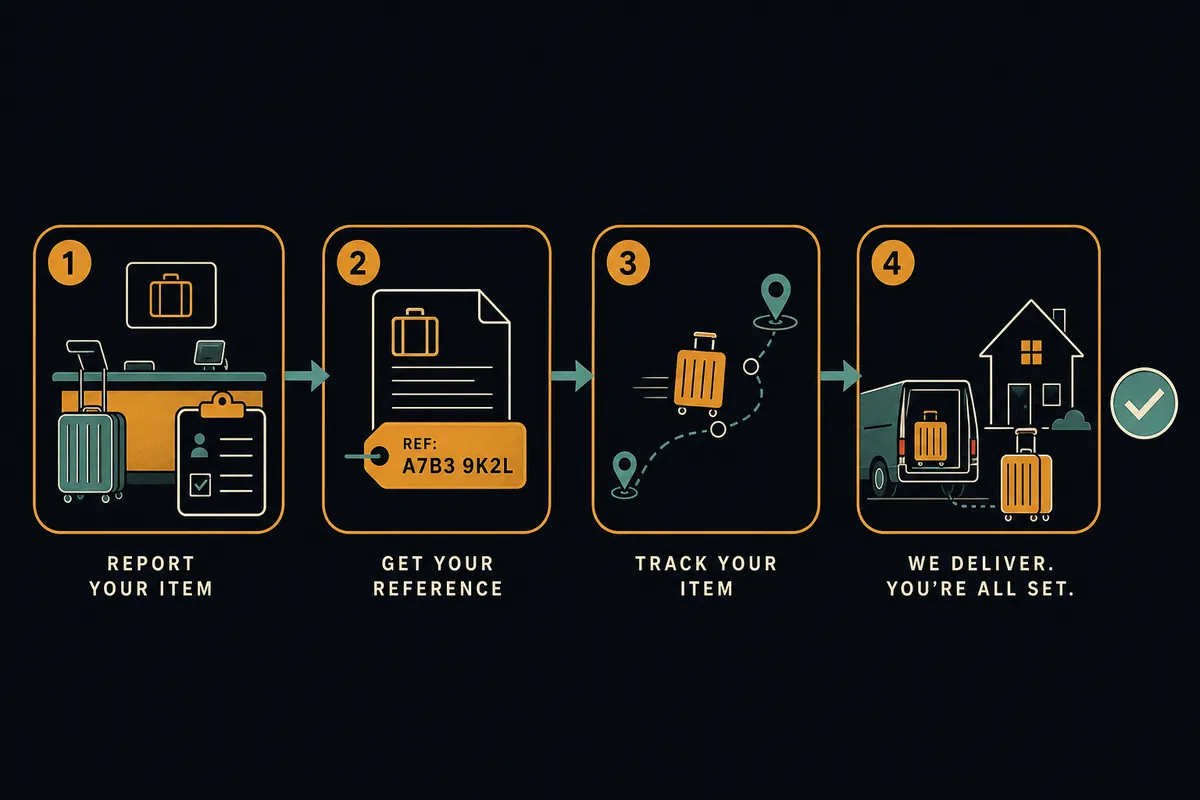
File a Property Irregularity Report before you leave the airport
The single most important step is to walk directly to the airline's baggage service office before exiting the arrivals area and file a Property Irregularity Report (PIR). Ask for a written copy with your reference number — you will need it to track the bag, claim expenses, and, if the airline resists, to file a DOT complaint. Most airlines also let you file through their app or website if you have already left, but doing it in person at the airport creates a timestamp that starts the compensation clock. Without a filed report, airlines are not required to reimburse you for incidental expenses.
- Go directly to the airline baggage service desk before leaving the terminal — do not exit to ground transportation first
- Request a written PIR with a reference number — take a photo of it before the agent hands it back
- If no desk is staffed, call the airline's customer service line from the airport and document the call (screenshot the call log with time)
- Some airlines (United, Southwest) also accept online or app reports if you have already left — use them as a fallback, not a first choice
How to track your delayed bag and get essentials while you wait
Once your PIR is filed, use the airline's app or website — or the industry-wide WorldTracer database(worldtracer.aero) — to monitor your bag's location. Airlines are required to compensate you for reasonable, verifiable incidental expenses incurred during the delay, including toiletries and replacement clothing. Critically, DOT rules explicitly prohibit airlines from setting an arbitrary daily cap (such as “up to $50 per day”) — they must cover actual, documented costs up to the maximum liability limit. Save every receipt; reimbursement without receipts is rarely honored.
- Ask the agent at the baggage desk about an essentials kit — many major carriers provide one free of charge
- Buy necessities and keep every receipt; photograph them immediately in case the paper fades
- File expenses with the airline as soon as the delay is confirmed — the earlier the better for your paper trail
- Bag fee refund is automatic once the delay threshold is crossed — you should not need to ask, but follow up in writing if it does not appear within 7 business days
When is your bag fee automatically refunded?
A 2024 DOT rule requires airlines to automatically refund your checked bag fee when the delay crosses a legally defined threshold. For domestic flights, the trigger is 12 hours after your flight arrives at the gate. For international flights, the threshold is 15 hours if your flight was 12 hours or shorter in duration, or 30 hours if your flight was longer than 12 hours. The refund must be issued within 7 business days for credit card payments or 20 calendar days for other payment methods. You must have a PIR on file with the airline for the automatic refund to trigger.
| Trip type | Fee refund triggers after | DOT max liability |
|---|---|---|
| Domestic flight | 12 hours after gate arrival | $4,700 per passenger |
| International (flight ≤12 hr) | 15 hours after gate arrival | ~$2,175 (1,519 SDRs) |
| International (flight >12 hr) | 30 hours after gate arrival | ~$2,175 (1,519 SDRs) |
- Domestic: bag not delivered within 12 hours of gate arrival = fee refunded automatically
- International (flight ≤12 hr): bag not delivered within 15 hours = fee refunded
- International (flight >12 hr): bag not delivered within 30 hours = fee refunded
- Refund issued within 7 business days (credit card) or 20 calendar days (other payment) — follow up in writing if the timeline is missed
When does a delayed bag officially become a lost bag?
Airlines set their own policies for when a bag transitions from “delayed” to “lost,” and DOT allows this — but it must happen within a reasonable time. Most airlines declare a bag lost between 5 and 14 daysafter the flight, according to the DOT. Once declared lost, the airline must compensate you for the bag's contents (subject to depreciation) and refund any bag fees paid. Airlines may require receipts or itemized lists for higher-value contents. If an airline unreasonably refuses to declare a bag lost after it has been missing for an excessive period, DOT can take enforcement action.
- 5–14 days is the standard industry window for declaring a bag lost (per DOT.gov, updated October 2025)
- Compile a detailed contents list immediately — memory fades and a thorough list strengthens your claim
- Airlines may depreciate items; they will not pay full replacement value for a worn suitcase or used clothing
- Ask for your claim number and expected compensation timeline in writing — a paper trail helps if you need to escalate
How much can you claim for a lost or delayed bag?
For domestic flights, the DOT caps airline liability at $4,700 per passenger for lost, damaged, or delayed bags combined — this limit was updated and is higher than the $3,800 figure that still circulates online. For most international flights, the Montreal Convention applies; as of December 28, 2024, ICAO raised the limit to 1,519 Special Drawing Rights, which equals approximately $2,175 USD. Airlines are free to pay more than these caps, but are not required to. These limits include all incidental expenses you claim during the delay, so large essential purchases eat into the total available for a lost-bag settlement.
- Domestic max: $4,700 per passenger (not $3,800 — that figure is outdated)
- International max: ~$2,175 USD (1,519 SDRs) effective Dec 28, 2024 — raised from the prior ~$1,700 limit
- Airlines may exclude liability for electronics, jewelry, cash, and fragile items on domestic flights — this is why carry-on packing matters
- On international flights, airlines are responsible for excluded items if they accepted the bag without noting any objection
For a full breakdown of what airlines charge and cover for checked bags, see the airline baggage fees compared guide.
How to stack credit card and travel insurance coverage on top of airline reimbursement
Airline reimbursement is a floor, not a ceiling. Many travel credit cards include baggage delay insurance that activates after a 6-hour delay and covers up to $100 per day for 3–5 days when you paid for your ticket with that card. Separate travel insurance policies often include lost-luggage coverage of $1,000–$3,000 per person, which can supplement or exceed what the airline pays. File with your credit card or insurer in parallelwith the airline — you cannot double-collect, but the combination can close the gap between depreciated airline settlement and actual replacement cost. Check your card's benefits guide before your trip; coverage varies significantly by card.
- Charge your ticket to a card with baggage delay/loss coverage before you fly — coverage only applies when the ticket was purchased with that card
- File with the airline AND your credit card or insurer simultaneously — process in parallel to avoid missing claim windows
- Keep receipts for every essential purchase regardless of which party you expect to reimburse you — each claim requires its own documentation
- AirTags and similar trackers cannot force the airline to act faster but help you give the airline precise last-known location data
What to always pack in your carry-on to survive a bag delay
Proactive packing is the best insurance. Anything that cannot be replaced quickly or cheaply — medication, electronics, jewelry, irreplaceable documents, business materials — should travel in your carry-on. DOT strongly advises against checking these items because airlines routinely exclude them from liability on domestic routes. A 24-hour carry-on kit (one change of clothes, toiletries, charger, passport, medication) costs nothing to prepare and eliminates most of the hardship caused by a one-night delay, which covers the vast majority of mishandled-bag situations.
- Medications and medical devices — always carry-on; airlines exclude these from liability and they cannot be replaced overnight
- One change of clothes and travel-size toiletries in a quart bag — covers the majority of one-night delay scenarios
- All electronics: laptop, phone charger, earbuds — explicitly excluded from domestic airline liability
- Passport, travel documents, credit cards — never put these in checked luggage under any circumstances
- Irreplaceable items: jewelry, heirlooms, important business materials — airlines explicitly exclude these from domestic liability
Data verified . Sources: DOT Baggage Rules · ICAO Montreal Convention update (Dec 2024) · NerdWallet baggage compensation guide.
Know exactly when to leave for the airport
The Leave-By Time calculator folds in today's live TSA security wait at your airport, your drive, and your airline's bag-drop cutoff into one time to walk out the door — so you arrive calm, not cutting it close.
Calculate your Leave-By Time →Keep planning
Baggage
Airline baggage fees, compared
What every major airline charges for carry-on and checked bags in 2026 — including Southwest, which dropped free bags.
BaggageHow to avoid checked bag fees
Credit card waivers, airline status perks, and packing tricks that keep bag fees off your bill.
BaggageOversize and overweight baggage fees by airline (2026)
Bags over 50 lbs or 62 linear inches cost $100–$200 extra — here is what each major US airline charges.
BaggageCarry-on size limits by airline (2026)
Maximum carry-on and personal item dimensions for every major US airline — and which base fares include a carry-on.