Baggage
TSA-approved luggage locks: what they are and why they matter
By the TSA Wait Times team · Updated · Published June 2026
A standard padlock on your checked bag can be cut by a screener, and TSA owes you nothing. A TSA-approved lock — one carrying the red Travel Sentry diamond or green Safe Skies clover — gives screeners a master key to open and re-lock your bag without damage. Here is how the system works, which brands to buy in 2026, and the honest limits of what any lock actually protects.
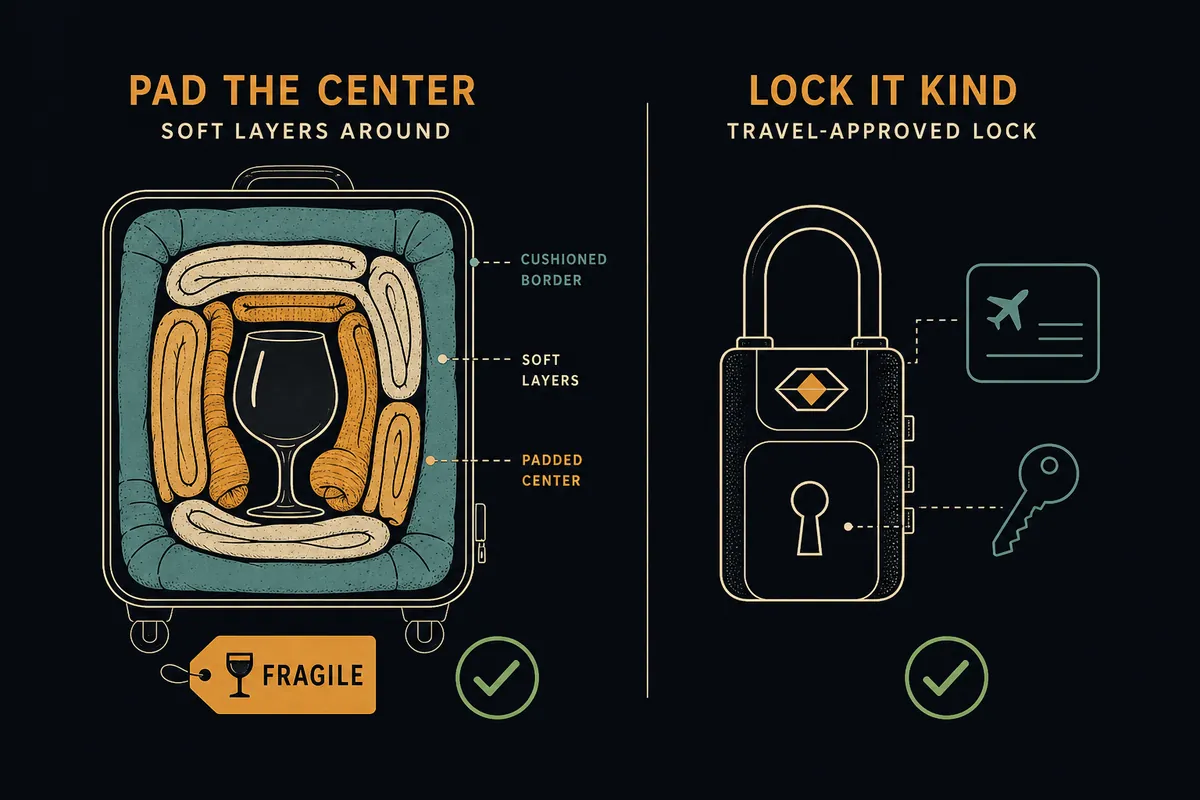
What is a TSA-approved lock and how does the master-key system work?
A TSA-approved lock is one licensed under Travel Sentry or Safe Skies, the two programs authorized by the TSA. Each approved lock has a small alphanumeric code stamped on it — such as TSA002 or TSA007 — and the lock's mechanism accepts one of eight master keys held exclusively by TSA screeners. When a screener needs to inspect your checked bag, they match the code to the correct master key, open the bag, inspect it, and re-lock it before it continues to your flight. No damage, no bill, and no additional note beyond the standard inspection notice already placed in bags.
- Eight master keys cover all TSA-approved locks sold in the US.
- Each lock is stamped with its key code (e.g., TSA007) so screeners know which key to use.
- Travel Sentry and Safe Skies are the only two licensed programs; any lock claiming TSA approval must carry one of their certification marks.
Travel Sentry vs. Safe Skies: how to tell the two programs apart
Both programs are fully accepted by the TSA, but they are independently operated and use different logos. Travel Sentry is by far the more common and is behind most locks sold at major US retailers. Safe Skies is equally recognized — TSA screeners are trained on both symbols. Confirm a lock is genuine by checking for the logo on the lock body itself, not just the packaging.
| Feature | Travel Sentry | Safe Skies |
|---|---|---|
| Logo | Red diamond | Green clover |
| Retail availability | Very wide (Target, Amazon, Home Depot) | Narrower; mainly online |
| Major brands | Master Lock, Samsonite, Tumi, Lewis N. Clark | Safe Skies branded locks |
| Master key pool | 8 keys (TSA001–TSA009 range) | Separate Safe Skies key set |
| Best for | General travelers; widest lock selection | Budget multi-packs; family travel |
What actually happens when a screener needs to open your locked checked bag?
If your checked bag triggers a secondary inspection and you have a TSA-approved lock, the screener uses the matching master key, opens the zipper or clasp, inspects the contents, and re-locks the bag — the process leaves no visible sign of forced entry. If your bag has a standard (non-approved) padlock, the screener will cut it and is not liable for its replacement under TSA regulations; most non-approved lock manufacturers also do not warranty against TSA removal. TSA may leave a paper notice inside the bag when an inspection takes place, regardless of lock type.
- TSA screeners are trained to recognize both the Travel Sentry and Safe Skies symbols.
- A cut lock is the screener's only alternative when no master key applies — and TSA bears zero liability for cutting a non-approved lock.
- International airports outside the US do not carry TSA master keys; a TSA-approved lock does not help foreign screeners open your bag non-destructively.
When you actually need a TSA-approved lock — and when you don't
The two clearest use cases are checked bags on international itineraries (where bags may connect through multiple US airports and be re-screened) and bags transferred on codeshare routings where handlers change. Domestic checked bags also benefit, though TSA screening rates on checked bags are lower. Carry-on bags are generally not locked — you may be asked to open your bag at the checkpoint, and a lock only slows the process. Cable locks are acceptable for securing zipper pulls on soft-side luggage but offer a deterrent rather than real resistance.
- Checked bags on international trips: strongest use case.
- Domestic checked bags: reasonable, low friction.
- Carry-ons: skip the lock — it only slows checkpoint screening and screeners can require you to remove it.
- Hard-shell luggage with built-in TSA combination locks: already covered, no add-on needed.
Best TSA-approved luggage locks in 2026
Forbes Vetted updated its ranking in January 2026 after testing with frequent fliers. Master Lock's 4696T combination lock remains the top overall pick for value and durability. Tumi leads the premium segment for build quality. Lewis N. Clark's cable lock is the top choice when you need to thread through multiple zipper pulls on soft luggage. Prices range from roughly $10 for a basic Master Lock to $30 for Tumi. All four Travel Sentry brands below are widely available at US retailers.
| Brand / Model | Type | Approx. Price | Best For |
|---|---|---|---|
| Master Lock 4696T | 3-dial combination | ~$11 | Best overall, widest availability |
| Tumi Luggage Lock | 3-dial combination | ~$25–30 | Best durable / premium pick |
| Samsonite TSA Lock | 3-dial combination | ~$15–18 | Good match for Samsonite suitcases |
| Lewis N. Clark Cable Lock | Cable + combination | ~$10–12 | Best for flexible zip-through use |
| Safe Skies 4-Pack | Key lock | ~$12–15 | Best for families needing multiple locks |
Do TSA locks protect against theft? The honest answer.
TSA-approved locks are designed for compliance, not security. Because the master keys were inadvertently published online years ago, motivated thieves can 3D-print a working copy of most of the eight keys. A TSA lock signals that your bag is harder to open quietly, but it is not a meaningful deterrent against someone willing to spend two minutes on a baggage cart. For actual theft-tracking, an Apple AirTag or similar Bluetooth tracker hidden inside the bag provides far more value — it will not stop a theft, but it gives you a precise last-known location to share with law enforcement or the airline. Use TSA locks to satisfy airline policy and avoid screener cutting; use a tracker to deal with actual loss.
- TSA master key 3D-print vulnerability is well-documented and effectively public knowledge.
- A TSA lock does visibly slow casual tampering by unequipped opportunists.
- AirTag or Tile tracker: a better anti-theft tool than any lock.
- Some travel insurance policies require evidence of a locked bag to pay a theft claim — a TSA lock satisfies that requirement even if it doesn't stop the thief.
Wondering what your airline charges if the bag makes it through screening but comes out heavier? See airline baggage fees compared for a full 2026 breakdown.
Common questions about TSA-approved locks:
What is a TSA-approved lock and how does the master-key system work?
A TSA-approved lock carries a coded slot — stamped with a code like TSA007 — that accepts one of eight master keys held by TSA screeners, letting them open and re-lock your bag without cutting it. Only locks certified by Travel Sentry (red diamond logo) or Safe Skies (green clover logo) qualify.
What happens if I use a regular (non-TSA) lock on my checked bag?
If a screener needs to inspect a non-TSA-approved locked bag, they will cut the lock and are not liable for replacing it under TSA policy. Most non-approved lock warranties also exclude TSA removal.
Should I lock my carry-on bag?
Generally no. TSA screeners at the checkpoint may ask you to unlock or remove a carry-on lock, and you are legally required to comply; locking it only adds friction. Save TSA-approved locks for checked bags.
Do TSA locks work on international flights?
Your TSA-approved lock will protect your bag from being cut by US domestic screeners, but airports outside the US do not carry TSA master keys. If a foreign screener needs access, they may cut a TSA lock just as they would any other. For purely international routes, a TSA lock still adds a deterrent layer but does not guarantee non-destructive opening.
Which is better: a combination lock or a cable lock?
A combination lock with a hardened shackle is more resistant to cutting than a cable lock; cable locks are thinner steel and can be defeated with basic tools in seconds. Use combination locks when security matters; use cable locks only when you need to thread through multiple zipper pulls on soft-side luggage and convenience outweighs resistance.
Know your exact Leave-By Time
A TSA-approved lock is one piece of a smooth departure. The other piece is knowing exactly when to leave home — factoring in today's live security wait at your airport, your drive, and parking — so you reach the bag-drop counter with time to spare.
Calculate your Leave-By Time →Sources: Travel Sentry, Safe Skies Locks, Forbes Vetted, TSA.gov, Home Depot. Last verified .
Keep planning
Baggage
Airline baggage fees, compared
What every major airline charges for carry-on and checked bags in 2026 — including Southwest, which dropped free bags.
BaggageHow to avoid checked bag fees
Credit card waivers, airline status perks, and packing tricks that keep bag fees off your bill.
BaggageOversize and overweight baggage fees by airline (2026)
Bags over 50 lbs or 62 linear inches cost $100–$200 extra — here is what each major US airline charges.
BaggageCarry-on size limits by airline (2026)
Maximum carry-on and personal item dimensions for every major US airline — and which base fares include a carry-on.