Packing
How to pack for winter travel: the layering system and ski gear guide
By the TSA Wait Times team · Updated · Published June 2026
Winter travel packing is mostly a space problem — a puffy coat alone takes half a roller bag. The solution is a layering system that is more versatile than individual thick garments, wearing your bulkiest items on the plane, and knowing what to ship vs check vs carry on for ski gear.
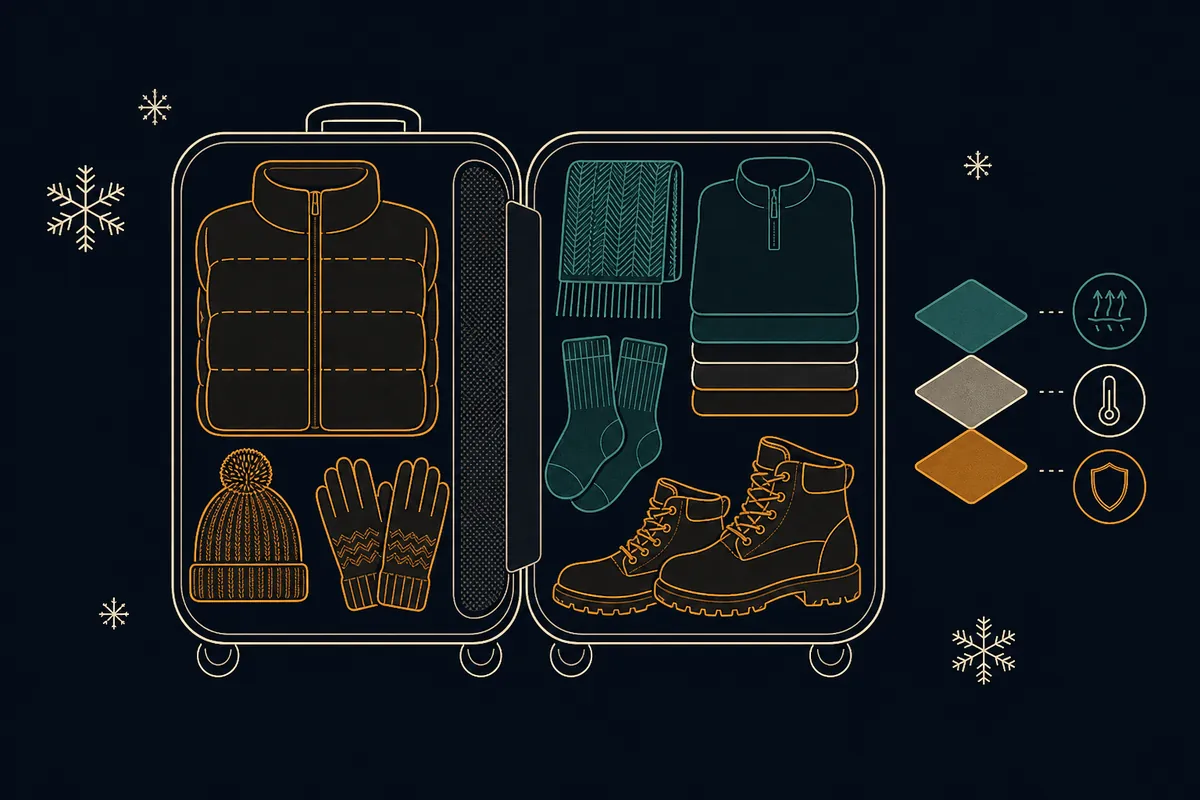
The three-layer system (replaces three separate sweaters)
Instead of packing multiple thick garments, build three lightweight layers that nest together. Each layer has a distinct function — and together they handle any cold-weather condition from a city walk to a ski slope.
Layer 1
Base layer — moisture-wicking thermals
Merino wool or synthetic thermal underwear. This is the essential winter travel piece — lightweight, compresses small, works for hiking, skiing, and city walking. Bring 2–3 base layer tops and 1–2 bottoms. Brands: Smartwool, Icebreaker (merino wool); Patagonia Capilene (synthetic).
Layer 2
Mid layer — insulating puffy
A down or synthetic puffy jacket traps warmth and compresses extremely small. A fleece jacket works for milder cold. The Uniqlo Ultra Light Down jacket compresses to the size of a water bottle and is comfortable down to 30°F with a base layer underneath.
Layer 3
Outer layer (shell) — wear on the plane
A waterproof, windproof shell jacket with no insulation — like an Arc'teryx Alpha or a quality rain jacket — protects against wind and snow without the bulk of an insulated parka. Wear this on the plane instead of packing it.
The result
Three lightweight layers that all fit in a carry-on and function as a complete winter system from 20°F to 50°F (−6 to 10°C). This is more versatile than one heavy coat — and packs to a fraction of the size.
The golden rule: wear your heaviest items on the plane
Clothes worn on your body do not count toward your bag allowance on any major US airline. Wearing your heaviest items saves 4–6 lbs of bag weight and frees significant space before you pack a single item.
Wear on the plane — do not pack:
- Your heaviest boots (trail runners, winter boots, or duck boots)
- Your outer shell jacket (fold it into the overhead bin at the gate)
- Your jeans or thicker pants
- Your heaviest sweater, if you have one
At the security checkpoint
Boots stay on through security unless they have substantial metal components — in that case remove them at the checkpoint like you would any other footwear. The jacket goes into a bin; pick it up on the other side and put it in the overhead bin at the gate.
Winter packing list (5–7 days, cold city destination)
This list fits in a 40L carry-on for 5–7 days, assuming you wear your heaviest items on travel day.
Clothing
- 2 base layer tops + 1 base layer bottom
- 1 mid-layer puffy (compressed in bag)
- 1 outer shell (worn on plane)
- 2–3 t-shirts or light tops (to layer under base)
- 2 pairs of pants (jeans or hiking pants — 1 worn on plane)
- 1 pair of thermal leggings (doubles as pajamas and under-layer)
- 5 pairs of wool socks — wool is warmer and drier than cotton
- 5 pairs of underwear
Accessories
- 1 warm hat (compresses flat)
- 1 pair of gloves (compresses flat)
- 1 scarf or buff (wrap style, compresses to almost nothing)
Shoes
- 1 pair of winter boots (worn on plane)
- 1 pair of lighter shoes or sneakers (packed)
Ski and snowboard gear: check, rent, or ship?
Ski gear is the hardest winter travel logistics problem. The right answer depends on how often you ski and which gear is custom-fitted to you.
Ski boots
The hardest item — heavy, rigid, enormous. Three options:
- Rent at the resort: $30–60/day for boots. Most quality resorts have excellent rental boot fitting — the most efficient option for occasional skiers.
- Ship via FedEx or UPS: Ship ski boots ahead in a padded bag (~$40–60 each way, 2–3 day transit). Often cheaper than airline ski bag fees.
- Check as airline ski bag: Airlines charge $35–75 each way for ski boot bags. Most airlines count ski boots + poles as a single checked bag.
Skis and snowboard
Rent at the resort unless you have a custom setup.
- Rental quality at major ski resorts (Vail, Park City, Breckenridge, Aspen) is genuinely high — demo equipment is available that surpasses mid-range consumer skis.
- If bringing your own: airline ski bag fees are typically $35–75 each way. Delta and Southwest include ski bag in checked bag allowance on select routes to ski destinations.
Ski clothing — packs better than you think
A ski jacket in a compression sack reduces to the size of a football. Ski bibs compress to roughly the size of a large fleece. Both items can fit in a 40L carry-on alongside a week of base layers and accessories.
Cold weather essentials that are easy to forget
- Lip balm: Mountain air and cabin air at altitude are extremely dry — put ChapStick in every pocket.
- Hand cream: Essential for extended cold exposure — hands crack in dry winter air within a day.
- Sunscreen (SPF 50): Sun reflection off snow at altitude causes burns faster than a summer beach trip. Powder sunscreen travels carry-on without the quart-bag restriction.
- Hand warmers: HotHands disposable warmers — cheap, lightweight, pack flat. Pack 4–6 pairs for a ski trip.
- Altitude medication: If traveling above 8,000 feet from sea level, consider Diamox (acetazolamide) — talk to your doctor before a ski trip.
What not to bring
These are the most common items winter travelers overpack — and the reasoning for leaving each one behind:
- Full-size shampoo/conditioner: Most winter hotels have these. Buy a small local brand if your hotel does not provide them.
- A separate fleece AND a puffy: Choose one mid-layer, not both. The down puffy wins on weight and compression every time.
- Multiple pairs of jeans: Jeans are heavy and take a long time to dry — one pair maximum.
- Heavy sweaters: The layering system (base + mid + shell) makes bulky sweaters redundant — they compress poorly and the layering system is warmer anyway.
Frequently asked questions
Can I carry on ski clothes or do I need to check them?
Ski clothing (jacket, bibs) can fit in a carry-on with proper packing — ski jackets compress significantly in a dry-bag or compression sack. A 40L carry-on handles ski clothes for a 5-day trip.
Should I check ski boots or rent them?
For occasional skiers (1-2 trips/year), renting at the resort is cheaper and eliminates luggage stress. For frequent skiers with custom-fitted boots, shipping via FedEx or checking as an airline ski bag is worth it.
How do I pack a coat in a carry-on?
The trick is a packable or compressible coat (down or synthetic puffy). Real winter coats (wool overcoats, quilted parkas) do not compress — wear them on the plane instead of packing them.
What temperature does the layering system work down to?
The three-layer system (base layer + down puffy + shell) is comfortable from about 20–40°F (−6 to 4°C). Below 20°F, a heavier insulating mid-layer or insulated outer shell is needed.
Related guides
- How to fly carry-on only — the complete capsule wardrobe and liquids strategy for any trip
- Carry-on vs checked bag — when checking a bag is actually the better call (ski trips included)
Know your Leave-By Time before you head to the airport
Winter weather, holiday crowds, and ski-destination airports all add security wait time. Use the Leave-By Time calculator to fold your airport’s live security wait, your drive, and your airline’s check-in cutoff into one exact time to leave home.
Calculate your Leave-By Time →Verified as of . Sources: REI Layering Guide, The Points Guy, SmarterTravel.