Flight day
Involuntary denied boarding: your rights and compensation
By the TSA Wait Times team · Updated · Published June 2026
Federal law guarantees cash compensation of up to $2,150 when an airline forces you off an oversold flight — but only if you know the rules, demand cash instead of a voucher, and refuse to let the airline reclassify an involuntary bump as voluntary. The DOT raised those compensation caps in January 2025, and a new 2026 disclosure rule now requires airlines to publish your rights in plain language on their websites.
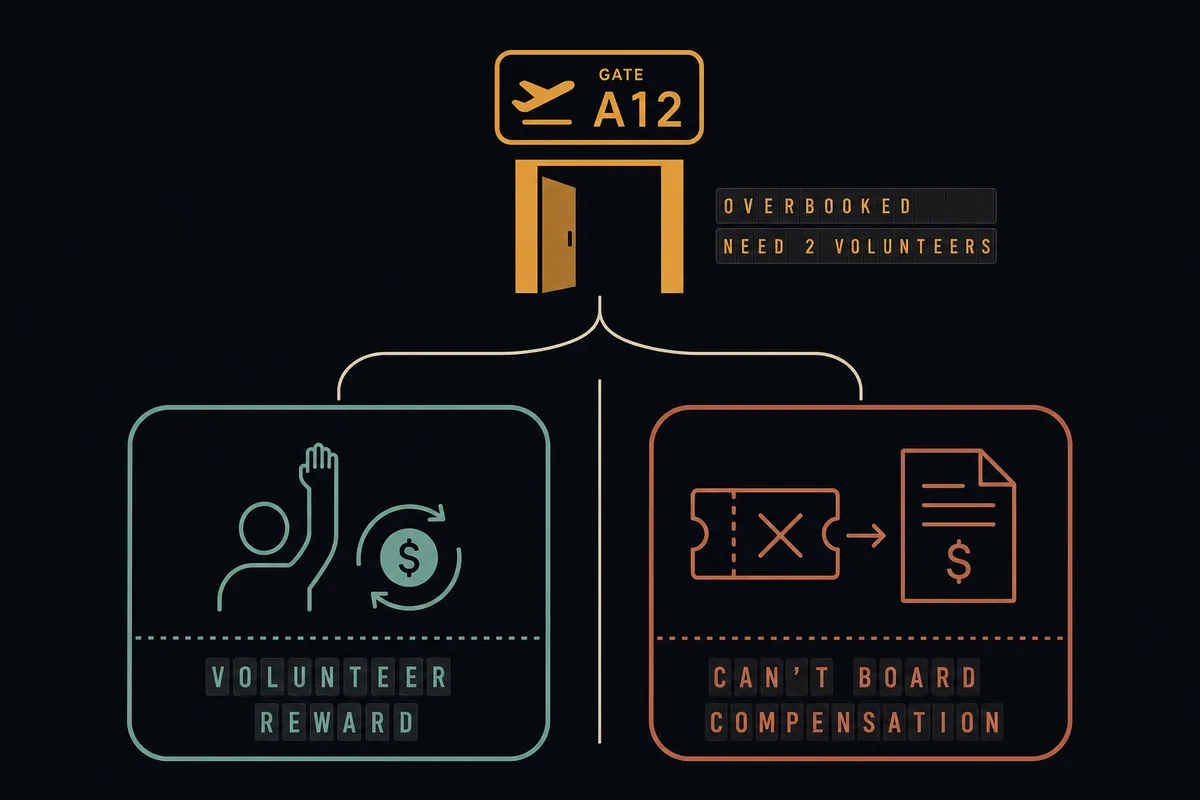
What is involuntary denied boarding and when does it trigger?
Involuntary denied boarding — commonly called being bumped — happens when a flight is oversold, there are more confirmed passengers than available seats, and the airline cannot find enough volunteers willing to take a later flight. Federal rules require the airline to solicit volunteers first, typically by offering increasing compensation at the gate until enough people agree to give up their seats. Only after that volunteer process fails does the airline have the legal authority to remove anyone against their will.
The moment you accept any offer from the airline and agree to take a different flight, your bump is reclassified as voluntary — and the mandatory federal compensation minimums no longer apply.
- Overbooking is legal — DOT does not prohibit airlines from selling more seats than exist
- Airlines must seek volunteers before bumping anyone involuntarily
- Accepting any airline offer, even under gate-area pressure, converts your bump to voluntary
- Fewer than 1 in 10,000 passengers are bumped involuntarily on U.S. carriers in a typical year
- You must have a confirmed reservation, checked in by the deadline, and arrived at the gate on time to be eligible
How much compensation are you owed if you are involuntarily bumped?
The Department of Transportation sets mandatory minimums under 14 CFR Part 250, calculated as a percentage of your one-way fare and capped at dollar limits that were raised effective January 22, 2025 to account for inflation. If alternate transportation arrives within one hour of your original arrival time, no compensation is owed at all. These dollar caps are a floor — airlines are free to pay more and sometimes do.
| Scenario | Compensation formula | Dollar cap (from Jan 2025) |
|---|---|---|
| Alternate arrives under 1 hour (domestic or international) | No compensation required | $0 |
| Arrival delay 1–2 hours (domestic) | 200% of one-way fare | $1,075 |
| Arrival delay over 2 hours (domestic) | 400% of one-way fare | $2,150 |
| Arrival delay 1–4 hours (international) | 200% of one-way fare | $1,075 |
| Arrival delay over 4 hours (international) | 400% of one-way fare | $2,150 |
The formula applies separately for domestic and international flights, with international passengers receiving a longer grace window before the higher tier kicks in. The dollar caps above are a floor — airlines may pay more.
Who qualifies — and what exemptions remove the compensation requirement?
To qualify for the DOT-mandated payout, you must have a confirmed reservation, completed check-in by the carrier's published deadline, arrived at the boarding gate on time, and face an alternate arrival that is more than one hour late. However, three narrow but meaningful exemptions exist under Part 250 that let airlines bump passengers without owing any compensation. Knowing these exemptions matters because airlines rarely volunteer the information at the gate.
- Aircraft with fewer than 30 seats are fully exempt from Part 250 — regional turboprops often fall here
- Charter flights are exempt regardless of aircraft size
- If the airline substitutes a physically smaller aircraft on the same route, denied boarding rules do not apply
- Missing the airline's check-in or gate-arrival deadline voids your claim even if you later make it to the gate
- You keep your original ticket regardless — you can use it on a later flight or request a full cash refund even after accepting the compensation payment
Should you ask for cash or accept a travel voucher?
DOT regulations explicitly require airlines to pay involuntary denied boarding compensation in cash or by check if the passenger requests it — no carrier can force a travel voucher on you when the bump is involuntary. Travel credits and flight vouchers routinely carry expiration windows as short as 12 months, blackout dates during peak travel periods, and booking restrictions that make them worth significantly less than their stated face value. The safest move is to state clearly at the gate, before signing anything, that you are requesting cash or check payment under federal regulations.
- Say at the gate: “I am requesting cash or check payment per DOT regulations under 14 CFR Part 250”
- A Visa or Mastercard gift card loaded with the cash amount is generally an acceptable cash equivalent
- Vouchers often require booking through the airline's own site and exclude partner awards and codeshares
- For voluntary bumps, airlines sometimes offer higher voucher face values than cash — calculate real-world usability before deciding
- Get the offer in writing before you step away from the gate counter
How do you negotiate the best deal before you are bumped involuntarily?
When a gate agent calls for volunteers, you have genuine leverage: the airline legally cannot remove anyone involuntarily until it has exhausted reasonable volunteer efforts, and the offers almost always increase as the clock runs down. Before accepting anything, confirm you will receive a guaranteed seat assignment on a specific flight — not standby status, which can leave you waiting through multiple sold-out departures. Voluntary compensation has no legal ceiling, and well-prepared passengers have negotiated packages worth several times the involuntary minimum.
- Do not volunteer at the first offer — wait for the second or third round when values typically jump
- Ask specifically: “Is this a confirmed seat assignment or standby?” Standby offers are high-risk
- If rebooked overnight, request meal vouchers, hotel accommodation, and ground transport in writing
- Push for cash rather than travel credits even for voluntary bumps
- Ask for lounge access during a long airport wait as part of the package
- Flexible travelers on leisure trips with no time-sensitive connections have the most negotiating power
If you do end up waiting several hours at the airport, see how to get in — our guide to airport lounge access covers day passes, credit card memberships, and Priority Pass options worth adding to your compensation negotiation.
What are your rights if the airline pays less than required or refuses to pay?
Under 14 CFR § 250.9, the airline must hand you a written statement at the gate that explains your rights and describes the carrier's boarding-priority policy — this is a legal requirement, not a courtesy. If the airline underpays, delays payment beyond 24 hours after departure, or refuses a cash request, you have three enforceable escalation paths available without needing an attorney. Keep every piece of documentation before leaving the airport: your boarding pass, the written denial notice, the compensation offer in writing, and any receipts for expenses caused by the delay.
- File a complaint at transportation.gov/airconsumer — DOT tracks patterns and can assess civil penalties
- Dispute the ticket charge with your credit card issuer if you purchased with a card
- File in small claims court in your home state — most jurisdictions cover claims well above $2,150
- DOT can impose per-violation civil penalties on airlines that systematically violate Part 250
- Send a written demand to the airline's customer relations department before escalating to preserve a paper trail
What changed in 2025 and 2026 for denied boarding compensation?
The most significant change passengers need to know: the DOT raised the involuntary denied boarding compensation dollar caps in October 2024 (effective January 22, 2025), lifting them from $775/$1,550 to $1,075/$2,150 under the biennial Consumer Price Index adjustment mechanism built into Part 250. Many widely shared guides — and some airline-provided handouts — still cite the old $775/$1,550 figures, so knowing the current limits matters at the gate. Separately, in April 2026 DOT finalized a rule requiring all covered carriers to post a plain-language one-page passenger rights summary on their websites, with submission due May 26, 2026 and public posting required within 90 days.
- Old caps (before Jan 22, 2025): $775 for 1–2 hour delays, $1,550 for 2+ hour delays
- Current caps (from Jan 22, 2025): $1,075 for 1–2 hour delays, $2,150 for 2+ hour delays
- Caps are subject to biennial CPI review — next adjustment expected around 2027
- April 2026 rule: covered carriers must submit and post a one-page passenger rights summary covering denied boarding, delays, baggage, and cancellations
- The 2026 disclosure rule does not change the underlying compensation amounts — it only affects how airlines must communicate existing rights
The same rulemaking cycle that raised denied boarding caps also updated domestic baggage liability limits. See airline baggage fees compared for the 2025 fee changes across carriers, and visit airline check-in guides to confirm your carrier's current check-in deadlines before you fly.
Common questions about denied boarding compensation:
What is involuntary denied boarding and when does it trigger?
Involuntary denied boarding occurs when a flight is oversold and the airline fails to recruit enough volunteers to give up their seats. Once the airline removes you from a flight without your agreement, federal law classifies the bump as involuntary, triggering mandatory DOT compensation. Critically, if you accept any offer from the airline — even one made under pressure — the classification flips to voluntary and the legal minimums no longer apply.
How much compensation are you owed if you are involuntarily bumped?
As of January 22, 2025, the DOT-mandated minimums are 200% of your one-way fare up to $1,075 if your alternate flight arrives 1–2 hours late domestically, and 400% of your fare up to $2,150 for delays over 2 hours domestic or over 4 hours international. No compensation is owed if alternate transportation lands within one hour. These are minimums — airlines may pay more, and you should ask them to.
Should you ask for cash or accept a travel voucher?
Always request cash or a check. DOT rules require airlines to pay involuntary bumping compensation in cash or by check when you ask for it — they cannot force you to take a travel voucher. Vouchers frequently carry expiration dates, blackout periods, and booking restrictions that make their real-world value much lower than the stated amount. State your cash preference explicitly at the gate before signing anything.
How do you negotiate the best deal before you are bumped involuntarily?
When gate agents ask for volunteers, hold out through at least two rounds — offers typically increase each time. Before accepting, confirm the rebooking is a guaranteed seat (not standby status), and ask the airline to add meal vouchers, hotel accommodation for overnight delays, and ground transport to the package. Voluntary compensation has no legal ceiling, so there is genuine room to negotiate well above the involuntary minimums.
What are your rights if the airline pays less than required or refuses to pay?
The airline must give you a written statement of your rights at the gate under 14 CFR § 250.9. If they underpay or refuse a cash request, file a complaint at transportation.gov/airconsumer, dispute the charge with your credit card issuer, or take the airline to small claims court in your home state. Preserve your boarding pass, the written denial notice, and all receipts before leaving the airport.
What changed in 2025 and 2026 for denied boarding compensation?
Effective January 22, 2025, the compensation caps were raised from $775/$1,550 to $1,075/$2,150 — many airline handouts and third-party guides still display the old numbers, so knowing the current figures matters when you are negotiating at the gate. Separately, a DOT rule finalized in April 2026 requires covered carriers to post a plain-language one-page passenger rights summary on their websites by approximately August 2026; it does not alter the compensation amounts themselves.
Sources: 14 CFR § 250.5 (Cornell LII) · DOT Bumping & Oversales · Federal Register 2025 cap revision · Aviation regulatory update April 2026
Last verified .
Know your gate-to-gate timing too
Arriving early enough to make the check-in cutoff is your first line of defense. Use the Leave-By Time calculator to fold today's live security wait, your drive, and your airline's check-in deadline into one departure time.
Calculate your Leave-By Time →Keep planning
Flight day
How early should you get to the airport?
Two hours domestic, three international — then let today's real security wait and your drive set the exact time to leave.
Flight dayHow early for an international flight?
Three hours is the rule of thumb — but the 60-minute check-in cutoff and today's live wait set your real time to leave.
Flight dayCheck-in and bag-drop cutoff times
Most airlines close check-in 45 minutes before a domestic flight, 60 before international. Every cutoff, plus what changed in 2025.
Flight dayMinimum connection time, by hub
The shortest layover an airline will book — about 35 minutes domestic, two hours-plus international. Check yours before you cut it close.