Pet travel
Flying with pets: the complete airline guide for 2026
By the TSA Wait Times team · Updated · Published June 2026
Dogs and cats can fly in-cabin for $35–$200 each way if they fit in a carrier under the seat. Larger pets fly as checked baggage or cargo. Breed restrictions, health certificates, and carrier size rules apply. Here is everything you need to know by airline.
In-cabin vs. cargo vs. checked baggage
How your pet travels depends on their size, breed, and the airline you fly. There are three distinct options — and they are not interchangeable.
Cabin
In-cabin. Your pet stays under the seat in front of you in a soft-sided carrier. Limited to dogs, cats, and some small household pets. The pet plus carrier must typically weigh under 20 lbs combined and fit under the seat. In-cabin is always the preferred option — the cabin is temperature-controlled and you can monitor your pet throughout the flight.
Hold
Checked baggage (cargo hold). Your pet travels in the cargo hold in a TSA-approved hard crate. Available on most legacy carriers for pets that exceed in-cabin size limits. Requires a health certificate from a vet within 10 days of travel. Temperature extremes are a concern in summer and winter.
Ship
Pet cargo shipping.For pets traveling without their owner — handled by airline cargo divisions separately from the passenger process. Often the only option for large dogs. Fees are substantially higher and require advance arrangements with the airline's cargo department.
Per-airline pet fees and policies (2026)
In-cabin pet fees are charged each way per pet. Airlines limit the number of in-cabin pets per flight — typically four to six total. Confirm your airline's current policy at booking, as fees and limits change without notice.
AirlineIn-cabin fee
Delta
Dogs and cats; soft-sided carrier required
United
Dogs, cats, rabbits, small birds in-cabin
American
Highest among major US carriers
Southwest
Max 6 in-cabin pets per flight
JetBlue
Dogs, cats, and small household birds
Alaska
Lowest among legacy carriers
Frontier
Dogs, cats, rabbits, hamsters
Allegiant
Dogs and cats only
Hawaiian
$35 inter-island, $125 mainland — lowest inter-island fee in the US
Breeze
Lowest of any US carrier as of 2026
WestJet
Dogs and cats; route-dependent
Aeromexico
Route-dependent; confirm at booking
Copa
In-cabin; confirm cargo options separately
Breed restrictions
Failure to check breed restrictions can mean denied boarding at the gate — with no refund on your ticket.
Most legacy carriers prohibit snub-nosed (brachycephalic) breeds from the cargo hold due to breathing risks at altitude. Delta, United, and American all ban snub-nosed breeds from cargo entirely.
- Restricted dogs (cargo): English Bulldogs, French Bulldogs, American Bulldogs, Boston Terriers, Boxers, Pugs, Shih Tzus, Pekingese, and Lhasa Apsos.
- Restricted cats (cargo): Persian, Himalayan, Burmese, and Exotic Shorthair.
- In-cabin exception. Snub-nosed breeds are often permitted in-cabin — the pressurized, climate-controlled cabin reduces the breathing risk that makes cargo dangerous for these breeds. Confirm with your specific airline before booking.
Carrier size requirements
Your carrier must fit under the seat in front of you with your pet inside. Typical maximum dimensions are 18 × 11 × 11 inches, but this varies by aircraft type — always confirm with your airline before purchasing a carrier.
- Pet must be able to move. Airlines require that the pet can stand up, turn around, and lie down naturally inside the carrier. A carrier that is too snug will be rejected.
- Soft-sided carriers only in-cabin. Hard-shell crates are not permitted under the seat — they are required for checked baggage and cargo only.
- Recommended carriers. Sherpa Original (airline-approved across most carriers), Sleepypod Air, and K9 Sport Sack are consistently approved on major US airlines. Do a test run at home to verify your pet fits comfortably before travel day.
TSA security with pets
The checkpoint protocol for pets is straightforward — but it catches travelers off guard more than almost any other security procedure.
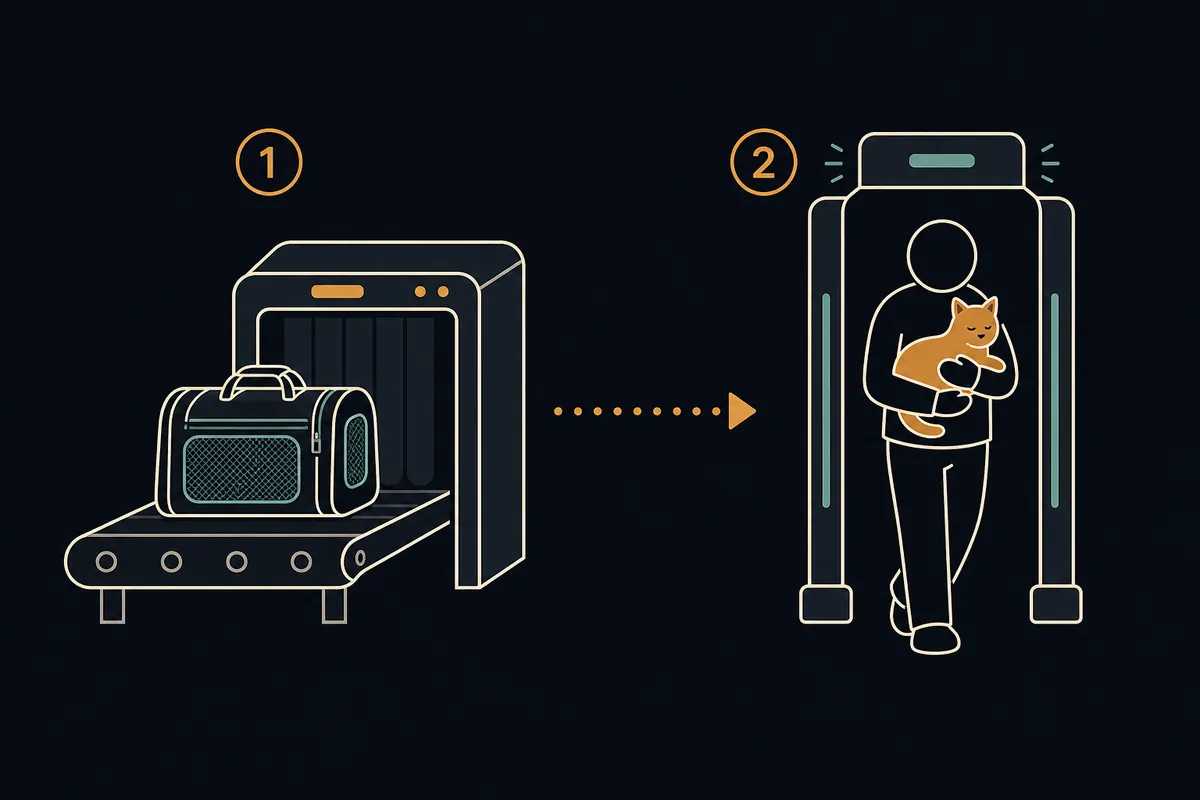
Pet comes out of the carrier. Remove your pet before you reach the X-ray belt. The empty carrier goes through the X-ray machine on the belt like any bag. You carry or hold your pet while walking through the metal detector or body scanner.
Secure your pet before removing them. Put a slip lead on your dog before taking them out of the carrier. Hold cats firmly — a startled cat at a security checkpoint is a genuine safety hazard. If your pet is anxious, request a private screening area; TSA will accommodate.
Service animals. Pass through security in their vest or harness and do not need to be removed from working gear. ADA rules apply. TSA officers will not require a service animal to be separated from its handler during screening.
Emotional support animals. No longer recognized as service animals by airlines as of the 2021 DOT rule change. They travel as pets — standard pet carrier rules and fees apply.
Health certificate requirements
A Certificate of Veterinary Inspection (CVI) is required for pets in cargo and for most international routes.
- Cargo and checked baggage pets. Most airlines require a CVI issued by a USDA-accredited vet within 10 days of travel (some specify 7 days — confirm with your carrier before scheduling the vet visit).
- International travel. A USDA endorsement of the CVI is required for most international routes. Destination country requirements vary significantly — some countries require weeks or months of advance preparation, including microchipping, rabies titer tests, and quarantine periods. Research destination rules early.
- In-cabin domestic flights. Most US airlines do not require a health certificate for in-cabin pets on domestic routes. A vet visit confirming fitness to fly is still recommended before any air travel.
How to book a pet on your flight
- Call the airline directly. Most airlines cannot process in-cabin pet reservations online — you must call. Book as early as possible, as airlines cap in-cabin pets at four to six per flight and spots fill quickly on popular routes.
- Confirm 24–48 hours before travel. Pet reservations are occasionally dropped from bookings. Call the airline the day before your flight to verify your pet is on the manifest.
- What to bring. Your approved pet carrier, health certificate if required, proof of rabies vaccination, and a comfort item — a small toy or blanket from home reduces travel anxiety noticeably.
At the airport with your pet
- Relief before security. Give your pet a chance to relieve themselves before entering the security checkpoint. Most large airports have service animal or pet relief areas before the security line. Look for them near the ticket counters or curbside, not inside the terminal.
- In-terminal pet areas.Many major airports have pet water fountains and in-terminal relief areas after security. Check your airport's map before you travel — knowing the location saves stress on a long layover.
- Do not sedate your pet.Sedation at altitude is dangerous — it impairs a pet's ability to regulate breathing and maintain balance. Most veterinarians advise against sedation for air travel. Ask your vet about anxiety-reducing alternatives such as calming treats or pheromone sprays if needed.
- For cargo pets: fly direct. Request a direct flight to avoid temperature-variable cargo transfers. In summer, fly in the morning or evening to avoid tarmac heat; in winter, fly midday to avoid extreme cold.
Changing plans after booking? Airline cancellation and change fees covers what you owe if travel is rescheduled or canceled. Traveling light? How to pack carry-on only walks through fitting everything — including your pet carrier — in a single bag.
Common questions
Which airline has the cheapest pet fee?
Breeze Airways charges $35 each way for in-cabin pets — the lowest of any US carrier as of 2026. Hawaiian charges $35 for inter-island flights. Alaska charges $100, the lowest among legacy carriers.
Can I bring both a cat and a dog on the same flight?
One pet per carrier, one carrier per passenger. Some airlines allow two passengers to each bring one pet in-cabin on the same flight — but airlines limit total in-cabin pets per flight.
What happens if my pet does not fit under the seat?
Your pet will not be allowed to board. Measure carefully — the carrier must fit under the seat with the pet inside. Many flyers do a full test run at home before travel day.
Do I need a health certificate for an in-cabin dog on a domestic flight?
Most domestic airlines do not require a health certificate for in-cabin pets, but policies vary by carrier. Always confirm with your airline before travel.
Heading to the airport with your pet? Nail the timing first.
Run your Leave-By Time and we'll count backward from your flight — today's live security wait, the drive, and the walk to your gate — so you and your pet arrive with room to breathe before boarding.
Get your Leave-By Time →