Security
Flying with a CPAP machine: TSA rules and airline policies
By the TSA Wait Times team · Updated · Published June 2026
The TSA does not require you to remove your CPAP from its bag at security, and federal regulation exempts the machine from your carry-on count — but battery watt-hours, distilled water, altitude settings, and in-flight power each have their own rules that can derail a trip if you miss them.
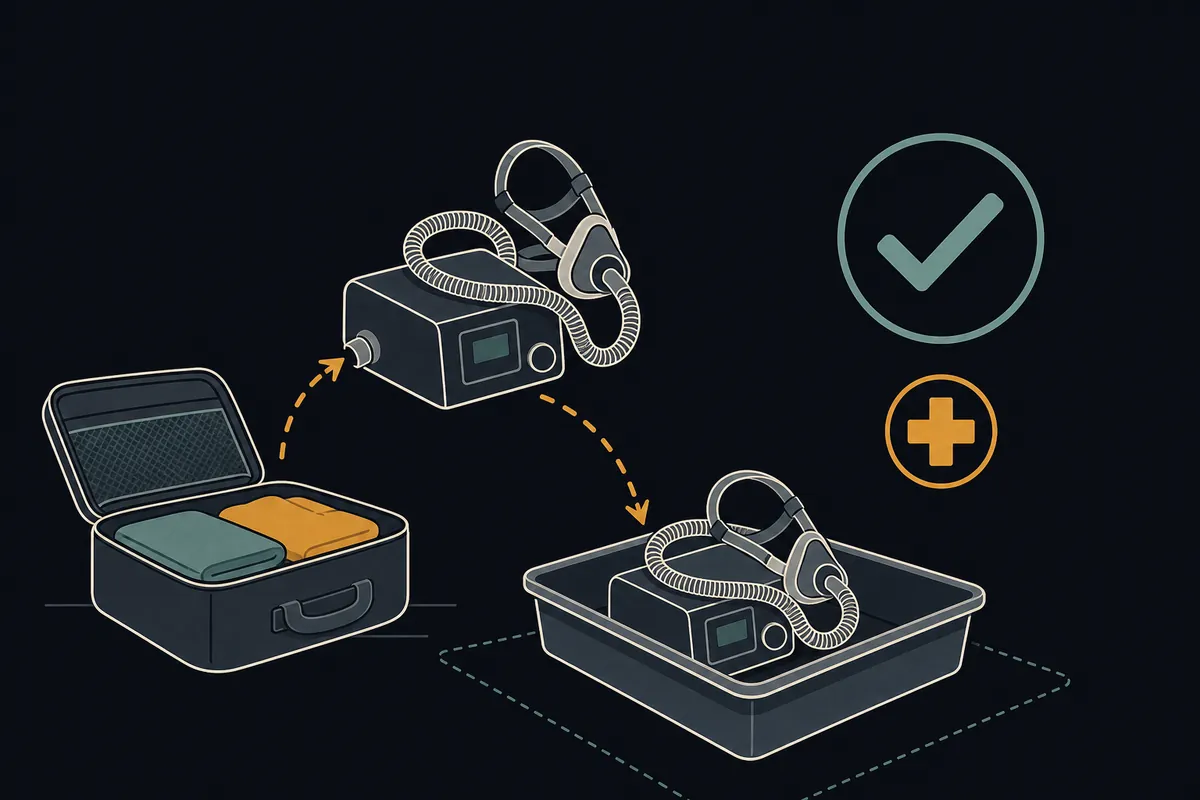
Does TSA require you to remove your CPAP at the security checkpoint?
TSA does not require you to remove your CPAP from its bag, but placing the unit in a dedicated bin for X-ray screening is strongly recommended because it gives officers a cleaner image and reduces the chance of a bag search or secondary screening. Empty the water reservoir completely before you approach the checkpoint, since liquid follows the 3-1-1 rule and standing water inside the humidifier chamber can flag the bag. The machine may be swabbed for explosive trace detection even if the X-ray is clean — this is routine, not cause for concern.
- Empty the humidifier water reservoir before reaching the checkpoint
- Remove the CPAP from its case and place it alone in a bin — do not stack other items on top
- Keep a doctor's prescription or letter of medical necessity accessible in case an officer asks
- Swab testing is routine; it does not indicate suspicion and rarely delays screening more than a minute
TSA PreCheck lanes do not change the CPAP screening process — the bin recommendation applies in both standard and PreCheck lanes. That said, PreCheck significantly cuts overall wait time. See live wait times and PreCheck availability at your airport with the Leave-By Time calculator.
Does a CPAP count as a carry-on, or do airlines charge extra for it?
Under the Air Carrier Access Act (49 U.S.C. 41705), a CPAP machine is classified as a medical device and does not count against your standard carry-on plus personal item allowance on all major US carriers. You are entitled to board with your CPAP, a full-size carry-on bag, and a personal item at no extra charge. Most airlines suggest notifying them in advance if you plan to use the device during flight, though this is rarely enforced for travelers who simply want to store it in the overhead bin.
- American, Delta, United, Southwest, JetBlue, and Alaska all treat CPAP as a free medical extra
- BiPAP and APAP machines receive the same medical-device exemption
- Carry a brief doctor's note as backup — gate agents are not always trained on the policy
- Store the unit in an overhead bin or under the seat in front for quick access if you want to use it mid-flight
For a full breakdown of what each airline includes in the ticket price — and where bag fees apply — see the airline guides hub or the how to avoid checked bag fees guide.
What are the rules for CPAP lithium batteries on a plane?
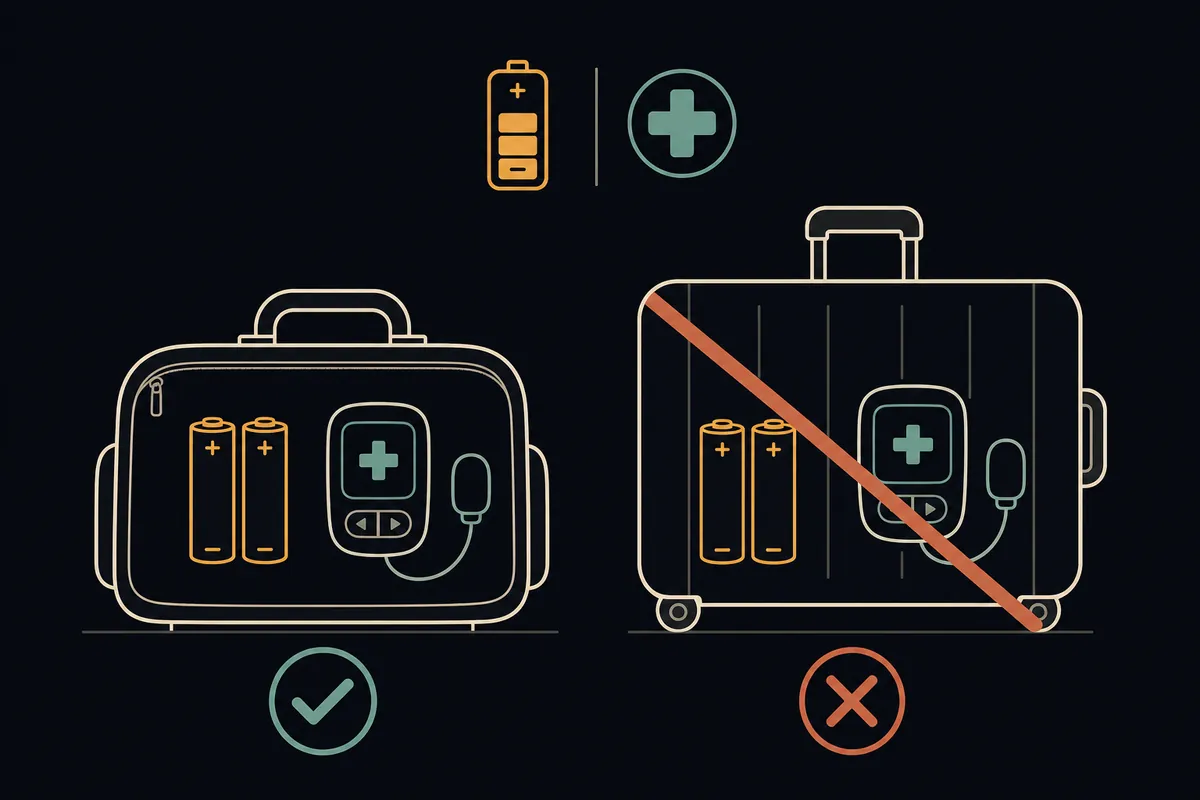
All lithium-ion batteries, including dedicated CPAP travel batteries, must travel in the cabin and cannot go in checked baggage under any circumstances. The FAA sets watt-hour thresholds that determine whether airline pre-approval is required. Most CPAP travel batteries sold today are engineered at approximately 97 to 99 Wh specifically to stay below the 100 Wh approval threshold. Contact your airline before departure if your battery is rated between 100 and 160 Wh.
| Battery capacity | Carry-on status | Airline approval |
|---|---|---|
| Under 100 Wh | Allowed in carry-on | No approval needed |
| 100–160 Wh | Allowed in carry-on only | Airline pre-approval required; max 2 batteries |
| Over 160 Wh | Not permitted | Neither carry-on nor checked |
Source: FAA 14 CFR Part 175 and Advisory Circular AC 91-55. Verify your battery's watt-hour rating on the label or the manufacturer's spec sheet — not all batteries list Wh prominently.
Can you bring distilled water for your CPAP through airport security?
Standard TSA 3-1-1 rules apply to distilled water — containers must be 3.4 oz (100 mL) or smaller, which is far too little to be useful for a CPAP humidifier. Your best options are to buy a small bottle of distilled water at an airport pharmacy or convenience store on the airside after clearing security, purchase it near your destination hotel, or run the humidifier on dry mode if your machine supports it. Tap water is an acceptable substitute for a single night when distilled water is unavailable.
- Airport pharmacies and some Hudson News or travel stores past security stock small distilled water bottles
- CVS, Walgreens, and grocery stores near your hotel are the most reliable source at your destination
- Tap water for one night is a low-risk short-term substitute — avoid it for multi-week trips
- Turning the humidifier off entirely eliminates the water question for short domestic trips
For a full reference on what liquids TSA allows in what container sizes, see the 3-1-1 liquids rule guide.
Will your CPAP work at altitude inside the plane cabin?
Aircraft cabins are pressurized to the equivalent of roughly 6,000 to 8,000 feet, which is lower air pressure than at sea level. Modern CPAP machines — including the ResMed AirSense 10, AirSense 11, and Philips DreamStation 2 — automatically detect and compensate for altitude changes, requiring no manual intervention. Older or first-generation devices may require you to activate an altitude mode in the device menu before departure; check your owner's manual or manufacturer app if your machine is more than five years old.
- ResMed AirSense 10, AirSense 11, AirMini: altitude auto-adjusts with no manual setting
- Philips DreamStation 2: altitude compensation is on by default
- Older models (S9, first-gen DreamStation 1): check the settings menu for an altitude or travel mode before departure
- The auto-adjustment range on modern units typically covers sea level through 8,500 feet — well above cabin pressure altitude
How do you power a CPAP machine during the flight?
In-flight power for CPAP is available on some but not all aircraft, and you cannot rely on it without checking in advance. Long-haul widebody jets (Boeing 777, 787, Airbus A330, A350) frequently offer 110V AC outlets at each seat in premium cabins and sometimes economy. Domestic narrowbody aircraft (Boeing 737, Airbus A319/320/321) are inconsistent — some rows have outlets, many do not. A dedicated CPAP travel battery is the most reliable backup for any flight. Flight attendants may ask to inspect your power cord before you plug into an aircraft outlet, so always carry it even if you plan to run on battery.
- Verify outlet availability for your specific aircraft using SeatGuru or the airline's interactive seat map
- Always carry your AC power cord even when using a battery — flight attendants may request it for inspection
- A DC travel cord (12V) can power most CPAP units from aircraft DC seat ports on long-haul international flights
- Enable airplane mode on AirSense 10 and 11 before use — it disables the built-in wireless radio per FAA rules
What should you pack in a CPAP travel kit?
A complete CPAP travel kit protects the device at the checkpoint and ensures uninterrupted therapy at your destination. The machine and mask are obvious, but several supporting items are easy to forget and difficult to source on the road. Packing a brief checklist the night before departure takes two minutes and prevents the most common CPAP travel problems.
- CPAP unit, mask (full assembly), hose, and AC power cord
- CPAP travel battery if you are unsure about in-flight or hotel outlet compatibility
- One spare mask cushion or full backup mask — a torn cushion eliminates seal and ruins sleep
- Doctor's prescription or letter of medical necessity for TSA and airline questions
- Travel-size CPAP wipes or a small bottle of CPAP equipment cleaner
- Universal AC adapter if traveling internationally (most modern CPAPs are 100–240V dual-voltage auto-switching, but confirm your model)
Plan the checkpoint before you pack
TSA PreCheck reduces checkpoint wait times and lane unpredictability — useful when you're carrying a CPAP and already managing extra gear. Explore PreCheck enrollment and lane availability at major hubs: LAX, ATL, ORD, and DFW. Not sure which expedited program fits your travel pattern? The TSA PreCheck vs CLEAR and Global Entry vs TSA PreCheck guides break down the differences. For what else goes in the overhead bin alongside your CPAP, see the carry-on size limits by airline.
Last verified . TSA policies and airline medical device rules can change; confirm current requirements with your airline and the TSA website before departure.
Know your Leave-By Time before you pack the CPAP
Factor in today's live security wait at your airport — not yesterday's average — and get the exact time to walk out the door.
Calculate my Leave-By Time →