Guide · Booking
Codeshare flights explained: what they mean for your miles, seat, and rights
By the TSA Wait Times team · Updated · Published June 2026
A codeshare flight has two airline codes on it — a marketing carrier (whose flight number you booked) and an operating carrier (the airline whose plane you actually fly on). Understanding which rules apply to each can save confusion about seat selection, baggage allowances, and miles earned.
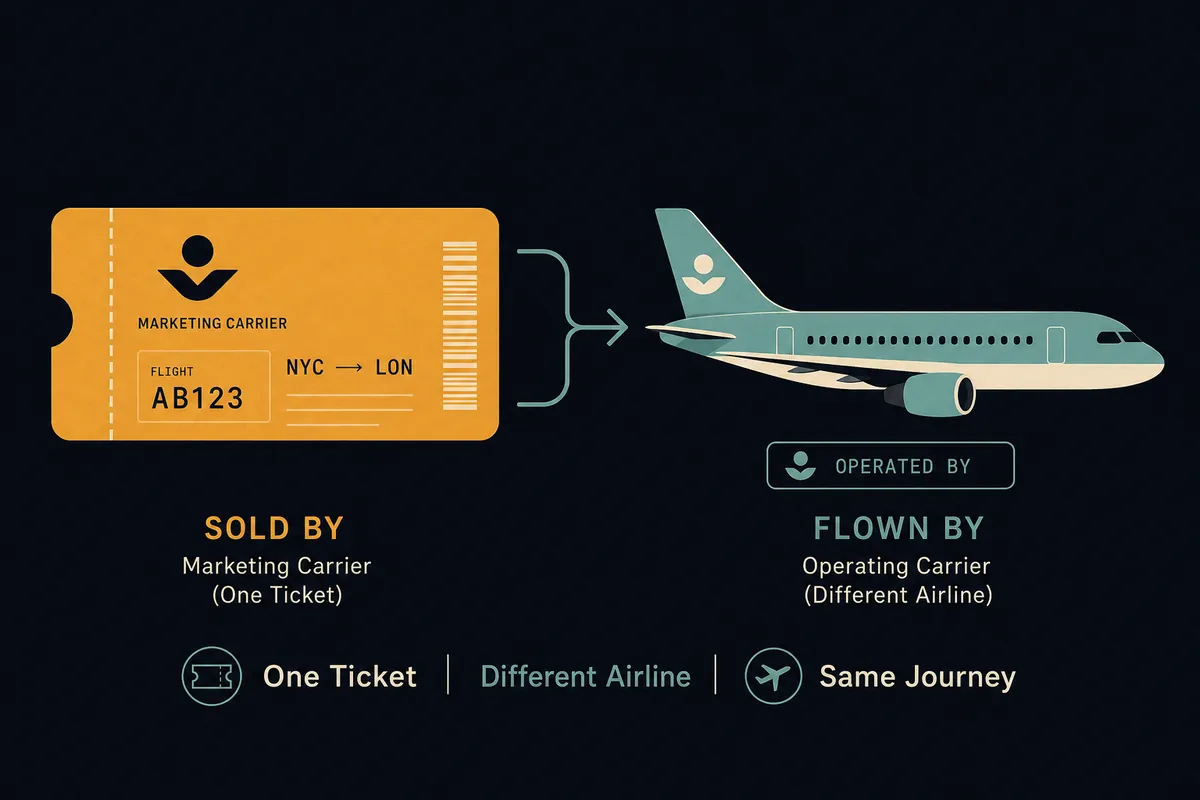
What is a codeshare?
A codeshare agreement allows one airline (the marketing carrier) to sell seats on another airline's (the operating carrier's) flights under its own flight number. Both flight numbers refer to the same physical aircraft on the same route.
Example
You book United flight UA889 from Chicago (ORD) to London (LHR). When you check in, you discover the plane is operated by Lufthansa — you board a Lufthansa aircraft with Lufthansa crew and Lufthansa food. The flight is still called UA889 on your booking, but Lufthansa actually operates it.
How to identify a codeshare
Look for language like “Operated by [other airline]” or “Marketed by [other airline]” in the fine print on your booking confirmation. Codeshares are always disclosed — though not always prominently. On many booking sites this note appears inside a collapsed “flight details” section.
Why airlines do codeshares
- Extend network:An airline can appear to fly to destinations it does not actually serve — useful for connecting passengers who want to book a single itinerary on one ticket.
- Alliance depth: Star Alliance, oneworld, and SkyTeam members share codeshare agreements so members can book seamlessly across alliance partners. See the airline alliance guide for the full breakdown.
- Revenue: Marketing carriers earn revenue on seats they did not have to buy aircraft to operate.
What changes on a codeshare flight
Seat selection
The operating carrier's seat map applies — but you may only be able to see a subset of seats through the marketing carrier's website.
Example
If you book a United codeshare on a Lufthansa flight, you may need to go to lufthansa.com and enter your booking reference to see the full seat map and all available seats. The United app may show a limited view with fewer options.
Action:Always visit the operating carrier's website with your booking reference to check seat availability and confirm your selection before the flight.
Baggage allowance
This is where it gets complicated. The operating carrier's rules usually apply at the check-in counter — but this can conflict with what the marketing carrier's website displayed at booking.
- General rule:The marketing carrier's allowance shown at booking should be honored, but always verify with the operating carrier before packing.
- Key example: When booking a United code on a Lufthansa transatlantic flight, you typically get the Lufthansa international allowance (1 checked bag included) rather than what a domestic United ticket would show.
Miles earned
Miles are earned based on the ticketing airline's program in most cases — the marketing carrier's program.
- Example:Book UA889 on Lufthansa metal → miles post to United MileagePlus.
- Exception:Some codeshares post miles to the operating carrier's program or allow you to choose. Check the marketing carrier's website for partner earning rates on codeshare flights.
- Earning rates: Partner flights on alliance codeshares often earn fewer miles per mile flown than flights on the marketing carrier's own metal. Check the specific partner earning chart before assuming full credit.
Elite status benefits
Generally, your status with the marketing carrier (the one you booked with) is recognized on the operating carrier — but the services provided depend on what the operating carrier offers.
Example
United Premier Gold flying on a Lufthansa codeshare gets Star Alliance Gold benefits at Lufthansa — lounge access, priority boarding. But Lufthansa's lounge may be nicer or have different rules than the United Club.
TSA PreCheck note:TSA PreCheck only applies at US departure points. If the operating carrier is a foreign airline using a different check-in desk, make sure your Known Traveler Number (KTN) is in the passenger record. Issues sometimes arise with codeshares — always verify with the marketing carrier before your departure date.
Check-in
Codeshare check-in can be confusing. General rule:
- If the operating carrier flies the first segment: check in with the operating carrier.
- If your itinerary starts with a domestic flight on the marketing carrier before the codeshare: check in with the marketing carrier.
- When in doubt: check in online with the marketing carrier 24 hours before departure — this usually generates the correct boarding passes for all segments.
Wet lease vs codeshare vs interline
| Type | What it means | Risk |
|---|---|---|
| Codeshare | Two carriers share a flight number. Same aircraft, sold under two codes. | Low — always disclosed |
| Wet lease | One airline provides aircraft and crew to another. The leasing carrier fully operates the service under the marketing airline's brand. | Low — operated normally |
| Interline | Agreement allowing bag check-through and a single ticket across carriers without a shared flight number. More limited than a codeshare. | Low — airlines have formal agreement |
| Virtual interline | Third-party sites (e.g. Kiwi.com) combine routes on carriers with no formal agreement. Airlines are not responsible for missed connections. | Higher — use caution |
Practical tips for codeshare travelers
- Check the operating carrier — always identify which airline actually operates your flight before packing. It appears in your confirmation under “Operated by.”
- Visit both airline websites — use the marketing carrier for booking management; use the operating carrier for the seat map and check-in details.
- Verify your KTN is in the record — TSA PreCheck or Global Entry KTN sometimes does not transfer properly to codeshares. Call the marketing carrier to confirm it appears on all segments.
- Confirm miles posting — after the flight, check if miles posted correctly. If not, file a missing miles claim with the marketing carrier. Most programs allow claims up to 6 months post-flight.
- Know your check-in counter — at the airport, go to the operating carrier's counter if in doubt. They have the physical aircraft and can issue boarding passes for all connecting segments.
Does a codeshare affect my miles?
Miles typically credit to the marketing carrier (the one who issued your ticket). Earning rates for partner/codeshare flights are often lower than for flights on the carrier's own aircraft — check the specific partner earning chart.
Can I choose my seat on a codeshare flight?
Yes, but you may need to visit the operating carrier's website to see the full seat map. The marketing carrier's site may show a limited selection.
Whose baggage rules apply on a codeshare?
The operating carrier's rules typically apply at check-in, but the allowance shown at booking (the marketing carrier's representation) should be honored. When in doubt, call before you pack.
Is a codeshare flight safe?
Yes — safety standards apply to the operating carrier and the actual aircraft. The operating carrier's safety record, crew training, and maintenance standards are what matter.
Related guides
Know when to leave, whoever operates your flight
Whether you board under the marketing carrier's code or walk up to the operating carrier's counter, your Leave-By Timeis the same — it counts back from your departure using live TSA wait times, your drive, and the terminal walk so you always have the right buffer built in.
Get your Leave-By Time