Baggage
How to measure your bag for airline carry-on and checked bag rules
By the TSA Wait Times team · Updated · Published June 2026
Linear inches = length + width + height, including wheels and handles. The standard US carry-on cap is 22 × 14 × 9 in (45 linear in) and checked bags max at 62 linear in (158 cm) — a gate fee of up to $100 per direction is the price of getting it wrong. Here is how to measure correctly and avoid the surcharge.
On this page
- What is a linear inch and why do airlines use it?
- How to measure a carry-on bag correctly
- Carry-on size limits by airline (2026 chart)
- What is the 62-inch rule for checked bags?
- Hard-sided vs. soft-sided bags: which is easier to measure?
- What happens at the gate if your bag fails the sizer test?
- Quick-reference: common bag types in linear inches
- Do wheels and handles count when measuring a carry-on?
What is a linear inch and why do airlines use it?
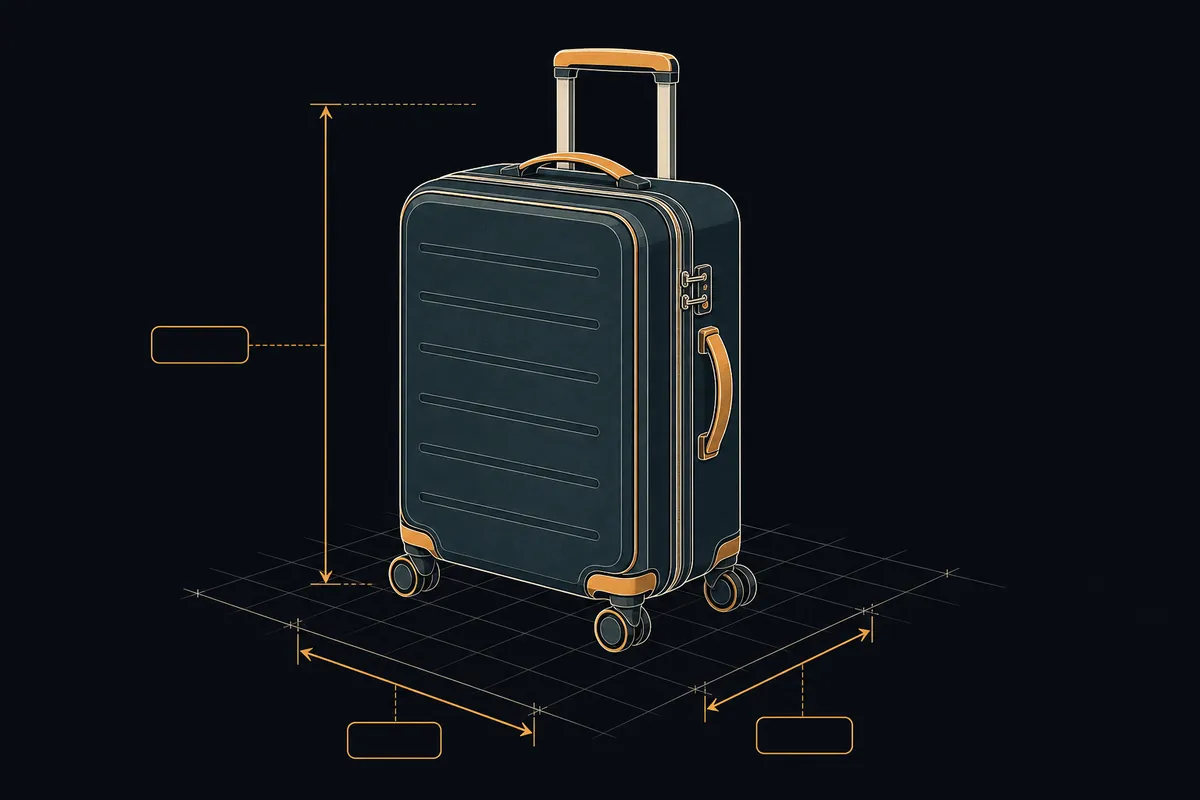
A linear inch is the sum of a bag's three dimensions: length + width + height. Most US carriers cap carry-ons at 45 linear inches (22 + 14 + 9 = 45) and checked bags at 62 linear inches. Airlines use this single number because it accounts for every dimension at once — a squat, wide bag and a tall, narrow one can both total 45 linear inches. Delta, American Airlines, Air Canada, and Southwest officially publish their carry-on limits in linear inches rather than as three separate numbers.
- Carry-on max: 45 linear in (22 × 14 × 9 in) at most US carriers
- Checked bag max: 62 linear in (158 cm) at virtually all US and major international carriers
- Formula: L + W + H = linear inches
- Wheels, handles, and external feet are included in every measurement
How to measure a carry-on bag correctly
Lay the bag flat and use a flexible tape measure on each dimension: the longest side (length), widest flat face (width), and depth front to back when the bag is fully packed (height). For rigid hard-sided cases, measure with the handle fully compressed, not extended — airlines measure bags in their stowed position. Include wheels in the height by measuring from the bottom of the wheels to the top of the compressed handle. Add all three numbers; the total must be 45 in or less for most US carriers.
- Length: longest dimension of the bag body
- Width: widest flat face
- Depth/Height: front to back when fully packed, handle compressed, wheels included in the measurement
- Rigid bags: handle retracted; the bump of spinner wheels adds to the stated height — account for it
- Soft bags: measure fully packed — a lighter pack lets them compress into the bin even if slightly over on tape
Carry-on size limits by airline (2026 chart)
Most major US carriers align on 22 × 14 × 9 in for 2026, unchanged since January 2025 when the industry standard narrowed from 22 × 15 × 9 to 22 × 14 × 9 (a 1-inch width reduction). Notable exceptions are Southwest and Frontier, both more generous. The FAA has not mandated any new carry-on dimensions for 2026, though enforcement via physical sizer boxes is increasing at gates across carriers.
| Airline | Carry-on max size | Weight limit |
|---|---|---|
| American Airlines | 22 × 14 × 9 in (45 lin in) | None published |
| Delta | 22 × 14 × 9 in (45 lin in) | None published |
| United Airlines | 22 × 14 × 9 in (45 lin in) | None published |
| Alaska Airlines | 22 × 14 × 9 in (45 lin in) | None published |
| JetBlue | 22 × 14 × 9 in (45 lin in) | None published |
| Hawaiian Airlines | 22 × 14 × 9 in (45 lin in) | 25 lbs |
| Allegiant Air | 22 × 16 × 10 in (48 lin in) | None published |
| Southwest Airlines | 24 × 16 × 10 in (50 lin in) | None published |
| Frontier Airlines | 25 × 16 × 10 in (51 lin in) | 35 lbs |
Spirit Airlines is not listed: it ceased operations in May 2026. For exact fee amounts by carrier, see the airline baggage fees compared guide. Detailed check-in policies per airline are on the airlines hub.
What is the 62-inch rule for checked bags?
Checked bags must not exceed 62 linear inches (L + W + H = 158 cm) — the near-universal limit aligned with IATA standards and followed by virtually all US and major international carriers. A typical 28-inch spinner (approximately 28 × 20 × 12 in = 60 lin in) fits with a small buffer; a 30-inch spinner (approximately 30 × 21 × 13 in = 64 lin in) typically exceeds the limit and triggers an oversize fee of $100–$200 per direction on top of any checked bag fee. Measure at home while the bag is fully packed, then weigh it on a bathroom scale — most carriers also cap Economy checked bags at 50 lbs.
- 62 linear in = 158 cm — the standard checked bag size ceiling
- Measure the bag fully packed with a tape measure, just as an agent would at the counter
- 28-in spinner: ~60 lin in — within limit
- 30-in spinner: ~64 lin in — typically oversize, expect a fee
- Oversize fee: $100–$200 per direction at most US carriers, on top of the regular checked bag fee
- Weight cap: 50 lbs in Economy; 51–70 lbs triggers a separate overweight fee
If you are packing a large spinner, the oversize and overweight bag fees guide has exact dollar amounts by airline.
Hard-sided vs. soft-sided bags: which is easier to measure?
Hard-sided (rigid) suitcases have fixed dimensions that are easy to measure consistently, but they leave no room for error — if the shell measures 22.5 in on one side, that is what a gate sizer will show. Soft-sided bags flex and can compress into an overhead bin or sizer frame even when a tape measure shows them slightly over the limit, because the bin walls and sizer frame — not a rigid shell — determine real-world fit. For checked bags the distinction matters less; both types are measured the same way, and oversize fees apply regardless of material.
- Rigid bags: add the bump of wheels (~1 in) to the stated case height; they cannot compress at the sizer
- Soft bags: measure fully packed — packing lighter lets them squeeze through even a tight sizer frame
- A 40L travel backpack (typically ~20 × 13 × 8 in = 41 lin in) clears the 45-in limit on every US carrier
- Soft bags are more forgiving at the gate sizer; rigid bags should be exactly at or under the limit
What happens at the gate if your bag fails the sizer test?
At most US airlines, carry-on enforcement is visual and inconsistent — agents rarely use a tape measure. However, a growing number of carriers now deploy physical sizer boxes at the gate, and some are moving them pre-security. If your bag does not fit the sizer, airlines charge a gate check fee of up to $100 per direction. Budget and European carriers are the strictest, routinely measuring bags at the gate. The physical sizer box is the final authority: if your bag fits inside without forcing, you will not be charged even if a tape measure shows it slightly over.
- Gate check fee: up to $100 per direction at most US carriers
- Sizer box = the legal standard; if it fits, you pass — no tape measure needed
- Enforcement is increasing in 2026; more US carriers are deploying sizers pre-boarding
- Tip: test your bag in a sizer on your outbound trip so you know before the return flight
- Soft bags that measure slightly over on tape often still pass a physical sizer frame
Quick-reference: common bag types in linear inches
Bag tags and retailer listings often omit linear-inch totals. The table below converts typical real-world dimensions so you can quickly gauge where any bag lands relative to carry-on and checked bag limits.
| Bag type | Typical dimensions | Linear inches |
|---|---|---|
| Standard carry-on spinner (most US airlines) | 22 × 14 × 9 in | 45 lin in — at the limit |
| 40L travel backpack | 20 × 13 × 8 in | 41 lin in — safe |
| Personal item (AA / Allegiant / Frontier standard) | 18 × 14 × 8 in | 40 lin in — safe |
| Larger Southwest / Frontier carry-on | 24 × 16 × 10 in | 50 lin in — fine on SW / Frontier only |
| 25-in checked spinner | 25 × 18 × 11 in | 54 lin in — well within 62 |
| 28-in checked spinner | 28 × 20 × 12 in | 60 lin in — within 62 |
| 30-in checked spinner | 30 × 21 × 13 in | 64 lin in — oversize at most airlines |
One more measurement question that comes up often:
Do wheels and handles count when measuring a carry-on?
Yes — always measure with wheels included in the height (from the bottom of the wheels to the top of the compressed handle). Retractable handles must be measured fully compressed, not extended, since airlines measure bags in their stowed position. On a typical 22-in spinner, the wheel bump adds roughly 1 in, which is already factored into the stated case height by quality luggage brands — but verify before you buy.
If you are travelling with liquids or want to avoid a secondary screening, see the 3-1-1 liquids rule. Thinking about TSA PreCheck or CLEAR to speed up the security lane? See PreCheck vs CLEAR vs Global Entry. Every airline's baggage policy in one place is on the airlines hub.
Know your bag size. Now nail your departure time.
The Leave-By Time calculator folds your airport's live TSA wait, your drive, parking, and airline check-in cutoff into one time to walk out the door — so you clear security without cutting it close.
Calculate my Leave-By Time →Data verified . Sources: Kayak carry-on size guide, Upgraded Points carry-on chart, Horizn Studios size allowances, DB Journey 2026 carry-on restrictions.
Keep planning
Baggage
Airline baggage fees, compared
What every major airline charges for carry-on and checked bags in 2026 — including Southwest, which dropped free bags.
BaggageHow to avoid checked bag fees
Credit card waivers, airline status perks, and packing tricks that keep bag fees off your bill.
BaggageOversize and overweight baggage fees by airline (2026)
Bags over 50 lbs or 62 linear inches cost $100–$200 extra — here is what each major US airline charges.
BaggageCarry-on size limits by airline (2026)
Maximum carry-on and personal item dimensions for every major US airline — and which base fares include a carry-on.