Booking
Is travel insurance worth it for flights?
By the TSA Wait Times team · Updated · Published June 2026
Travel insurance for flights typically costs 4–10% of your total trip cost and covers cancellation, medical emergencies abroad, and delay expenses. Many premium credit cards include comparable coverage automatically — check your card before buying a separate policy.
On this page
- What travel insurance covers
- When to buy travel insurance
- What your credit card may already cover (for free)
- Choosing a standalone policy — what to look for
- Travel insurance vs. DOT airline protections
- Know your security wait before you leave home
What travel insurance covers
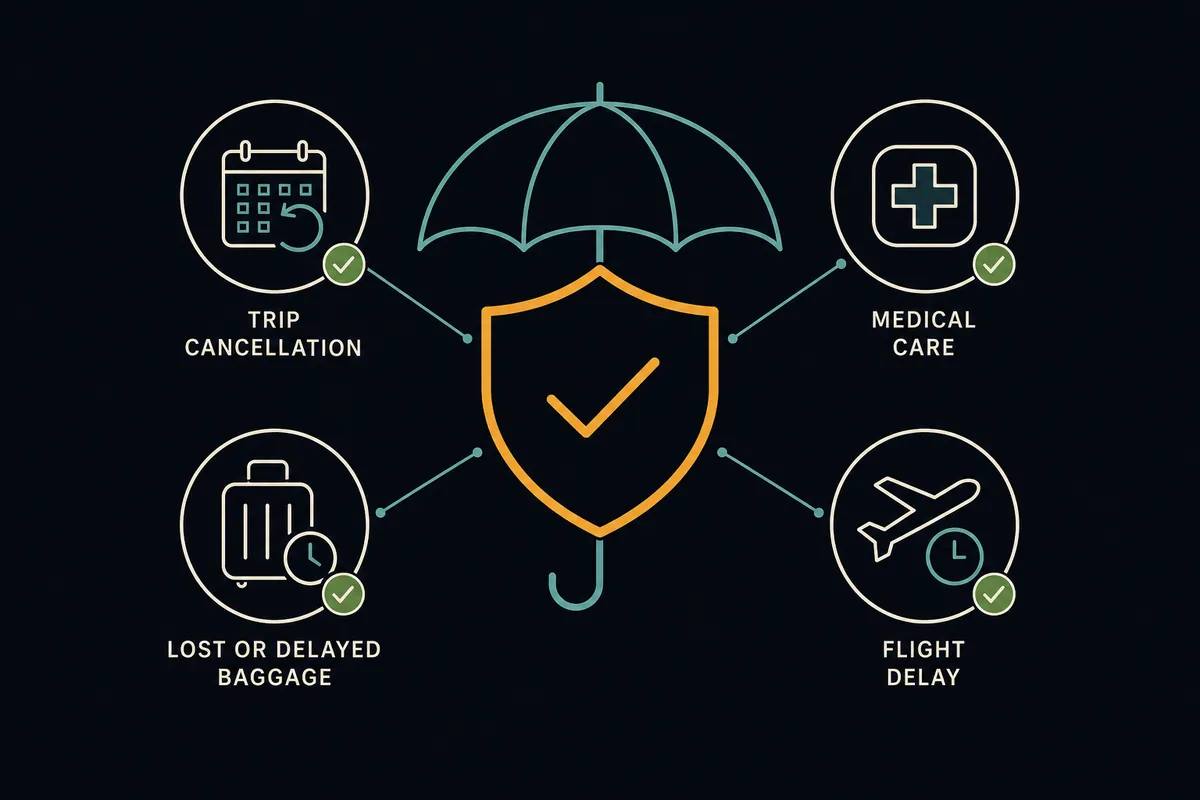
A comprehensive travel insurance policy bundles several distinct coverage types. Understanding each helps you decide whether the premium is worth it for your specific trip.
Trip Cancellation
Reimburses prepaid nonrefundable costs if you cancel for a covered reason — illness, death in the family, natural disaster, or jury duty. A Cancel For Any Reason (CFAR) add-on covers any reason at all, but raises the policy cost to roughly 10–12% of trip value.
Trip Interruption
If you must cut the trip short for a covered reason, interruption coverage reimburses the unused portion of your prepaid bookings plus the extra cost of getting home early.
Travel Delay
Covers hotel, meals, and incidentals if your flight is delayed 6 or more hours. Typical limits run $150–$200 per day per person.
Baggage Loss / Delay
Pays for replacement clothing and essentials if your bags are lost or delayed more than 12 hours. This supplements (but does not replace) the airline's own liability.
Emergency Medical
Covers medical care abroad. This is often the most financially critical coverage — US domestic health insurance plans rarely cover international care, and out-of-pocket hospital bills abroad can reach tens of thousands of dollars.
Medical Evacuation
Pays for emergency airlift back to the US. Without coverage, a medical evacuation can cost $50,000–$200,000 depending on location and medical complexity.
When to buy travel insurance
The math generally favors buying a policy in these situations:
- Traveling internationally — medical and evacuation coverage alone often justifies the entire premium
- Trip costs $3,000+ in nonrefundable bookings — the larger the at-risk amount, the more compelling the coverage
- Traveling during hurricane season (June–November) to coastal or island destinations
- Pre-existing health condition that might force cancellation or require medical care
- Booked far in advance — more lead time means more opportunities for something to change
- You want maximum flexibility — add the CFAR rider for the ability to cancel for any reason
You can likely skip travel insurance if:
- All flights are flexible or refundable — DOT rules already require airlines to issue cash refunds for cancellations and significant delays they cause
- Your premium credit card already includes strong travel protections — check the section below before paying twice
- Domestic trip under $500 — the math rarely pencils out when nonrefundable exposure is low
What your credit card may already cover (for free)
Several premium credit cards bundle meaningful travel protections at no extra charge. You must pay for at least part of the trip with the card for coverage to apply. Benefits below reflect 2026 cardholder agreements:
- Chase Sapphire Reserve / Preferred: Trip cancellation up to $10,000/trip, travel delay $500/ticket (after 6 hours), baggage delay $100/day up to 5 days
- Amex Platinum: Trip cancellation up to $10,000, travel delay $500/ticket (6-hour delay threshold)
- Capital One Venture X: Trip cancellation up to $2,000, travel delay $500/ticket, baggage delay $100/day
- Citi Strata Premier: Trip cancellation up to $5,000 per covered person
| Card | Trip Cancellation | Trip Delay | Baggage Delay |
|---|---|---|---|
| Chase Sapphire Reserve / Preferred | Up to $10k/trip | $500/ticket (6 hrs) | $100/day × 5 |
| Amex Platinum | Up to $10k | $500/ticket (6 hrs) | — |
| Capital One Venture X | Up to $2k | $500/ticket | $100/day |
| Citi Strata Premier | Up to $5k/person | — | — |
Credit card travel protections do not include emergency medical or evacuation coverage — standalone policies are still worth considering for international trips even if your card covers cancellation and delays. For a full comparison of airport-perk cards, see best credit cards for airport perks.
Choosing a standalone policy — what to look for
Not all travel insurance policies are equivalent. Key features to evaluate before purchasing:
- Cancel For Any Reason (CFAR) vs named-perils only — CFAR adds 10–12% to cost but removes all coverage uncertainty
- Pre-existing condition waiver — must purchase within 14–21 days of first trip deposit to qualify
- Medical coverage limit: $100,000+ recommended for international travel
- Medical evacuation limit: $500,000+ recommended — evacuations regularly exceed $100,000
- 24-hour emergency assistance hotline — essential for coordinating care abroad when you need help fast
Established providers to compare: Allianz, World Nomads, Travel Guard, Travelex, and InsureMyTrip (a comparison marketplace that quotes multiple carriers side by side).
Travel insurance vs. DOT airline protections
The DOT's 2026 passenger rules require airlines to issue an automatic cash refund when the airline cancels your flight or causes a delay of 3 or more hours on a domestic flight. That is the full extent of what DOT mandates.
Travel insurance fills everything DOT does not cover:
- Cancellations you initiate for illness, family emergencies, or personal reasons
- Medical emergencies and hospital costs abroad
- Delay out-of-pocket expenses — hotel, meals, and incidentals the airline does not cover
- Baggage loss above the airline's liability cap
- Emergency medical evacuation — the airline has no obligation to fly you home for medical reasons
The two protections are complementary, not redundant. DOT rules cover the airline's fault; travel insurance covers everything else. For more on what happens when the airline cancels, see airline cancellation fees and change fees.
Common questions about travel insurance:
Does travel insurance cover COVID-related cancellations?
Standard named-perils policies only cover documented illness — you typically need a positive test result and a doctor's note. Cancel For Any Reason (CFAR) add-ons cover fear of illness, travel advisories, and any other personal reason, making them the only reliable option for pandemic-related concerns.
When should I buy travel insurance?
As soon as you book your trip — especially if you want the pre-existing condition waiver, which most insurers require you to purchase within 14–21 days of your first trip deposit. Buying early also maximizes the policy's trip-cancellation window.
Is travel insurance itself refundable?
Most standalone policies include a 10–15 day free-look period after purchase during which you can cancel for a full refund. After that window closes, travel insurance premiums are generally nonrefundable.
Does travel insurance cover flight delays?
Yes — most policies cover delays of 6 or more hours and reimburse hotel stays, meals, and incidentals up to the daily limit (commonly $150–$200 per day). Some premium credit cards provide comparable delay coverage automatically if you paid for the ticket with the card.
Coverage terms, benefit limits, and card protections reflect published cardholder agreements and insurer disclosures as of . Policy terms change — confirm current benefits with your card issuer or insurer before purchasing.
Know your security wait before you leave home
Travel insurance covers the unexpected — but missing your flight because you misjudged the security line is not covered. Your Leave-By Time folds the live TSA wait, your drive, and the gate walk into one number so you always leave with enough time.
Get your Leave-By Time