At the airport
International layover guide: clearing customs when connecting
By the TSA Wait Times team · Updated · Published June 2026
At every US airport, passengers arriving from an international flight must collect their bags and clear customs before connecting — no exceptions, even on the same airline. Rules differ sharply by country and connection type; this guide tells you exactly when customs applies and how much time to allow.
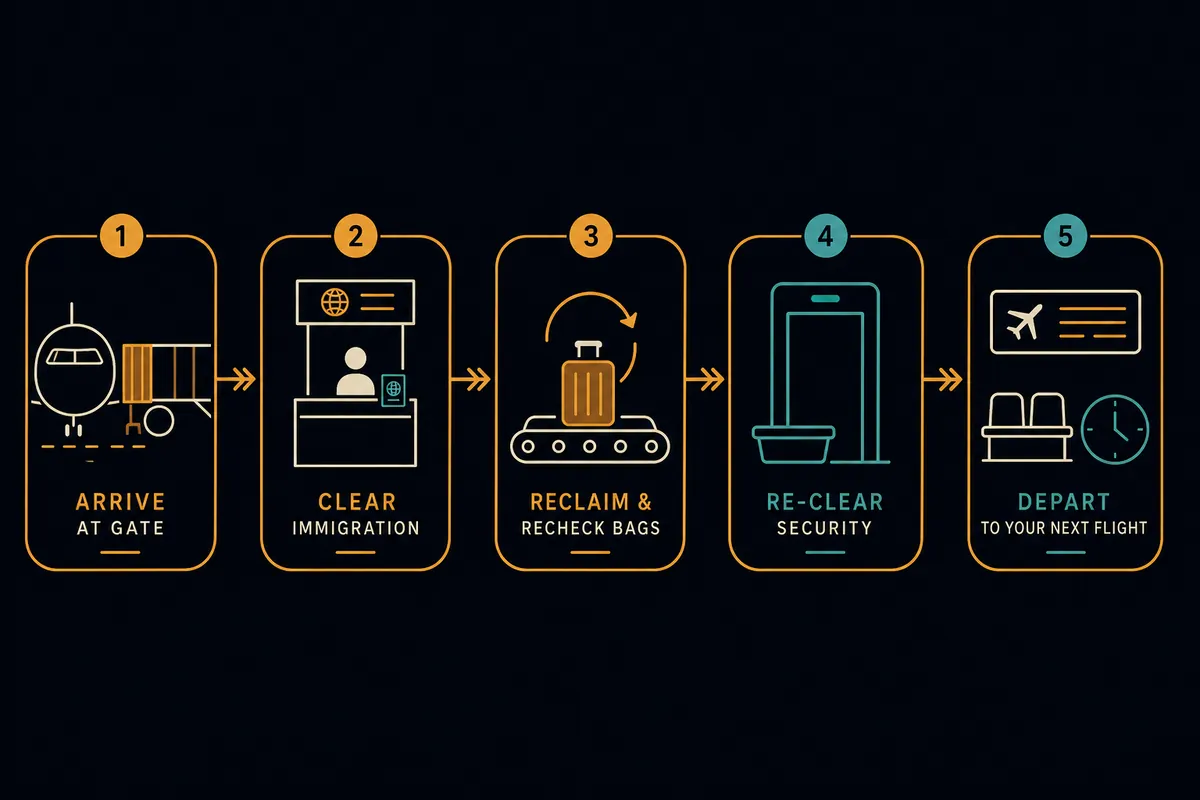
Do you clear customs on a layover? Three things determine the answer
Whether you face a customs stop on a connection depends on three factors: the country where you are connecting, whether you stay airside (within the secure international transit zone) or must exit, and how your bags are routed. Some countries, including the United States and Canada, require every arriving international passenger to clear customs regardless of their onward destination. Others, like the Schengen zone countries of the European Union, allow airside connections without any customs inspection as long as you remain in the transit area. Getting this wrong can mean a missed flight — confirm the rules before you book.
- Country of connection: rules differ dramatically between the US, Canada, EU/Schengen, UK, and Australia
- Airside vs. landside: staying within the sterile transit zone avoids customs in most countries; exiting requires it
- Bag routing: if your bags are not checked through to your final destination, you must collect and re-check, triggering a customs stop
- Ticket type: a single itinerary usually checks bags through; separate tickets on different airlines often do not
US international connections: you always clear customs — no exceptions
The United States requires every passenger arriving on an international flight to collect their checked bags, clear US Customs and Border Protection (CBP), and re-check luggage before their domestic or onward connection. This applies even if you are continuing on the same airline, the same flight number, or a code-share partner — there is no airside transit option in the US. Allow a minimum of 3 hours for an international-to-domestic connection; 3.5 to 4 hours is safer at large hubs like JFK, LAX, ORD, or MIA during peak periods.
- Collect all checked bags at the baggage carousel after landing — they are not automatically forwarded
- Present travel documents and declaration form at CBP primary (and secondary if referred)
- Re-check bags at the airline's dedicated re-check counter after clearing customs
- Clear TSA security again before reaching the domestic or onward gate
- Book 3–4 hours minimum; 4+ hours recommended at major hubs or if traveling with children
European (Schengen zone) connections: airside transit means no customs stop
If your connecting airport is within the Schengen Area (26 countries including Germany, France, Spain, Italy, and the Netherlands) and you remain airside, you do not clear customs and your bags travel through to your final destination. You will pass through a passport control checkpoint but not a customs inspection. Connecting between two Schengen countries is fully seamless. The complication arises when your incoming flight originates outside Schengen — for example, flying London Heathrow to Frankfurt and then onward. London is not in Schengen, so you will pass through Schengen entry passport control at Frankfurt, but customs is still not required if you stay in the transit area.
- Schengen-to-Schengen airside: no customs, no passport control — fully domestic-like
- Non-Schengen inbound, connecting onward within Schengen: passport control at the first Schengen airport you land in
- UK airports (post-Brexit) are not in Schengen — transit rules are completely separate
- An overnight layover that requires you to leave the transit zone requires a Schengen short-stay type C visa, not just an Airport Transit Visa
Canada, UK, and Australia: rules at other major connection hubs
Canada operates similarly to the United States: all passengers arriving from international destinations must clear the Canada Border Services Agency (CBSA), collect bags, and re-check before a connecting domestic or US-bound flight. Allow at least 2.5 to 3 hours at Toronto Pearson (YYZ) or Vancouver (YVR). The United Kingdom has its own transit visa system entirely separate from the EU — most nationalities can transit UK airports airside without a visa, but some nationalities require a Direct Airside Transit Visa (DATV); verify at the UK government's official visa checker at gov.uk before flying. Australia allows airside transit at Sydney (SYD), Melbourne (MEL), and Brisbane (BNE) without customs clearance for most nationalities, provided you are not disembarking.
- Canada (YYZ/YVR): always clear CBSA and re-check bags; allow 2.5–3 hours
- UK (LHR/LGW/MAN): airside transit generally allowed; DATV required for certain nationalities — check gov.uk
- Australia (SYD/MEL/BNE): airside transit available with no customs if you are not entering the country
- Japan (NRT/HND): efficient airside transit available for most nationalities; no customs if connecting within transit zone
Airport transit visas: do you need one just to connect?
An Airport Transit Visa (ATV) is not an entry visa — it only permits you to remain in the international transit zone of an airport while waiting for a connecting flight. The Schengen Area has a common ATV list of 12 nationalities who must obtain an ATV even for an airside layover where they never enter the country. Individual Schengen countries can add more nationalities to this list. Notably, as of June 3, 2026, Germany lifted its ATV requirement for Indian nationals following Federal Chancellor Merz's diplomatic visit to India in January 2026 — a meaningful 2026 change for one of the world's largest traveler populations.
- Common Schengen ATV list (all 26 countries): Afghanistan, Bangladesh, DR Congo, Eritrea, Ethiopia, Ghana, Iran, Iraq, Nigeria, Pakistan, Somalia, Sri Lanka
- France adds ~20 additional nationalities including Angola, Bolivia, Cuba, Turkey, and Russia (when traveling from certain countries)
- Germany's extended list: Indian nationals removed effective June 3, 2026
- Exemptions from ATV: holders of a valid US, Canada, EU member state, UK, or Japan visa or residence permit are generally exempt
- UK DATV requirements are independent of Schengen — check gov.uk separately
Same airline vs. separate tickets: who handles your bags on a connection?
When you book a single itinerary — all flights in one booking — the airline is responsible for checking your bags through to your final destination, and is required to rebook you if a delay causes a missed connection. At US airports, you will still collect and re-check at the customs re-check counter, but the airline handles the rest. If you book separate tickets on different carriers with no interline agreement, the first airline has no obligation to check your bags through; you must collect, clear customs, and re-check with the second airline independently, adding significant time and risk.
- Single itinerary, same airline: bags checked through to final destination (US: collect and re-check after CBP, then airline forwards them)
- Single itinerary, partner or code-share airline: bags usually interlined; confirm at check-in. See airline baggage fees compared for fee details.
- Separate tickets, different airlines with no interline agreement: collect, clear customs, check in with second airline from scratch
- Missed connection protection: applies only on a single itinerary — separate tickets leave you entirely on your own
How much time do you actually need? Minimum connection times by scenario
Airlines publish Minimum Connection Times (MCTs) — the shortest allowed gap between flights at a given airport. These are operational minimums that assume no delays, short walks, and fast queues. For connections involving customs clearance, always budget well beyond the MCT. The table below shows recommended (not minimum) connection times by scenario. If your booked connection is shorter than these figures, call the airline before travel to confirm the connection is protected.
| Connection type | Recommended time | Key reason |
|---|---|---|
| Domestic US to domestic US | 45–60 min | Security only, no customs |
| International to domestic US (clearing customs) | 3–4 hours | CBP + baggage claim + re-check + TSA |
| International to international, same Schengen airport, airside | 1.5–2 hours | Passport control only, bags through-checked |
| Non-Schengen inbound, connecting within Schengen airside | 2–2.5 hours | Schengen entry passport control queue |
| International via Canada (YYZ/YVR) to onward | 2.5–3 hours | CBSA clearance + baggage re-check |
| International via UK (LHR/LGW), airside same terminal | 1.5–2 hours | UK border check, no customs if airside |
| Separate tickets, different airlines, US airport | 4+ hours | Customs + re-check + no airline rebooking protection |
MCTs are the floor, not a comfortable target. When in doubt, build in more time — a long layover is an inconvenience; a missed connection can mean a night at the airport. For PreCheck and CLEAR tips that can shorten the TSA leg, see PreCheck vs. CLEAR vs. Global Entry.
Know your leave-by time before you connect
Use the Leave-By Time calculator to stack your customs window, live TSA wait, drive, and parking into the one moment to walk out the door.
Calculate your Leave-By Time →Data verified . Sources: US CBP; Schengen ATV rules; UK visa checker; Germany ATV update. Also see how early to arrive for an international flight and minimum connection times guide.
Keep planning
At the airport
How to get into an airport lounge
Five ways in — a credit card, Priority Pass, a premium ticket, elite status, or a day pass — and what each one costs.
At the airportHow to buy an airport lounge day pass
Most airport lounges sell day passes for $35–$59 at the door. Here is which lounges sell them and when they are worth the money.
At the airportHow to get Priority Pass: the credit cards that include it free
Priority Pass costs $429 a year standalone — but 10+ travel credit cards include it free. Here is which cards give full access.
At the airportBest US airports for long layovers
Some airports have free art museums, great dining, and easy city access. Here are the best US airports to spend time in during a long wait.