Baggage
How to fly with a pet in the cabin
By the TSA Wait Times team · Updated · Published June 2026
Small dogs and cats can fly in the cabin on most US airlines for $95–$150 each way in an approved soft-sided carrier that fits under the seat in front of you. The catch: most flights only allow 2–4 cabin pets per flight, and those spots fill up on popular routes. Book early, or your pet may be denied boarding even if you have a reservation.
Note that Delta raised its cabin pet fee from $95 to $150 for all tickets issued on or after April 8, 2025, bringing it in line with United and American. Here is everything you need to know before your trip.
On this page
- Which airlines allow pets in the cabin, and how much does it cost?
- What size carrier is allowed in the cabin?
- How do you book a cabin pet spot, and how early should you do it?
- What happens at TSA security when you travel with a pet?
- Does your pet need a health certificate to fly?
- What is the difference between a service animal, an ESA, and a pet — and who flies free?
- Can your pet fly in the cabin on international flights?
Which airlines allow pets in the cabin, and how much does it cost?
Most major US carriers accept small dogs and cats in the cabin on domestic routes, but fees range from $95 to $150 each way per carrier. Delta raised its fee from $95 to $150 effective April 8, 2025, bringing it in line with United and American. Southwest remains the most affordable option at $95, while JetBlue and Alaska charge $100. For a full look at how airline fees compare, see the airline baggage fees compared guide.
| Airline | Cabin pet fee (each way) | Key notes |
|---|---|---|
| Delta | $150 | Raised from $95 Apr 8, 2025; no breed ban in cabin |
| United | $150 | Bans flat-faced breeds; carrier = personal item slot |
| American | $150 | Cats and dogs only; not allowed on transcon/intl |
| Southwest | $95 | No health cert required for domestic |
| JetBlue | $100 | JetPaws members may receive perks |
| Alaska | $100 | Two pets of same species may share one carrier |
- Fees apply per carrier each way — both legs of a round trip are charged separately.
- United adds a $150 surcharge if your connection layover exceeds 4 hours on domestic routes.
- United bans brachycephalic (flat-faced) breeds in the cabin; Delta has no explicit breed ban.
- Frontier historically charged lower fees — verify Frontier's current policy before booking. Spirit Airlines ceased operations in May 2026.
What size carrier is allowed in the cabin?
Your carrier must slide fully under the seat in front of you and stay there for the entire flight. Most airlines approve a soft-sided carrier up to approximately 18" L × 11" W × 11" H, but Southwest specifies a narrower 18.5" × 8.5" × 13.5"limit. Hard-sided carriers are also accepted with a smaller footprint (roughly 17.5" L × 11–12" W × 7.5" H). The practical combined weight limit for pet plus carrier is about 20 lbs on most carriers.
- Soft-sided carriers are strongly preferred because they compress slightly to fit varied under-seat clearances.
- Regional jets have less under-seat space than mainline narrow-bodies — verify by aircraft type before flying.
- Delta evaluates fit per aircraft tail number; call reservations if you're on a regional connection.
- Your carrier counts as your personal item on United and as your carry-on on Delta.
- The carrier must be well-ventilated, leak-proof, and large enough for your pet to stand and turn around.
How do you book a cabin pet spot, and how early should you do it?
Book your pet at the same time you book your ticket — not after. Most airlines limit cabin pets to 2–4 per flighton a first-come, first-served basis, and those slots fill up on popular routes. On most airlines you add the pet during online booking (look for “Travel with a pet” in the traveler section) or by calling reservations afterward. You pay the fee at the airport check-in counter, not online.
- Book as early as possible — especially on holiday travel, early-morning, and nonstop popular routes.
- You cannot sit in exit rows, bulkhead rows, or seats with no under-seat storage.
- Check in at the Special Service Counter (Delta) or main counter to receive your cabin pet tag.
- If the flight is oversold on pet slots, the airline can deny boarding for your pet even if you have a reservation.
What happens at TSA security when you travel with a pet?
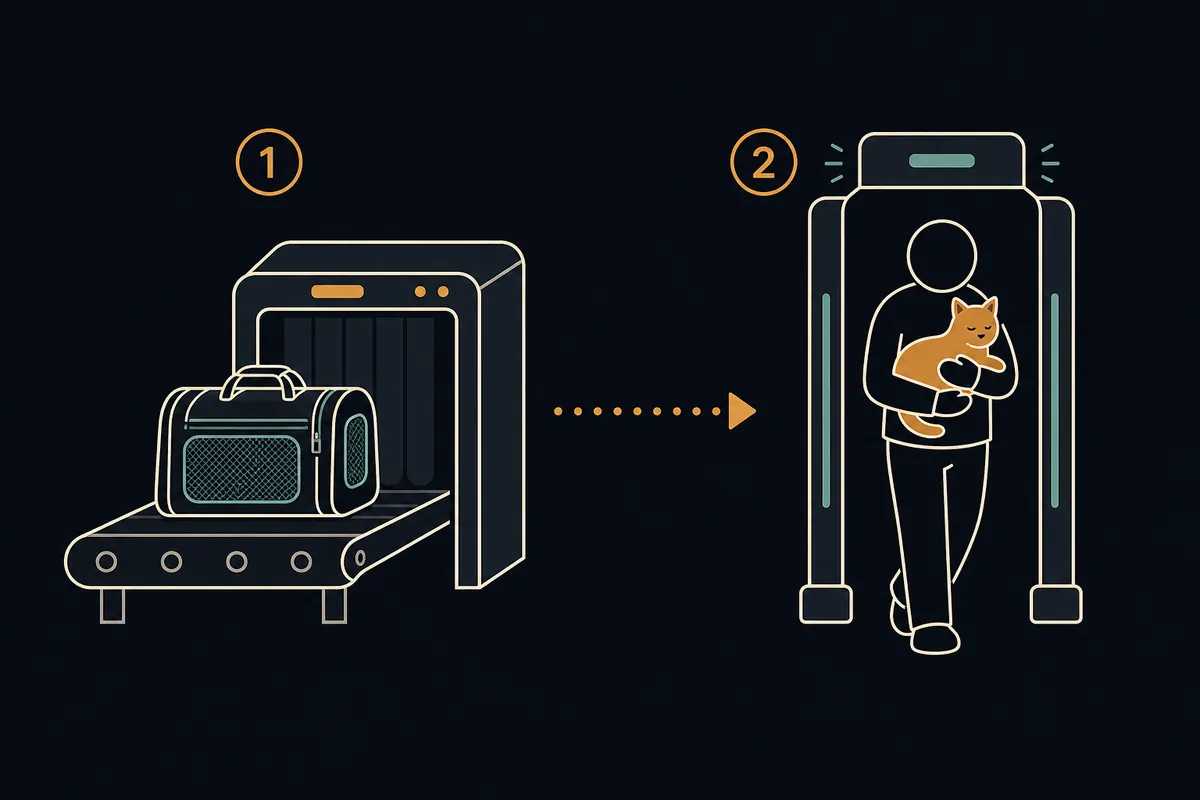
TSA requires you to remove your pet from the carrier at the security checkpoint. You carry your pet through the metal detector (or AIT body scanner walk-through) while the empty carrier passes through the X-ray machine. Your pet never goes through the X-ray. After clearing the checkpoint, place your pet back in the carrier before proceeding to the gate.
For tips on moving through the checkpoint faster, see the PreCheck vs CLEAR vs Global Entry guide — though note that TSA PreCheck does not change the pet-removal requirement.
- Hold your pet firmly — no leash is required through the checkpoint but a harness helps prevent escapes.
- TSA PreCheck does not change the pet-removal requirement.
- Expect longer processing time at security; arrive at least 30 extra minutes early when traveling with a pet.
- Water bowls and small items of food for the pet in the carrier are generally allowed in reasonable quantities.
Does your pet need a health certificate to fly?
Health certificate requirements vary by airline. United and Delta require a USDA-accredited veterinarian's certificate for domestic flights, typically valid within 10 days of travel. Southwest does not require a health certificate for domestic US flights. American Airlines requires a health certificate for international itineraries but not for most domestic routes. Always check your specific airline's current policy before your trip, as requirements can differ for Hawaii, Puerto Rico, and US Virgin Islands routes.
- A health certificate is a standard vet visit — the vet confirms your pet is healthy enough to fly and free of communicable disease.
- Some destinations (Hawaii, international) may require additional documentation such as proof of rabies vaccination.
- Book the vet appointment within 2 weeks of your travel date to ensure the certificate is still valid at departure.
- Keep a physical copy and a photo on your phone in case the original is lost at check-in.
What is the difference between a service animal, an ESA, and a pet — and who flies free?
Trained psychiatric and mobility service animals fly free in the cabin under the ADA and DOT rules because they perform specific tasks for a person with a disability. Emotional Support Animals (ESAs) lost their free-flying status in 2021 when the DOT updated its Air Carrier Access Act guidance, allowing airlines to treat ESAs the same as regular pets. This means ESAs pay the standard pet fee ($95–$150) and must fit in an approved under-seat carrier.
- A service animal must be a dog trained to perform a specific disability-related task.
- Airlines require DOT-approved documentation forms for service animals, submitted in advance.
- ESA letters from telehealth services no longer entitle free cabin access on any major US carrier.
- If your ESA exceeds in-cabin size/weight limits, it cannot travel in the cabin — there is no service-animal exception for ESAs.
Can your pet fly in the cabin on international flights?
On most international itineraries, pets cannot travel in the passenger cabin— they must be shipped as cargo or checked baggage if the airline's cargo program allows it. A handful of short international routes (e.g., US to Canada or Mexico on certain carriers) may allow in-cabin pets, but the destination country's import requirements also apply. Delta, United, and American all prohibit in-cabin pets on transatlantic and transpacific routes.
- US–Caribbean routes (Puerto Rico, US Virgin Islands) are generally treated as domestic and allow in-cabin pets.
- Canada routes may allow in-cabin pets on some airlines — verify per airline and with the Canadian Food Inspection Agency.
- International cargo pet programs have their own season and temperature restrictions; many airlines suspended cargo pet programs.
- Check destination country quarantine requirements well in advance — some countries (Australia, New Zealand, UK) have strict rules that can require months of preparation.
A few more common questions about flying with pets:
Which airlines allow pets in the cabin, and how much does it cost?
Delta, United, American, Southwest, JetBlue, and Alaska all allow small dogs and cats in the cabin on most US domestic routes. Fees range from $95 (Southwest) to $150 (Delta, United, American) each way per carrier as of 2026.
What size carrier is allowed in the cabin?
Most airlines allow a soft-sided carrier up to about 18" L × 11" W × 11" H; Southwest specifies 18.5" × 8.5" × 13.5". The combined weight of pet plus carrier should generally stay under 20 lbs.
Does your pet need a health certificate to fly?
It depends on the airline. United and Delta require a vet-issued health certificate, typically dated within 10 days of travel; Southwest does not for domestic US flights. Always confirm with your airline before booking.
What is the difference between a service animal, an ESA, and a pet — and who flies free?
Trained service dogs fly free under DOT rules. Emotional Support Animals lost their free-flight status under the 2021 DOT rule revision and now pay standard pet fees ($95–$150 each way) and must fit in an approved under-seat carrier.
Can your pet fly in the cabin on international flights?
Generally no — most airlines require pets to travel as cargo on international routes. Short US-Canada or US-Mexico flights on select carriers may allow in-cabin pets, but you must also meet the destination country's import requirements.
Know exactly when to leave for your flight
Traveling with a pet means extra time at security and check-in. The Leave-By Time calculator folds today's live TSA wait at your airport, your airline's check-in cutoff, and your drive time into one number — the exact moment to walk out the door.
Calculate your Leave-By Time →Related guides: airline baggage fees compared · PreCheck vs CLEAR vs Global Entry · airline travel guides
Data verified . Sources: Delta pet travel, United pets, Southwest pet policy, Chewy airline pet guide, Pettable ESA guide.