At the airport
Arriving at a US airport on an international flight: step by step
By the TSA Wait Times team · Updated · Published June 2026
Landing in the United States on an international flight means clearing two separate federal agencies before you can exit the terminal: US Customs and Border Protection (CBP) and the USDA Animal and Plant Health Inspection Service. For most travelers the whole process takes 30–90 minutes from wheels-down to the exit doors. Global Entry members who use the kiosk or the 2026 mobile app can clear in as little as 10–20 minutes. Here is every step, in order.
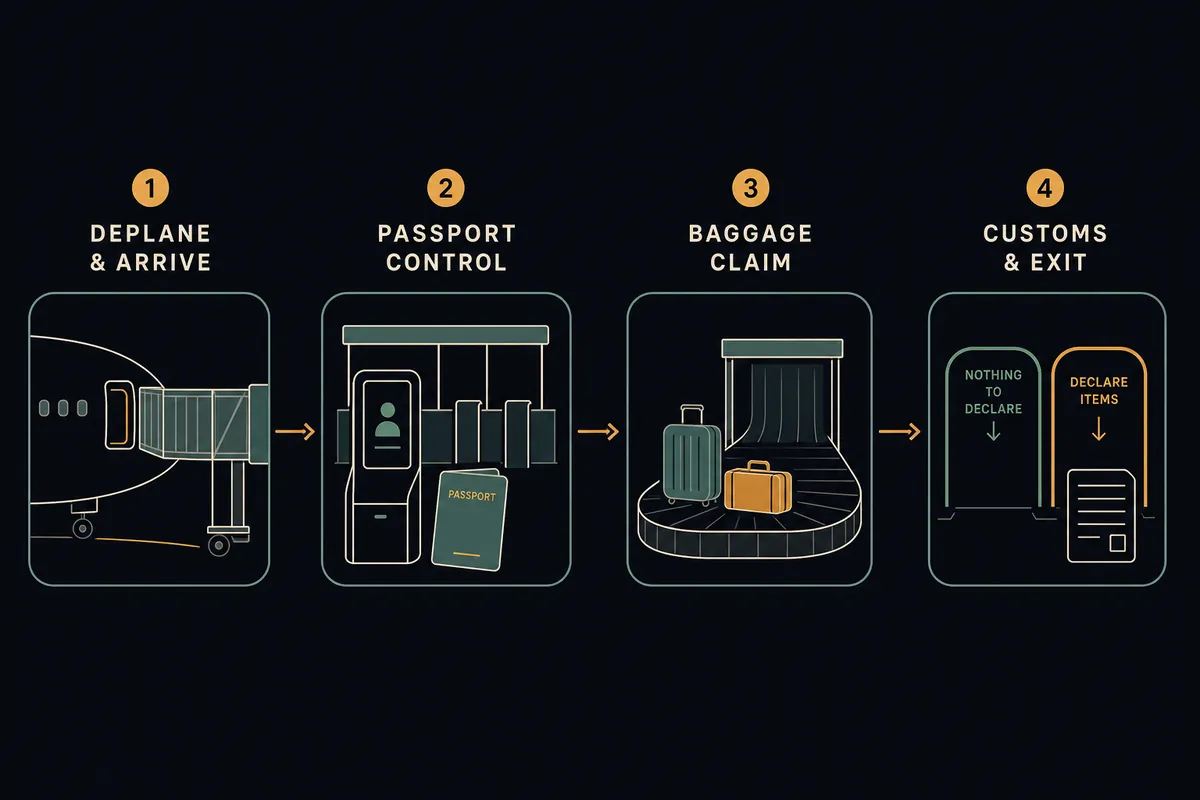
What are the steps from landing to exiting US customs on an international flight?
There are seven steps — eight if you have a domestic connection. After landing you follow Immigration / Customs / Baggage Claim signs (not “Domestic Connections”), choose your CBP inspection lane, see an officer or use a kiosk, collect all checked bags, hand over your declaration form, and clear the USDA agriculture inspection. Each step is sequential; you cannot skip baggage claim even when connecting to a domestic flight.
- 1Land and taxi to gate — remain seated until the jet bridge is attached.
- 2Follow ‘Connections / Immigration / Baggage Claim’ signs; ignore ‘Domestic Connections’ signs if arriving internationally.
- 3Choose your lane — US Citizens / Lawful Permanent Residents (LPR), Foreign Nationals, or Global Entry / Mobile Passport Control if eligible.
- 4CBP inspection — passport check by an officer, Global Entry kiosk, Global Entry Mobile App, or MPC lane. Officer may ask purpose of visit and what you are bringing back.
- 5Baggage claim — collect every checked bag, even if you are connecting to a domestic flight.
- 6Customs declaration — hand CBP Form 6059B to the officer or show your Global Entry / MPC digital receipt.
- 7USDA agriculture inspection — declare all food items; detector dogs may screen bags.
- 8Step 8 (domestic connections only): Domestic connections only: Find the baggage re-check desk → exit secure area → re-clear TSA security for your domestic gate.
How long does US customs and immigration take for international arrivals?
Processing time depends on traveler type, airport, and time of day. Global Entry holders using the mobile app or kiosk average 10–20 minutes total from landing. Standard US citizens should plan for 30–60 minutes; non-US travelers should budget 45–90 minutes. Anyone catching a domestic connection must add at least 60–90 minutes for bag re-check and TSA re-screening, making a minimum 2.5-hour connection strongly advisable.
| Traveler type | Typical total time | Key notes |
|---|---|---|
| Global Entry (kiosk or mobile app) | 10–20 min | Kiosks restored March 11, 2026; mobile app bypasses kiosk entirely |
| Mobile Passport Control (MPC app) | 15–30 min | Free app, no enrollment; faster than standard lane |
| US citizen / LPR — standard lane | 30–60 min | Varies by airport traffic and flight volume |
| Non-US citizen — foreign national | 45–90 min | Allow extra time at peak arrival windows |
| Any traveler with domestic connection | Add 60–90 min | For bag re-check + re-clearing TSA checkpoint |
What is the difference between Global Entry, Mobile Passport Control, and the standard lane?
All three pathways end at the same customs exit, but they differ in cost, eligibility, and speed. Global Entry is a paid CBP trusted traveler program ($120 application fee, valid 5 years) requiring a background check and in-person interview; as of March 11, 2026, Global Entry kiosks are fully operational at US airports after a temporary outage, and a newer Global Entry Mobile Application lets approved members bypass the kiosk entirely. Mobile Passport Control is a free CBP app requiring no enrollment — US citizens, LPRs, and certain visa holders download it and complete their declaration before landing. The standard officer lane requires no preparation but has the longest wait.
| Option | Cost & enrollment | Eligibility & speed |
|---|---|---|
| Global Entry (kiosk) | $120 fee; background check + interview | US citizens, LPRs, citizens of select countries; 10–20 min |
| Global Entry Mobile App | Included with Global Entry membership | Enrolled members; may bypass kiosk — potentially fastest option in 2026 |
| Mobile Passport Control (MPC) | Free; download app, no background check | US citizens, US nationals, LPRs, some B1/B2 visa holders; 15–30 min |
| Standard CBP officer lane | None | All travelers; no preparation required; slowest — 30–90 min |
Not sure which program is right for you? TSA PreCheck vs. CLEAR vs. Global Entry breaks down how each program stacks up for domestic and international travelers.
What do you need to declare on the CBP customs form?
Every international traveler must complete CBP Declaration Form 6059B — or its digital equivalent — before facing the customs officer. The duty-free exemption for US residents is $800 per person; items above that threshold may be subject to duty. Failing to declare can result in fines starting at $300; willful non-declaration of currency or prohibited items can reach $10,000 or more.
- All food, fruit, vegetables, meat, dairy, and eggs — even commercially sealed, from some countries.
- Plants, seeds, cuttings, soil, or any items that contacted farm soil.
- Live animals, birds, insects, and products made from wildlife.
- Currency or monetary instruments of $10,000 USD or more (or foreign equivalent).
- Gifts and goods purchased abroad — US residents receive an $800 duty-free exemption.
- Commercial merchandise or items intended for resale.
What happens at the USDA agriculture inspection after customs?
Immediately after the customs officer reviews your declaration, you enter the USDA-CBP agriculture inspection zone. Officers — often working alongside trained detector dogs that sweep through baggage claim — check for prohibited agricultural items that could introduce pests or disease into US crops and ecosystems. You must check “Yes” on Question 11 of CBP Form 6059B if you are carrying any food, have visited a farm, or have been in contact with livestock. Commercially packaged shelf-stable snacks from most countries are generally permitted; fresh produce, unprocessed meats, and soil typically are not. Prohibited items are confiscated on the spot.
- Always declare food — officers decide what is permitted, not travelers.
- Check "Yes" on Question 11 of Form 6059B for any food, plants, or farm contact.
- Detector dogs work the baggage claim hall and the agriculture inspection area.
- Fresh fruit, vegetables, and unprocessed meats from most countries are prohibited.
- Commercially sealed snacks and candy from most countries are generally allowed.
- Failure to declare agricultural items can result in fines up to $10,000.
Can you fill out the US customs form on your phone instead of using paper?
Yes — three digital options now replace the paper CBP Form 6059B at most major US international airports. The Global Entry Mobile Application (for enrolled Global Entry members) allows you to complete your declaration and biometric verification on your smartphone; travelers who clear successfully through the app bypass the kiosk entirely. The free Mobile Passport Control (MPC) app works for US citizens, US nationals, LPRs, and certain B1/B2 visa holders — complete your profile and declaration before landing, then proceed to the MPC lane. Paper forms remain valid at all airports and are still distributed by flight attendants on international arrivals.
- Global Entry Mobile App: biometric + declaration on phone; bypass kiosk (active 2026).
- MPC App (free, cbp.gov): complete declaration before landing; show receipt in the MPC lane.
- Paper CBP Form 6059B: distributed by flight attendants; valid at every US airport.
- Tip: download your chosen app before departure — airport Wi-Fi can be slow in arrivals halls.
Know exactly when to leave for your flight
International connection coming up? The Leave-By Time calculator folds today's live TSA wait, your drive, and parking into one time to walk out the door — so you arrive with enough buffer to clear customs, collect bags, and catch your next flight.
Calculate your Leave-By Time →Keep planning
At the airport
How to get into an airport lounge
Five ways in — a credit card, Priority Pass, a premium ticket, elite status, or a day pass — and what each one costs.
At the airportHow to buy an airport lounge day pass
Most airport lounges sell day passes for $35–$59 at the door. Here is which lounges sell them and when they are worth the money.
At the airportHow to get Priority Pass: the credit cards that include it free
Priority Pass costs $429 a year standalone — but 10+ travel credit cards include it free. Here is which cards give full access.
At the airportBest US airports for long layovers
Some airports have free art museums, great dining, and easy city access. Here are the best US airports to spend time in during a long wait.